
A searchable prompt library is a centralized, searchable store of reusable AI prompts that lets you find, reuse, and inject prompts across tools instantly. The core benefits are simple: you find what you already wrote, reuse it without retyping, inject it into whatever tool you're using, and keep versions straight as prompts evolve. The rest of this guide shows exactly how to search, organize, and put one to work.
TL;DR:
- Search operators like tags, folders, date created, and model filter prompts more precisely in large libraries, improving retrieval speed and relevance.
- Organizing prompts with a taxonomy based on task, model, audience, and stage enhances discoverability and helps maintain version control.
- Using prompts within workflows via injection tools, placeholders, and chains enables more efficient and multi-step AI processes.
- Moving from scattered prompts to a structured, tagged library reduces repetitive rewriting and accelerates implementation in daily tasks.
- Cloud-synced, fuzzy-search-enabled prompt managers with templates and restrictions improve collaboration, accuracy, and scalability across individual and team use cases.
Table of Contents
- What a prompt library is and why searchable discoverability matters
- How to search and browse a prompt library
- Organizing your library: taxonomy, folders, tags, and versioning
- Using prompt libraries in workflows: templates, placeholders, and chains
- Examples, templates, and quick prompts to copy
- Build, migrate, and scale a prompt library
- A searchable library changed how I actually use AI
- Getting started with PromptChief
- Where to learn more about prompt design and search
- Sources
- FAQ
What a prompt library is and why searchable discoverability matters
A prompt library is any organized collection of reusable AI instructions, whether it lives in a cloud app, a public collection of shared templates, or a git-based registry that tracks changes like source code. What separates a useful library from a folder of text files is discoverability: can you actually find the prompt you need in ten seconds, or are you scrolling through a document hunting for the one you wrote three weeks ago.
Without search, prompt collections create three familiar problems. Good prompts get buried and effectively lost, teams produce inconsistent outputs because everyone writes their own version of the same instruction, and new hires waste time reinventing prompts that already exist somewhere in a chat history.
Under the hood, prompt libraries take different architectural shapes. Some are local text files or spreadsheets, some run on lightweight databases like SQLite for fast local search, and others sync to the cloud so the same library is available on any device. The architecture matters less than whether the system can actually retrieve a prompt when you need it.
How to search and browse a prompt library
Basic search only gets you so far once a library grows past a few dozen entries. Real prompt management tools support structured operators that filter by metadata, not just keywords, similar to how library search systems handle Boolean logic to combine, exclude, and refine large result sets.
Common operators you'll find in a well-built prompt library include:
- tag: narrows results to a specific label, like
tag:copywriting. - folder: limits the search to one folder or project, like
folder:client-work. - created: filters by date range, useful for finding recent additions.
- author: useful on team accounts to find who wrote a given prompt.
- model: filters by which AI model the prompt was built for, like
model:claude. - AND / OR / NOT combine or exclude terms, so
tag:email AND NOT tag:draftreturns only finished email prompts.
A query like tag:blog AND model:gpt AND created:2026 pulls every blog prompt built for GPT this year in one pass.
Search operators combined with relevance-ranked full-text search give the fastest return on time invested, according to guidance on combining and qualifying searches. That points to a technical distinction worth understanding: many SQLite-backed prompt managers use BM25-ranked full-text search, which scores results by relevance and term frequency, rather than plain substring matching, which only checks whether a string of characters appears somewhere in the text. BM25 tends to surface the prompt you actually meant even when your search terms don't match word-for-word, while substring search only works when you remember the exact phrasing you used originally.

Organizing your library: taxonomy, folders, tags, and versioning
Search works best when the underlying structure gives it something to filter. A quick prompt taxonomy usually sorts prompts along a few practical axes:
- By task: writing, coding, research, image generation.
- By model: ChatGPT, Claude, Gemini, since wording that works well for one model may need adjustment for another.
- By audience: internal team use versus client-facing output.
- By stage: draft, tested, production-locked.
Folders and tags solve different problems. Folders enforce one home per prompt, which keeps things tidy but breaks down when a prompt belongs in two categories at once. Tags allow multiple labels per prompt, so a single email template can carry both sales and follow-up tags. Most people end up happiest with a hybrid: broad folders for major categories, tags for cross-cutting attributes like model or client.
Versioning matters once a prompt goes into regular use. Treat a prompt the way you'd treat code: keep a working draft, promote a tested version, and lock the production version so nobody edits it mid-use without a deliberate change. Locking prevents the quiet drift where five people each tweak a shared prompt and nobody remembers what the original said.
Pro Tip: Store storage patterns in one place you trust, like a dedicated storage guide, and revisit your tag list every few months before it sprawls.
Using prompt libraries in workflows: templates, placeholders, and chains
A prompt library only earns its keep once it's part of daily workflow, not a reference you visit occasionally. The mechanics of injection matter: a browser extension can drop a saved prompt straight into a chat window, an API call can pull a prompt programmatically into another app, and a command-line tool can fetch prompts for scripted workflows. Fillable placeholders let one template serve many situations, so a single "summarize this document" prompt can swap in a client name or document type without a rewrite each time.
Chains versus single-shot templates is a judgment call. A single-shot template works for a one-step task like drafting a subject line. A chain, where the output of one prompt feeds the next, fits multi-step work like research, then outline, then draft. Reusing prompts across different AI tools becomes easier when the library stores model-specific notes alongside the base prompt.
Integration patterns worth knowing:
- A browser extension injects prompts directly into whatever AI tool is open in the tab.
- Cloud sync keeps the same library available across a work laptop, a phone, and a home computer.
- IDE integration puts coding prompts a keystroke away for developers.
- CI checks catch prompt regressions before they ship, the same way tests catch code bugs.
Examples, templates, and quick prompts to copy
Testing a library's search works best with a handful of prompts you actually use. A few starting points, drawn from the kind of task-first structure Wharton's Generative AI Labs organizes around discover, analyze, and refine steps:
- Summary: "Summarize this document in three bullet points aimed at a non-technical reader."
- Brainstorming: "Generate ten headline options for an article about [topic], ranked by curiosity appeal."
- Code refactor: "Refactor this function for readability without changing its output, and explain each change."
- Image prompt: "A minimalist product photo of [item] on a plain white background, soft studio lighting."
Tag each one the moment you save it (task type, target model, project) so it surfaces later without guesswork. Run a quick search test right after saving: if you can't find a prompt using two or three obvious keywords, the tags need work. Iterate on wording after a few real uses rather than trying to perfect a prompt before it's ever run.
Build, migrate, and scale a prompt library
Moving from scattered chat histories to a working library follows a predictable sequence:
- Export existing prompts from chat histories, documents, and team channels.
- Deduplicate near-identical versions so search doesn't return five copies of the same idea.
- Tag each prompt by task, model, and stage before import.
- Import into whatever system you're standardizing on.
- Test search queries against real tasks to confirm nothing got lost in the move.
Tool patterns vary by scale. Solo users often start with a lightweight local store or a single cloud app. Teams tend to outgrow spreadsheets fast and move toward either git-backed registries, which bring version control and branching similar to code repositories, or a cloud SaaS platform built specifically for prompt management. Larger structured prompts benefit from being broken into loosely coupled sections rather than kept as one long block: Microsoft Research's UNIPROMPT work found that structured, sectioned prompts allow more granular optimization than monolithic ones tuned as a single unit.
Governance basics matter once more than one person touches the library: set permissions so production prompts aren't editable by everyone, keep lightweight tests on prompts that drive real output, and track basic usage so you know which prompts are actually earning their place.
A searchable library changed how I actually use AI
Before I organized anything, I kept prompts scattered across notes apps and old chat threads, and I rewrote the same research prompt probably a dozen times because I couldn't find the original. Tagging by task and model, then searching instead of scrolling, cut that dead time to nearly nothing. Tools with fuzzy search and cloud sync built in can make this workflow possible instead of theoretical. The takeaway: tag as you go, or you'll pay for it later in repeated work.
— John
Getting started with PromptChief
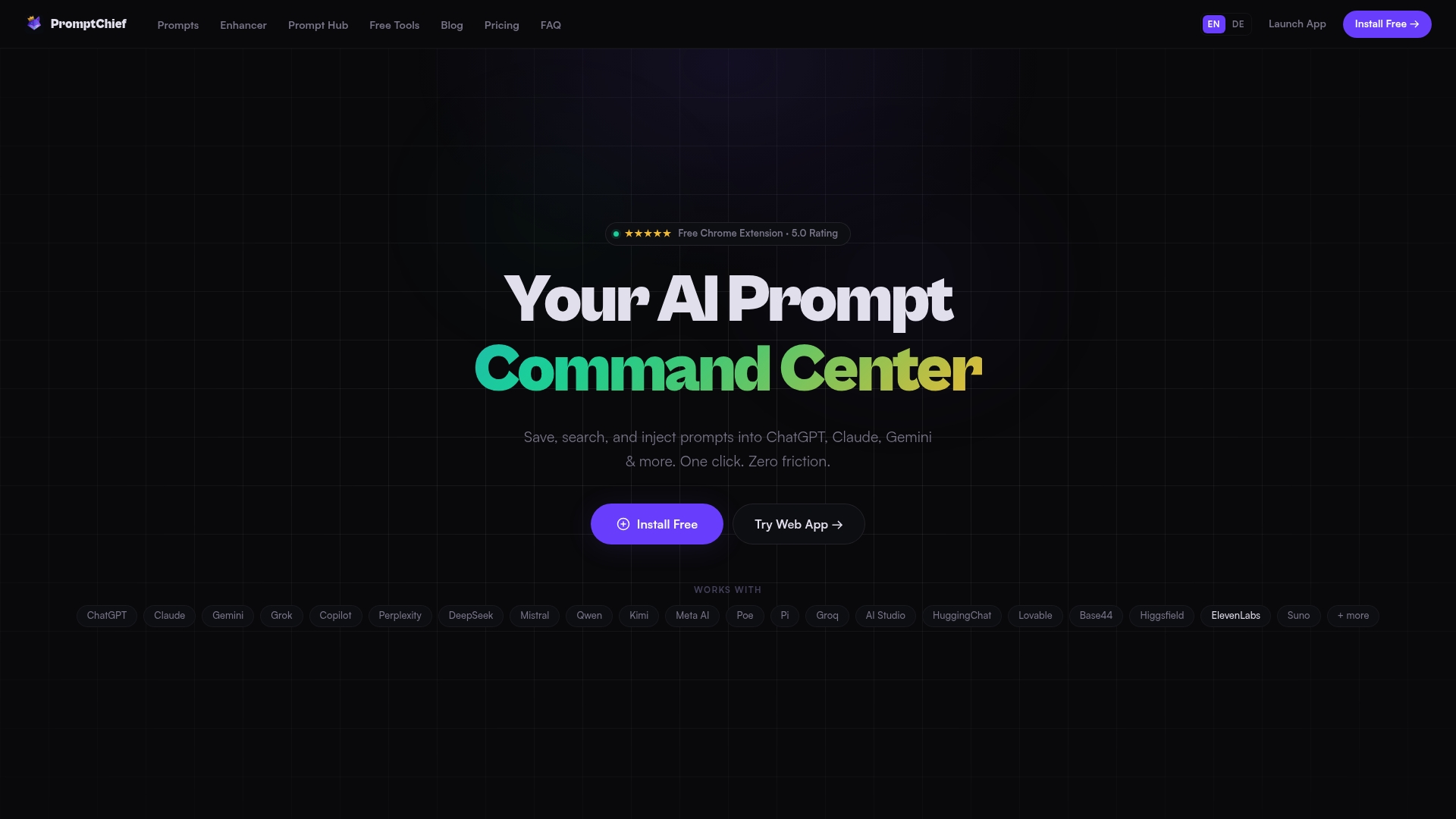
Once you've felt the difference a searchable library makes, the next question is which tool to build it in. Some platforms run as cloud-synced solutions with browser extensions and web apps, built specifically around the searchability problem this guide covers:
- Cloud sync can keep your library identical across every device you work from.
- Fuzzy search finds prompts even when you don't remember the exact wording.
- Fillable templates and prompt chains handle both quick tasks and multi-step workflows.
- Browser extension injection can drop saved prompts straight into AI tools without copy-pasting.
For students and researchers building study routines around AI, the templating approach mirrors what AnyLearns covers for studying with AI, and scheduling tools like Semester Flow show a similar template-driven approach applied to coursework planning.
Start with the Free plan to test search and organization on your own prompts, or check the pricing page if you already know you need team seats or higher AI credit limits.
Where to learn more about prompt design and search
For deeper reading, Wharton's Generative AI Labs covers prompt discovery and refinement, Microsoft's UNIPROMPT project covers structured prompt optimization, and EMNLP's PromptSuite paper covers comparing prompt variants systematically.
Sources
- Prompt Library - Wharton Generative AI Labs
- UNIPROMPT — a structured approach to prompt optimization
FAQ
Where can I find a free AI prompt library?
Several platforms offer free, browsable prompt collections, including PromptChief's public prompt library, which lists many free prompts organized by task. Academic sources like Wharton's Generative AI Labs also publish free prompt templates organized by purpose.
What are prompt libraries?
A prompt library is an organized, searchable collection of reusable AI instructions, stored as anything from a shared document to a cloud platform with tagging and search built in. The point is to save a prompt once and find it again quickly instead of rewriting it each time.
How to find prompt library in CoPilot?
Prompt or template collections in Microsoft tools are typically accessed through the app's built-in prompt or template panel rather than a separate library feature. For a searchable, cross-tool library that works the same way across multiple AI platforms, a dedicated prompt manager tends to offer more consistent search and tagging.
Where can I find AI prompt archives?
Public prompt archives exist as community hubs, curated prompt packs, and platform-specific collections organized by category or model. PromptChief maintains a community prompt hub alongside its cloud-synced personal library, giving you both a browsing archive and a private searchable store.