
Prompt archiving preserves reusable prompts, their metadata, versions, and representative outputs so teams and individuals can reliably find, reuse, and validate prompts later. Done right, it means faster retrieval, prompts that behave consistently across model updates, safer sharing across a team, and a paper trail you can actually audit. Done wrong, it's just a pile of chats you'll never find again.
TL;DR:
- Proper prompt archiving includes storing prompt text, metadata, version history, and sample outputs linked to specific model settings for effective reuse.
- Always test prompts after saving and before sharing, ensuring the output remains consistent with the stored version and parameters to prevent silent drift.
- Use descriptive, task-specific titles with distinctive keywords and attach sample outputs to improve searchability across chat history platforms.
- Regularly export backups, test restore processes, and keep clear version and lifecycle records to maintain prompt integrity over time.
- Avoid storing secrets directly in prompts and implement role-based access and lifecycle states to ensure team governance and prompt relevance.
Table of Contents
- What Prompt Archiving Actually Covers (It's Not Just Hiding Old Chats)
- How Do You Build a Prompt Archive Step by Step?
- Naming, Tagging, and Search Strategies That Actually Work
- Why Versioning and Provenance Prevent Silent Drift
- Which Storage Format Fits Your Prompt Archive?
- Keeping Secrets Out of Your Prompt Archive
- Team Governance: Roles, Lifecycle States, and Review
- The Two Fixes That Solve Most Archive Problems
- How Promptchief Handles This Workflow for You
- Sources
- FAQ
What Prompt Archiving Actually Covers (It's Not Just Hiding Old Chats)
A real prompt archive holds four things: the prompt text itself, metadata (purpose, platform, owner, date), version history, and at least one sample output tied to the exact model settings that produced it. Skip the last two and you've built a filing cabinet, not an archive.
Archiving and deletion solve different problems. Archiving preserves something for future reuse. Deletion destroys it. Retention policies sit between them, deciding how long something sticks around before it gets disposed of on purpose rather than by accident. The NIST Research Data Framework frames this as a lifecycle: inventory what you have, document its provenance, preserve it in a usable form, then decide its disposition. Applied to prompts, that means you don't just save the wording. You save enough context to reproduce the result, because a prompt without its model settings and a sample output is a guess about what it used to do, not a record of what it did.

How Do You Build a Prompt Archive Step by Step?
Most failed archives skip steps two and four below, then wonder why nothing is trustworthy six months later.
- Capture the full context. Save the prompt, the platform or model it ran on, and why it was written, not just the final wording.
- Redact before you store anything. Strip API keys, customer names, and any personal data, and swap them for placeholders.
- Standardize the name and metadata. Use a consistent title pattern and fill in owner, date, and platform every time, no exceptions.
- Test it, then save a known-good snapshot. Run the prompt, confirm the output holds up, and archive that output alongside the exact model parameters used.
- Record version notes and a lifecycle state. Note what changed and why, and mark the prompt as draft, tested, or approved.
- Promote through a short review checklist. A second set of eyes catches drift or scope creep before a prompt goes live for a team.
- Export and back up on a schedule, then test the restore. A backup you've never restored from is a backup you don't actually have.
Pro Tip: Set a recurring calendar reminder to test one random restore from your backup every quarter. It takes ten minutes and catches silent export failures before you need the file in an emergency.
The GitHub Models documentation outlines a version of this same sequence for engineering teams, right down to keeping sample test data next to the template.
Naming, Tagging, and Search Strategies That Actually Work
Vague titles are the number one reason archived prompts never get reused. "Chat about marketing" tells you nothing six weeks from now. A better pattern is task plus domain plus qualifier: "Blog Outline, SaaS Onboarding, 800 Words" beats "Content Idea" every time.
OpenAI's own guidance on searching chat history notes that search looks at both titles and content, and that archived conversations stay fully searchable. Search behavior on platforms like ChatGPT tends to favor exact matches, so consistent, distinctive wording in your titles matters more than clever phrasing.
A few habits make retrieval dramatically easier:
- Build a small controlled vocabulary of tags (five to ten max) instead of inventing new ones each time.
- Put the most distinctive keyword first in the title, since that's what your eye catches when scanning a list.
- Keep a sample output attached to each entry so a keyword search on results, not just prompt text, can surface it.
- Avoid generic verbs like "help" or "write" in titles; they match everything and narrow nothing.
Why Versioning and Provenance Prevent Silent Drift
A prompt that worked perfectly in March can quietly stop working in August, not because you changed it, but because the underlying model did. Without a snapshot of the original output and settings, you have no baseline to compare against.
Treat every saved version as an immutable record: prompt text, model, temperature or other parameters, and the output it actually produced at that moment. Provenance fields matter just as much as the text itself.
- Record who made each change, when, and why, even if it's a one-line note.
- Never overwrite a working version. Save a new one and mark the old one superseded.
- Run a small regression test, comparing outputs from a handful of representative inputs, whenever you edit a prompt or the underlying model changes.
- Diff the new output against the archived baseline before you promote anything to team-wide use.
This is the same discipline behind prompt version control in engineering contexts, just applied to prompts instead of code.
Which Storage Format Fits Your Prompt Archive?
A prompt file needs more than wording to be useful later. At minimum, include the template with {{variable}} placeholders, the model and parameters it was tested on, a sample input and output pair, and a plain-language description of its purpose. That structure is exactly what GitHub's prompt-storage schema recommends, and it's the difference between a reusable asset and a stale text file.
Git-based vaults suit teams that already live in code review and want privacy plus CI hooks; tools built around this pattern, like the PromptArchive project, snapshot outputs and support offline use. Cloud-synced managers trade some of that control for convenience: a shared interface, instant sync across devices, and less setup overhead. Either way, test your export and import process before you need it for real. A format you can't restore from isn't a backup.
Keeping Secrets Out of Your Prompt Archive
Never store API keys, passwords, or personal data directly in a prompt. Use a placeholder and pull the real value from a dedicated secrets store at runtime instead. It sounds obvious until someone pastes a live key into a "quick test" prompt and forgets to scrub it before saving.
Version history has a long memory. If a secret ever made it into an earlier saved version, scan your full history before sharing an archive with anyone outside your immediate team, and rotate the credential if you find one. OpenAI's guidance on deleting and archiving chats notes that deleted conversations are removed from search and permanently purged from systems within 30 days, subject to some exceptions, which is exactly why exports matter for anything you actually need to keep.
Pro Tip: Run a simple keyword search for "sk_", "api_key", and "password" across your archive once a quarter. It catches leaks before someone else finds them for you.
Team Governance: Roles, Lifecycle States, and Review
A prompt archive without lifecycle states turns into a junk drawer the moment more than one person touches it. Define clear stages, draft, tested, approved, deprecated, retired, and assign an owner to each prompt so someone is accountable for keeping it current.

Role-based permissions keep this from becoming chaos: not everyone needs edit access, but everyone should be able to view and reuse approved prompts. Before anything gets promoted to "approved," require a sample output and a pass through a short review checklist. Teams that manage this well, as covered in guides on how teams save and share prompts, also keep a small regression test set on hand so promotion isn't just a gut check.
The Two Fixes That Solve Most Archive Problems
Most teams don't fail at prompt archiving because it's hard. They fail because naming is inconsistent and nobody scans for leaked secrets.
— John
How Promptchief Handles This Workflow for You
Everything in the workflow above, capture, naming, testing, versioning, backup, gets easier when the tool is built around it instead of bolted on afterward. Promptchief lets you save a prompt the moment you write it, attach it to a consistent naming pattern, and find it later with fuzzy search that doesn't demand an exact keyword match. Cloud sync means the archive you build on your laptop is the same one your teammate sees on theirs, no manual exporting required.
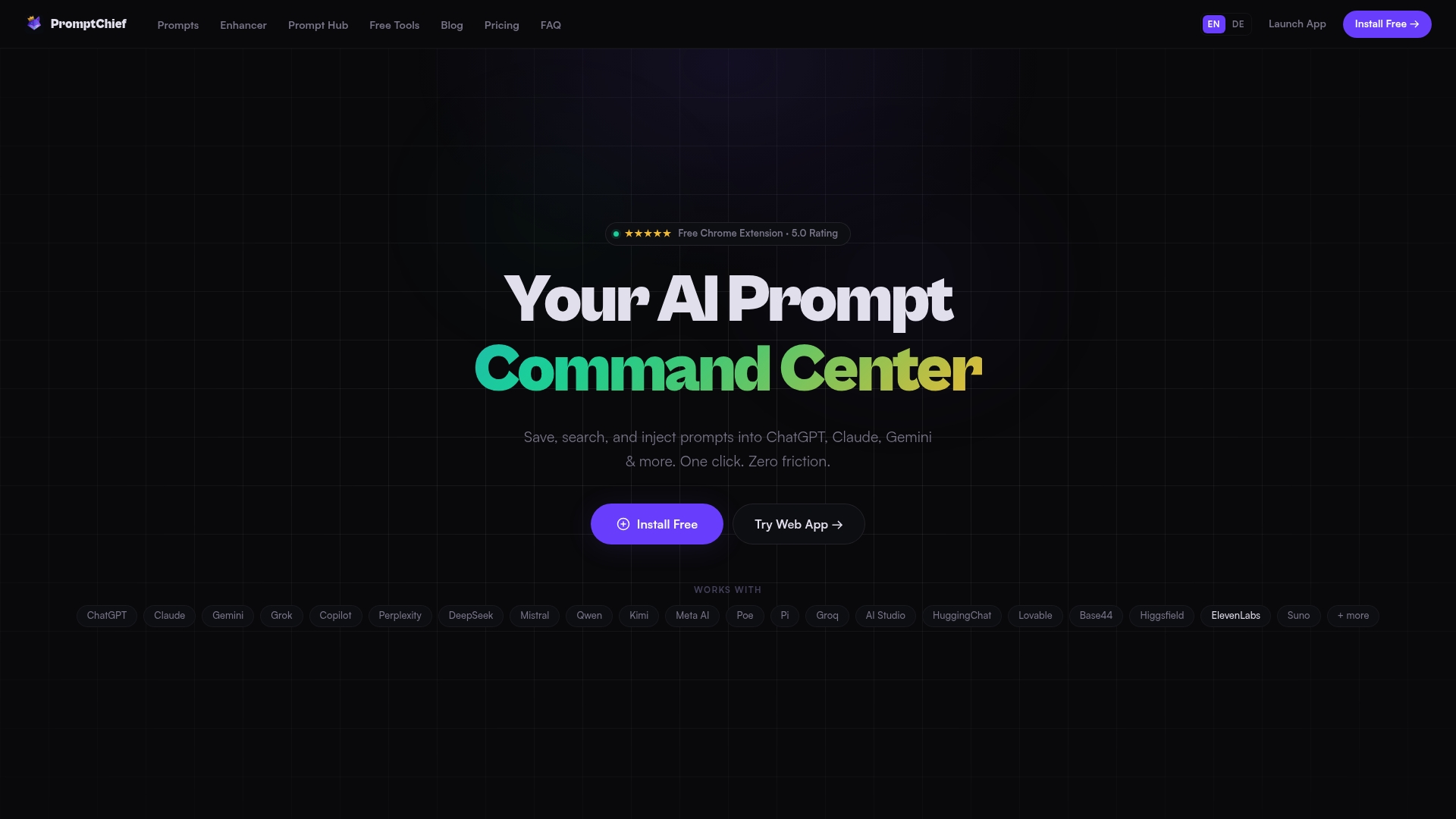
For teams, workspace permissions map directly onto the lifecycle governance described above: draft prompts stay visible only to their owner until someone promotes them for the whole group. If you manage archives across a team, the Teams plan runs $12 to $15 per seat per month and adds shared libraries and permission controls on top of the individual features. Solo users can start on the Free plan, and the Pro plan at $17.39 a month unlocks higher search and export limits for anyone archiving at real volume. Try exporting and reimporting a small batch of prompts first. That single test tells you more about whether a tool fits your workflow than any feature list.
Sources
For the standards behind this workflow, start with NIST's Research Data Framework for lifecycle and provenance concepts, OpenAI's Help Center for how archiving and deletion actually behave, and GitHub's documentation for a concrete prompt-storage schema. For a different angle on organizing AI-generated material more broadly, ClawBase's guide on AI note organization is worth a read too.
- NIST Research Data Framework (RDaF): Version 2.0 | NIST
- How to Delete and Archive Chats in ChatGPT | OpenAI Help Center
- How do I search my chat history in ChatGPT? | OpenAI Help Center
FAQ
What is the best method for archiving prompts?
There's no single best method, but the most reliable approach combines descriptive naming, stored metadata, a saved sample output, and a scheduled backup. A tool with cloud sync and fuzzy search, like Promptchief, handles most of this automatically instead of requiring a manual folder system.
Can you give an example of a prompt archive entry?
A well-formed entry includes the prompt template with placeholders, the model and parameters it was tested on, one sample input and output pair, and a short note on its purpose and owner. GitHub's prompt-storage schema uses exactly this structure for reproducibility.
What are the basic steps of archiving a prompt?
Capture the prompt and its context, redact any secrets, apply consistent naming and metadata, test it and save a known-good output, record version notes, and export a backup on a regular schedule. Each step catches a different failure mode, skipping redaction risks leaks, skipping testing risks silent drift.
What happens to a prompt after it's archived?
Archiving typically hides a prompt from your main view without deleting it. OpenAI's documentation confirms that archived ChatGPT conversations stay under normal account retention and remain fully searchable until you choose to unarchive or delete them.
Does Promptchief cost anything to try?
Promptchief offers a Free plan with no cost, and paid tiers start at $8.11 a month for Plus, billed monthly, with an annual option at €69.90 a year. Current pricing and feature limits for every tier are listed on the pricing page.