
Prompt governance is the practice of treating AI prompts as production-grade, versioned assets with named owners, approval gates, and audit trails. Every organization running GenAI in production needs five controls in place: ownership assignment, a central prompt registry, version control, an approval workflow, and audit logging. The single action a leader should take today is to appoint a prompt registry owner — one person accountable for knowing which prompts exist, who wrote them, and what they touch.
Pro Tip: Before your next all-hands, send a one-line email: "Who owns the prompts running in [product/department]?" If no one replies with a name, you have a governance gap.
Table of Contents
- What a core prompt governance framework looks like
- How the prompt lifecycle works in production
- How to tier risk and map controls to NIST AI RMF
- Implementation best practices: tooling, controls, and metrics
- Why prompt text alone is not a reliable governance control
- Your 90-day starter checklist for prompt governance
- Key Takeaways
- The part most governance guides get wrong
- Promptchief makes the 90-day checklist faster to execute
- FAQ
What a core prompt governance framework looks like
The PromptOps governance model organizes controls across three pillars: People, Processes, and Technology. Each pillar has a minimum viable set of requirements.
Processes: from spec to retirement
A governed prompt follows a defined lifecycle. The minimum process controls are:
- Write a functional spec (output shape, grounding requirements, acceptance criteria)
- Classify the prompt by risk tier before any development begins
- Run the approval gate appropriate to that tier
- Test against defined test cases before promotion to production
- Log every change with a timestamp, author, and reason
- Review and retire prompts on a defined schedule
Treating a prompt like a database migration — requiring a change ticket, a reviewer, and a rollback plan — is exactly the mindset shift that separates governed AI from shadow AI.
Technology: the controls that enforce the rules
No process survives without tooling. The minimum technology stack for prompt governance includes a central registry, version control, access controls, model and parameter locking, and audit logs. DataRobot's prompt management documentation shows how production-grade systems implement environment separation (staging vs. production) and version-controlled prompt bundles as standard practice.
Role and governance level by risk tier:
| Role | Low-Risk Prompt | Medium-Risk Prompt | High-Risk Prompt |
|---|---|---|---|
| Author | Creates, self-reviews | Creates, peer review | Creates, formal spec required |
| Approver | Optional | Required | Required + escalation sign-off |
| Subject-matter reviewer | Not required | Recommended | Mandatory |
| Audit log | Basic change log | Full change log | Full log + incident trail |
| Rollback plan | Not required | Documented | Tested and rehearsed |
Pro Tip: For low-risk prompts (marketing copy, internal summaries), a lightweight checklist beats a full approval workflow. Reserve formal gates for prompts that touch regulated data, financial calculations, or clinical outputs.
How the prompt lifecycle works in production
A production-grade prompt is not a text string. It is a bundle: the prompt text, the model version it was tested against, the parameter configuration (temperature, top_p, seed), any prompt partials or system instructions, and the metadata that makes it auditable.
The prompt bundle
Once the spec is approved, the bundle is assembled:
- Prompt text (versioned, with a semantic version number)
- Model identifier and version (e.g.,
gpt-4o-2024-11-20, not just "GPT-4o") - Parameter configuration locked at the approved values
- Prompt partials with their own version references
- Metadata: owner, risk tier, approval date, linked test suite
The NIST AI technical publication NIST.AI.600-1 requires that AI systems maintain documentation of their configuration and evaluation evidence — a prompt bundle satisfies that requirement directly.
Promotion and rollback
A prompt moves to production only when it passes its test suite and receives approver sign-off. The promotion checklist should include: test pass rate above the defined threshold, approver signature, rollback version identified, and monitoring alerts configured. Rollback criteria should be defined before deployment, not after an incident.
Pro Tip: Pin the model version in the prompt bundle. A prompt tested against one model snapshot can behave differently after a provider update — version pinning is the single cheapest regression-prevention control available.
How to tier risk and map controls to NIST AI RMF
Not every prompt needs the same governance overhead. Risk-tiering lets teams apply proportionate controls, so governance does not become a bottleneck for low-stakes work.
Defining the tiers
Low risk: prompts that produce non-binding, easily reviewed outputs with no access to sensitive data. Examples: marketing copy drafts, internal meeting summaries, brainstorming outputs.
Medium risk: prompts that inform decisions, access internal data, or produce outputs reviewed by a professional before action. Examples: contract clause suggestions, HR policy drafts, customer-service response templates.
High risk: prompts that produce outputs used directly in regulated decisions, access sensitive personal or financial data, or trigger automated actions. Examples: clinical note summaries, financial authorization recommendations, compliance screening outputs.
| Risk Tier | Example Use Case | Governance Required | Audit Evidence |
|---|---|---|---|
| Low | Marketing copy, internal summaries | Registry entry, owner, basic change log | Change log |
| Medium | Contract drafts, HR policy suggestions | Full spec, peer review, approval gate | Change log + test results |
| High | Clinical summaries, financial authorizations | Formal spec, SME review, escalation sign-off, tested rollback | Full audit trail + evaluation evidence |
Implementation best practices: tooling, controls, and metrics
Key metrics to track
Governance without measurement is just paperwork. Track these signals:
| Metric | What It Tells You | Alert Threshold |
|---|---|---|
| Adoption rate | % of production prompts in the registry | Below 80% signals shadow prompts |
| Rework rate | % of prompt outputs requiring manual correction | Rising trend signals drift |
| Incident rate | Policy-breaching or unexpected outputs per period | Any high-risk incident triggers review |
| Test pass rate | % of test cases passing on current version | Drop below threshold blocks promotion |
| Drift detection | Output variance on fixed inputs over time | Variance above baseline triggers re-evaluation |
ChatGPT usage analytics can feed governance dashboards directly, surfacing which prompts are being used, by whom, and how often — data that makes adoption-rate tracking concrete rather than manual.
Pro Tip: Set a drift alert on your top five highest-risk prompts first. Run the same fixed test input weekly and flag any output that differs materially from the baseline. That one alert catches most model-update regressions before users do.
Why prompt text alone is not a reliable governance control
Academic research published on arXiv presents a finding that most governance frameworks have not yet absorbed: treating system-level prompt text as a reliable control is fragile. A systematic review of the literature finds divergent claims about whether instruction text produces predictable behavior across models, versions, and contexts. The risk is a false sense of control — an organization that has written careful prompt instructions but has not tested them may believe it has governed the system when it has not.
Prompt text is a request, not a constraint. A model that follows a system instruction in testing may not follow it under adversarial input, after a model update, or in a context the author did not anticipate.
This has direct policy implications. Regulators are beginning to ask for disclosure of AI system behavior, evaluation evidence, and layered controls — not just documentation of what the prompt says. A text-only mandate ("we have a policy prompt that says X") does not satisfy that standard.
Practical mitigations:
- Require evaluation evidence for every production prompt: test results, not just a written spec
- Layer controls across the prompt stack: system instructions, input validation, output filtering, and human review are separate layers, each catching what the others miss
- In an audit, be prepared to show which layer is authoritative for each control claim — "the system prompt says so" is not sufficient on its own
| Control Layer | What It Catches | Limitation |
|---|---|---|
| System prompt instructions | Scope, tone, format constraints | Not enforced; model may deviate |
| Input sanitization | Injection attempts, out-of-scope inputs | Cannot catch all adversarial patterns |
| Output filtering | Policy-breaching content, PII leakage | Adds latency; may over-filter |
| Human-in-the-loop review | Edge cases, novel failures | Does not scale for high-volume outputs |
| Automated evaluation | Regression, drift, variance | Requires maintained test suites |
Pro Tip: When briefing a board or audit committee, present your prompt governance as a layered control system, not a single policy document. Auditors understand defense-in-depth; they are skeptical of single-point controls.
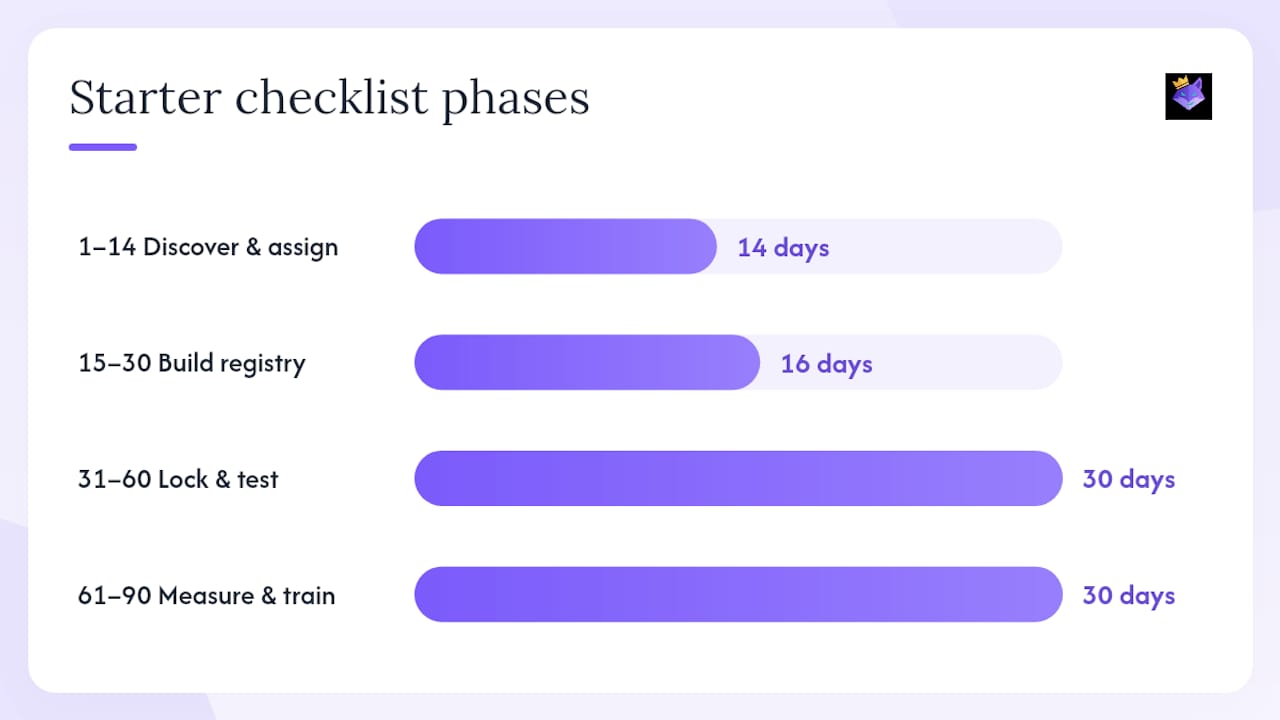
Your 90-day starter checklist for prompt governance
This checklist is time-boxed and role-assigned. It is designed to deliver measurable risk reduction within a quarter, not a full governance transformation.
Days 1–14: Discover and assign
- Appoint a prompt registry owner (one named person, executive-sponsored)
- Audit the prompt footprint: survey every team using GenAI and collect all production prompts
- Classify each prompt by risk tier using the three-tier model above
- Quarantine any high-risk prompts running without an owner or approval record
Days 15–30: Build the registry
- Stand up a central prompt registry (spreadsheet is acceptable for day one; a dedicated tool for week four)
- Enter every production prompt with owner, risk tier, model version, and last-modified date
- Define the approval workflow for medium and high-risk prompts
Days 31–60: Lock and test
- Lock model versions and parameter configurations for all high-risk prompts
- Write test suites for high-risk prompts (minimum five test cases each)
- Run the first automated evaluation pass and document results
- Establish staging/production separation for any agentic or tool-calling prompts
Days 61–90: Measure and train
- Configure drift alerts for the top five highest-risk prompts
- Publish the governance policy and role matrix to all GenAI users
- Run a one-hour training session for prompt authors on the spec and approval process
- Report adoption rate, rework rate, and incident rate to leadership
| Milestone | Owner | Success Signal |
|---|---|---|
| Prompt registry live | Registry owner | All production prompts entered |
| High-risk prompts locked | Registry owner + IT | Model/config locked, approval on file |
| Test suites running | Prompt authors | Automated pass/fail on every high-risk prompt |
| Governance policy published | Legal/compliance | All GenAI users acknowledged receipt |
| First metrics report | Registry owner | Adoption rate, rework rate, incident rate reported |
Pro Tip: The fastest way to build organizational buy-in is to show a quick win. In week two, find one high-risk prompt running without an owner and fix it publicly — announce the fix to leadership. That single visible action signals that governance is real, not a policy document.
Key Takeaways
Prompt governance requires ownership, a central registry, version control, risk-tiered approval gates, and evaluation evidence — not just a written policy.
| Point | Details |
|---|---|
| Treat prompts as production assets | Every production prompt needs a named owner, a version history, and an audit trail. |
| Risk-tier before you govern | Low, medium, and high-risk prompts need proportionate controls — not the same overhead. |
| Text alone is not a control | Evaluation evidence and layered controls are required; a well-written prompt is not sufficient. |
| Map to NIST AI RMF | Prompt governance maps to Govern, Map, Measure, and Manage — use that structure for audits. |
| Promptchief operationalizes the framework | Promptchief's registry, versioning, team workspace, and cloud sync cover the core 90-day checklist steps. |
The part most governance guides get wrong
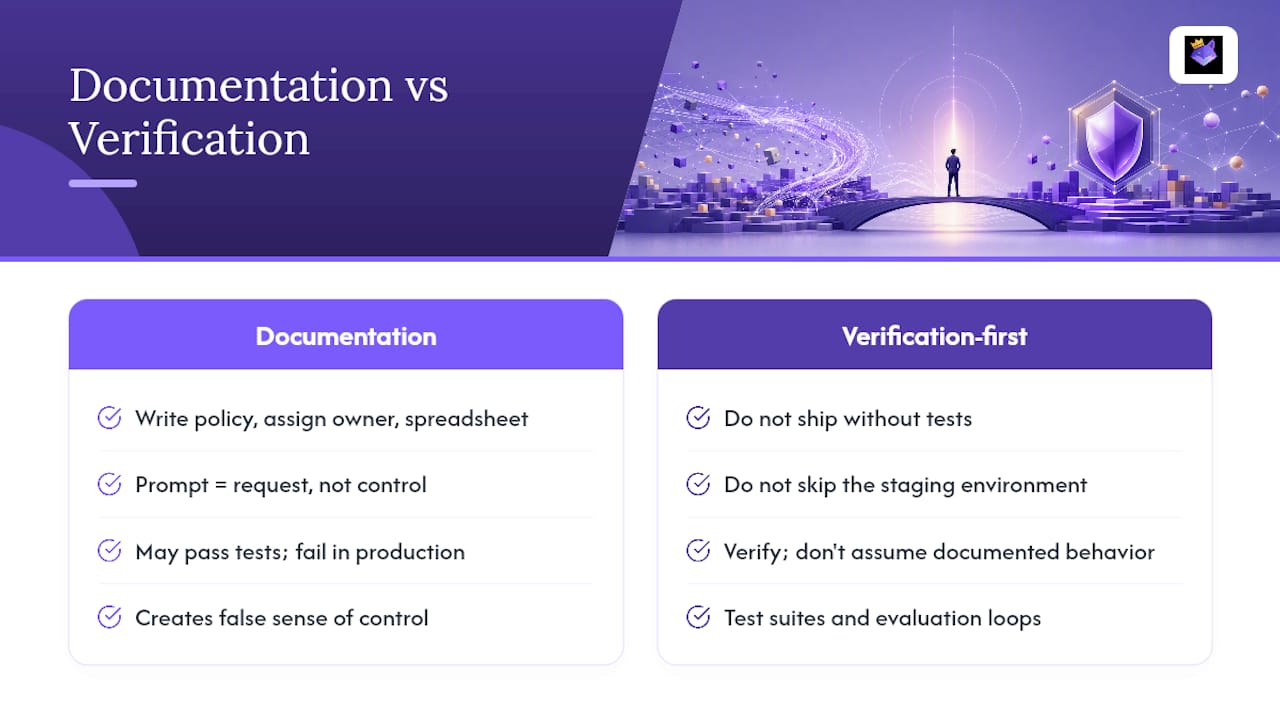
Most prompt governance guides treat this as a documentation problem. Write a policy, assign an owner, create a spreadsheet. Done. That framing misses the actual failure mode.
The real risk is not that organizations have no governance policy. It is that they have a governance policy that creates a false sense of control. A system prompt that says "do not discuss competitor products" is not a control. It is a request. The model may comply in testing and fail in production under adversarial input, after a provider update, or in a context the author did not consider. The arXiv research on prompt governance limits makes this explicit: instruction text and predictable model behavior are not the same thing.
The organizations that get this right treat prompt governance the way mature engineering teams treat code deployment. They do not ship without tests. They do not skip the staging environment. They do not assume the system behaves as documented — they verify it. That means test suites, evaluation loops, drift alerts, and human review for high-stakes outputs. The 90-day checklist above is designed around that principle: governance is a verification discipline, not a documentation exercise.
One more thing worth saying plainly: the NIST AI RMF is not bureaucratic overhead for organizations already using GenAI in production. It is a vocabulary that boards, auditors, and regulators already understand. Mapping your prompt controls to Govern, Map, Measure, and Manage gives you a defensible audit narrative without inventing a new framework from scratch.
Promptchief makes the 90-day checklist faster to execute
The hardest part of the 90-day checklist is not the policy writing — it is the operational plumbing: a registry that teams will actually use, version control that does not require a developer, and audit logs that survive a compliance review.

Promptchief covers those requirements directly. Its prompt management platform gives teams a cloud-synced registry accessible from any device, with fuzzy search across saved prompts, team workspace functionality for shared ownership, and support for 27+ AI platforms including ChatGPT, Claude, and Gemini. Version history, placeholder-based prompt templates, and multi-step prompt chains map to the bundle and lifecycle controls described in this article. For organizations standing up governance quickly, Promptchief removes the need to build registry infrastructure from scratch — teams can be operational within a day. Explore the prompt management software and see how it fits your rollout.
FAQ
What is prompt governance?
Prompt governance is the practice of managing AI prompts as versioned, owned assets with approval gates and audit trails — treating them the way mature organizations treat code or data pipelines.
What are the four pillars of a prompt governance framework?
Most frameworks organize around People (owners, approvers, reviewers), Processes (spec, risk-tiering, approval, testing, retirement), Technology (registry, version control, audit logs), and Measurement (adoption rate, rework rate, incident rate, drift detection).
What are the core principles of effective prompting in a governed system?
A governed prompt should be specific about output shape, grounded in defined context, tested against acceptance criteria, and locked to a model version — the five principles reduce variance and make outputs auditable.
How does prompt governance map to NIST AI RMF?
The NIST AI Risk Management Framework four functions — Govern, Map, Measure, Manage — map directly: ownership policy (Govern), risk classification (Map), test pass rates and drift metrics (Measure), and approval gates with rollback procedures (Manage).
Why is prompt text alone not sufficient as a governance control?
Academic research shows that instruction text does not reliably constrain model behavior across all contexts, model versions, and adversarial inputs. Effective governance requires layered controls: input sanitization, output filtering, automated evaluation, and human review alongside the prompt itself.