
Perplexity's prompt library, hosted inside the Comet resource hub, gives you categorized, ready-made prompts for research, finance, academic work, and general productivity. The fastest path forward: pick one that matches your task and run it directly in the app, or copy its core request into the Agent API's input field while keeping any standing rules in instructions. Ready-to-run examples and API snippets follow below.
TL;DR:
- Many prompts are best for one-off exploration inside the app, while others are suited for automation through the API, depending on their repeatability and output needs.
- When using the API, keep instructions short and specific, as they override preset system prompts and impact token costs across multiple search steps.
- Structuring prompts with clear placeholders and saving metadata, including last-test dates and token estimates, helps prevent prompt degradation over time.
- Verifying citations requires extracting URLs from all search results in each search step to avoid hallucinated links in outputs.
- Prompt management tools like Promptchief enable cross-platform saving, searching, and injecting, reducing time lost scouring chat histories or notes.
Table of Contents
- What's Inside the Perplexity Prompt Library (and When to Use the App vs. the API)
- How the Agent API Handles Instructions, Input, and Presets
- Ready-to-Use Prompts for Research and Productivity
- Running, Customizing, and Importing Prompts: App and API Walkthrough
- How to Organize a Prompt Library That Doesn't Rot
- How PromptChief Fits Into a Perplexity-Centered Workflow
- Where to Verify the Technical Details
- Why Most Prompt Libraries Fail at the Handoff, Not the Wording
- Stop Losing Your Best Perplexity Prompts to Scattered Chat Windows
- Sources
- FAQ
What's Inside the Perplexity Prompt Library (and When to Use the App vs. the API)
The Comet resource hub's prompt library organizes its prompts by job, not by industry buzzword. You'll find categories built around students, finance professionals, business researchers, and general productivity tasks. The prompts themselves cover concrete, unglamorous work: finding a specific PDF buried in a filing, checking a company's Product Hunt launch history, pulling recent SEC filings, comparing flight prices across dates, scouting influencers in a niche, or generating a quick meeting-prep brief.
Each prompt in the hub is written as a plain-language instruction, something you could type into a chat box without editing. That's the point. They're meant for one-off, interactive use inside Comet's browser environment, where you watch the agent work, click through sources, and course-correct mid-task if it drifts.
The Agent API serves a different purpose entirely. Instead of watching an agent browse in real time, you're sending a structured request and getting back a structured response, typically as part of an automated pipeline: a script that runs the same research task every morning, a tool that batch-processes fifty company profiles, or an internal app that needs live, cited answers without a human babysitting each query.
That distinction shapes how you should think about the library's contents:
- Interactive prompts (best for the app): exploratory research, comparison shopping, anything where you want to see sources as they surface and adjust on the fly.
- Production prompts (best for the API): repeatable, well-defined tasks you'll run dozens or hundreds of times with different inputs.
- Hybrid prompts: start in the app to validate the wording works, then port the working version into an API call once you trust it.
Nothing in the hub is explicitly labeled "API-ready" or "app-only." You have to make that call based on how repeatable the task is and whether you need programmatic output.
How the Agent API Handles Instructions, Input, and Presets
Perplexity's Agent API splits every prompt into two distinct fields, and understanding the split is the single biggest factor in whether your automated prompts behave predictably or drift into noise. According to the Agent API prompt guide, instructions hold system-level, persistent rules that apply across the entire run, while input carries the specific query that seeds the search and retrieval process.
Think of instructions as the personality and constraints ("respond in bullet points, cite every claim, never speculate beyond the sources") and input as the actual question ("what were Tesla's Q3 2026 delivery numbers compared to guidance"). Both matter for retrieval quality. Vague inputs generate vague searches, so naming specific entities, years, and sectors in your input field consistently produces better-targeted evidence than generic phrasing.
Here's the part people miss: if you set instructions when calling a preset, that text replaces the preset's built-in system prompt rather than adding to it. Presets are pre-tuned bundles combining a model choice, a default system prompt, a search configuration, and a toolset. Override the system prompt carelessly and you can accidentally strip away the preset's tuned behavior, sometimes without realizing it until output quality drops.
There's a performance cost hiding in plain sight, too. Because instructions get re-read and reprocessed on every step of a multi-step agent loop, a bloated system prompt doesn't just cost tokens once. It costs tokens repeatedly, on every loop iteration, which adds up fast on longer research tasks.
Practical rules for keeping prompts lean:
- Keep
instructionsshort: a few sentences of standing behavior, not a paragraph of edge cases. - Push hard constraints (allowed domains, date ranges, geographic region, output structure) into request parameters like
web_searchfilters andresponse_formatinstead of writing them as prose. - Use
max_stepsto cap how many search iterations an agent run can take, which limits both cost and runaway loops. - Reserve
inputfor the actual task, loaded with specific names, numbers, and time frames.
Rate limits scale with spending tier. According to Perplexity's pricing and rate-limit documentation, higher spending tiers unlock higher requests-per-minute limits. If you're planning to run prompt batches in production, check which tier you're on before you build a workflow that assumes unlimited throughput. A prompt library that works great for one-off testing can hit a wall fast once you're running it at scale.
Ready-to-Use Prompts for Research and Productivity
These prompts are grouped by what you're actually trying to accomplish, with a short note on how to split each one between instructions and input if you're moving it into the Agent API.
-
Deep research and citation extraction. Ask for multi-angle evidence rather than a single summary: "Research the current state of solid-state battery commercialization. Present arguments from at least three named companies, cite each claim, and flag any conflicting figures between sources." API adaptation: put the citation requirement and output format in
instructions("cite every claim inline"), and put the specific research topic ininput. -
Source triangulation. "Compare how three different outlets covered [specific event] and note where their reported numbers disagree." This surfaces bias and factual drift that a single-source summary hides. API adaptation: keep the comparison instruction standing ("always compare at least three sources"), and swap the event name in
inputfor each run. -
Quick fact-check. "Verify this claim: [paste claim]. State whether it's accurate, partially accurate, or false, and link the primary source." API adaptation: this is a strong candidate for a preset with lean instructions and a fast
max_stepscap, since fact-checks don't need deep multi-hop research. -
News synthesis with timeline. "Summarize the past two weeks of developments on [topic] as a chronological timeline with dates and sources." API adaptation: the timeline format belongs in
instructions; the topic and date window go ininput. -
Key-value extraction from documents. "Pull the following fields from this filing: revenue, net income, guidance range, and any mentioned risk factors." API adaptation: this pairs well with
response_formatset to structured JSON rather than describing the format in prose. -
Academic reading extraction. "Read this syllabus and list every required reading with author, title, and due date." API adaptation: stable extraction logic goes in
instructions; the document or course name goes ininput. -
To-do extraction from lecture notes. "Scan these notes and generate a task list of anything the professor said would be on the exam." Students running this weekly benefit from saving it as a template with a placeholder for the file or topic.
-
Flashcard generation. "Turn these notes into 15 question-and-answer flashcards covering the main concepts." API adaptation: set the card count and format as a standing instruction so every run produces consistent output.
-
Calendar blocking. "Given this list of tasks and their estimated durations, propose a blocked schedule for tomorrow that respects a 9-to-5 window and a 30-minute lunch break." API adaptation: the scheduling constraints (work hours, break length) are ideal for
instructions; the task list changes daily and belongs ininput. -
Inbox summary. "Summarize these unread emails into three categories: needs a reply today, can wait, and informational only." Useful as a morning ritual prompt, either run manually in the app or automated through the API on a schedule.
-
Meeting prep brief. "Research [company or person] and generate a one-page brief covering recent news, leadership changes, and any public statements relevant to [meeting topic]." API adaptation: the brief structure is a standing instruction; the company and meeting topic change with
inputeach time. -
Candidate sourcing scan. "Search for professionals with [skill set] and [years of experience] in [location or industry], and give a two-sentence rationale for each match." This is one of the prompts most likely to benefit from naming specific entities. Vague inputs like "good marketers" retrieve far weaker results than "B2B SaaS content marketers with demand-gen experience in fintech."
Pro Tip: Save the wording that works as a template with bracketed placeholders (like [company] or [date range]) the moment you get a strong result. That five-second habit turns a one-off lucky prompt into a reusable asset instead of something you have to reconstruct from memory next week.
Running, Customizing, and Importing Prompts: App and API Walkthrough
In Comet, using a library prompt takes three steps: open the prompt from the resource hub, edit the bracketed placeholders to match your actual task, and run it. Once results come back, check the cited sources before you trust the summary. Comet surfaces its sources inline, and clicking through them takes seconds. Skipping that step is the single most common way people end up repeating a factual error the model picked up from a weak source.
Running the same logic through the Agent API means structuring a request with three fields: the preset or model, the standing instructions, and the task-specific input. Here's what that looks like using a preset for search-based research, per the Agent API code examples:

import requests

response = requests.post(
    "https://api.perplexity.ai/responses",
    headers={"Authorization": "Bearer YOUR_API_KEY"},
    json={
        "model": "sonar-pro",
        "instructions": "Cite every factual claim inline. Keep answers under 300 words.",
        "input": "Compare the 2026 EV tax credit rules across three named automakers.",
        "max_steps": 4
    }
)
print(response.json())
The equivalent curl call swaps the Python request object for a plain POST with a JSON body, and the field names stay identical, which makes it easy to prototype in one language and port to another.
Perplexity's documentation is explicit on this point: read URLs and source metadata from the structured response payload, specifically the
search_resultsarray, rather than trusting whatever URL text the model prose mentions. Pulling citations straight fromsearch_resultsinstead of model-generated text is what keeps you from shipping a hallucinated link to a client or a teammate.
When a response streams back across multiple search steps, don't just grab the first batch of results. Collect URLs from every results[].url entry across the full run, since later search steps often surface sources the first pass missed entirely. If you're consuming a streaming response, that means listening for response.reasoning.search_results events rather than waiting for a single final payload.
How to Organize a Prompt Library That Doesn't Rot
A prompt library with no structure turns into a graveyard of half-remembered wording within a month. Building yours around a simple taxonomy prevents that: organize folders by job-to-be-done first (research, fact-check, academic, scheduling, sourcing), then by audience or preset within each folder.
Metadata worth saving per prompt:
- The purpose in one sentence, so you don't have to re-read the whole prompt to remember what it does.
- Every placeholder the prompt expects, clearly bracketed.
- Which preset or model it was tested against, since results vary noticeably between them.
- A rough token estimate per run, useful once you're tracking API costs.
- The date it was last tested, since retrieval quality shifts as models and search indexes update.
Teams building production-grade prompt integrations tend to go further: they save canonical templates with placeholders, version them like code, attach a tested preset to each one, and automate smoke tests that confirm citations and output format still hold after any change.
A basic testing checklist covers four things before you trust a prompt for repeated use:
- Smoke run. Does it return a coherent answer at all, on a representative input?
- Citation check. Do the sources in
search_resultsactually support the claims in the output? - Token and cost check. How many tokens does a typical run consume, and does that scale sanely across a batch?
- Rate-limit planning. Will your spending tier support the volume you're planning to run?
For teams sharing a library, a consistent naming convention (verb plus object plus scope, like "summarize_earnings_call_quarterly") saves more confusion than any folder structure alone. Our guide on reusing prompts across different AI tools covers the naming and versioning side in more depth if you're managing prompts across more than one platform.
How PromptChief Fits Into a Perplexity-Centered Workflow
Perplexity's prompt library solves the "what do I ask" problem. It doesn't solve the "where did I save that prompt, and how do I get it into my next tool" problem, and that second gap is where most people actually lose time. PromptChief offers a cloud-synced prompt management platform built for exactly that gap, with a Chrome extension and web app for saving, searching, organizing, and injecting prompts across 27+ AI platforms including ChatGPT, Claude, and Gemini — much like Otto, your AI chief of staff automates workflows and prompt-triggered tasks to boost productivity.
A few ways this shows up in practice for a Perplexity-heavy workflow:
- Centralized templates. Every adapted Perplexity prompt (the ones you've split into
instructionsandinputfields, or refined with placeholders) gets saved once and stays searchable through fuzzy search, instead of scattered across notes apps and old chat threads. - One-click injection. A browser extension can let users inject a saved prompt directly into the tool they're using, cutting out the copy-paste cycle.
- Multi-step chains. For research workflows that require a fact-check prompt followed by a summary prompt followed by a formatting pass, Prompt chains can let users link steps together instead of running each manually.
- Team sharing. A community Hub of many prompts and team workspace functionality means a working prompt one person refines can be shared across a whole team rather than living in a single person's browser history.
- Cross-tool portability. Because such tools can work across platforms, a prompt tuned for one AI API can sometimes be adapted and reused in others without starting from scratch.
The gap between having good prompts and having a system for managing them is where most people quietly lose hours every month.
Where to Verify the Technical Details
If you want to confirm any of the mechanics covered here directly from Perplexity, these are the pages worth bookmarking.
- The Agent API prompt guide is the primary source for how
instructionsandinputwork, how presets behave, and the reasoning behind keeping system prompts lean. - The Comet prompt library hosts the actual categorized prompts referenced throughout this piece, organized by student, business, finance, and general-use tags.
- The Agent API models documentation provides the full code examples in Python, TypeScript, and curl for calling the API with a preset,
input, andinstructions. - The pricing and rate-limits page covers how spending tiers affect throughput, relevant once you move past testing into production runs.
Why Most Prompt Libraries Fail at the Handoff, Not the Wording
The wording problem gets all the attention, but it's rarely the actual bottleneck. Perplexity's documentation is genuinely good at explaining how to structure instructions versus input, and the Comet library hands you dozens of working starting points. What breaks down is everything that happens after you find a prompt that works.
Most people test a prompt once, get a decent result, and move on without saving the exact wording. Three weeks later they're reconstructing it from memory, usually worse than the original. That's not a prompting failure. It's a filing failure, and it's the part conventional advice skips entirely because "write better prompts" is a more satisfying headline than "build a system for not losing your prompts."
The teams that actually get compounding value from a tool like Perplexity's Agent API are the ones treating prompts as versioned assets, not disposable chat messages. Test once, save with metadata, reuse with confidence. If you take one thing from this piece, prioritize that discipline over chasing marginally better phrasing. A mediocre prompt you can find and reuse in ten seconds beats a perfect prompt buried in a chat history you'll never scroll back through.
— John
Stop Losing Your Best Perplexity Prompts to Scattered Chat Windows
Once you've adapted a Perplexity prompt that actually works, whether it's a research template with instructions dialed in or a fact-check shortcut you run weekly, the next problem is keeping it somewhere you'll actually find again. That's the specific gap Promptchief closes: a cloud-synced library that saves your prompts once and makes them searchable and injectable across every AI tool you use, not just Perplexity.
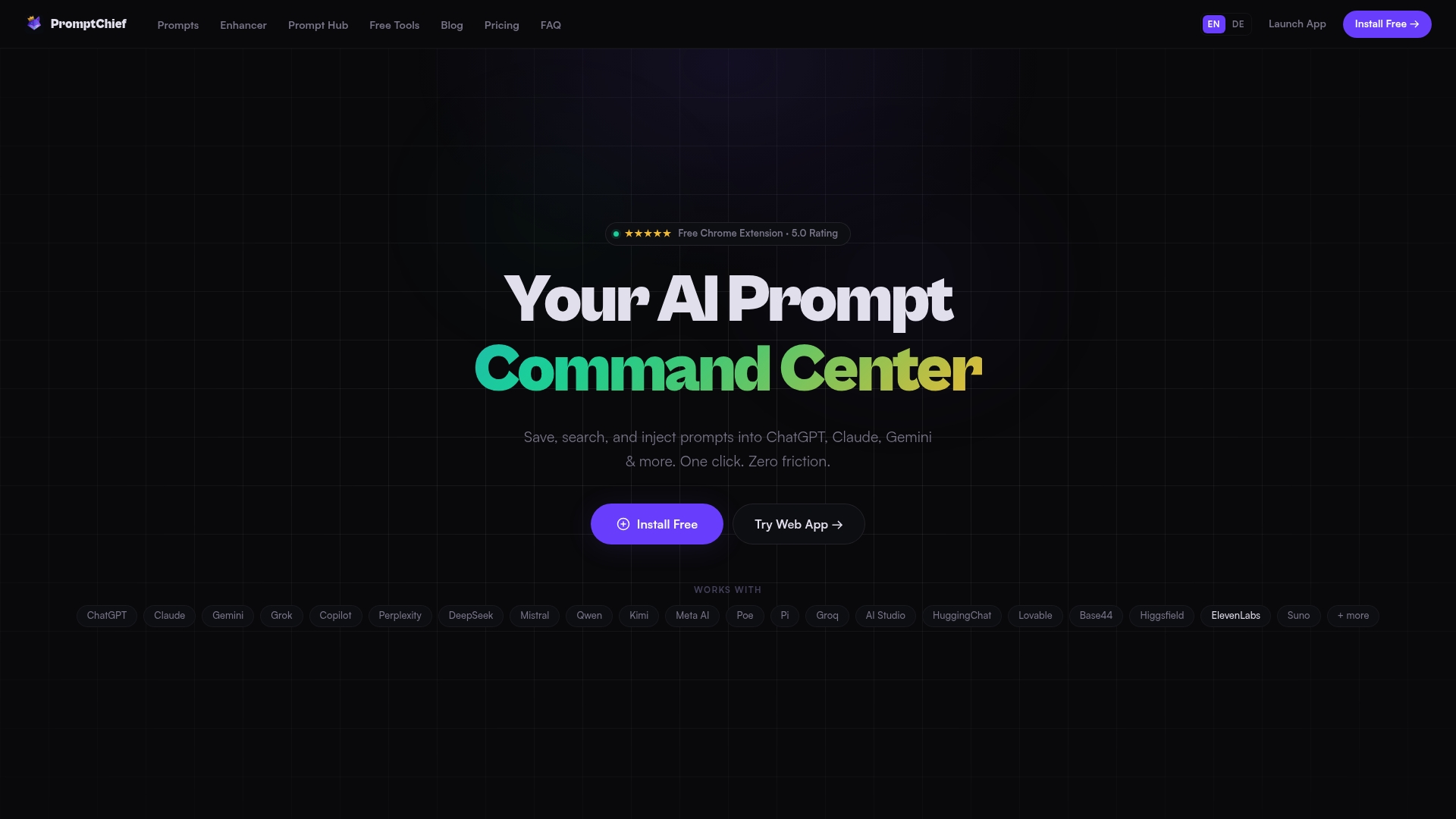
Instead of copy-pasting the same adapted prompt between Perplexity, ChatGPT, and Claude every time you switch tools, Promptchief's Chrome extension lets you inject a saved prompt directly into whatever window you're working in. Fuzzy search means you don't need to remember the exact title, and prompt chains let you link a research prompt to a summary prompt to a formatting pass without manually running each step. The community Hub adds over 400 tested prompts you can adapt for your own research and productivity workflows, and team workspace functionality means a prompt one person refines doesn't stay stuck on their machine.
Promptchief runs on a Free plan at $0 per month, with a Plus tier at $8.11 per month and a Pro tier at $17.39 per month for higher AI credit limits and advanced features like the prompt enhancer and export options. Start by saving the Perplexity prompts from this guide into a free account, and see whether your next research task takes less setup time than the last one.
FAQ
What Is the Perplexity Prompt Library?
The Perplexity prompt library is a section of the Comet resource hub containing categorized, ready-to-run prompts for tasks like research, finance analysis, academic work, and general productivity. You can copy a prompt directly into Comet or adapt it for the Agent API by splitting it into instructions and input.
How Do I Adapt a Library Prompt for the Agent API?
Separate the standing rules (tone, citation requirements, output format) into the instructions field, and put the specific task or question into input. According to the Agent API prompt guide, setting instructions replaces a preset's default system prompt, so keep them focused and short.
What Are Presets in the Agent API?
Presets are pre-configured bundles combining a model, a default system prompt, search settings, and available tools. Overriding instructions when using a preset replaces its built-in system prompt rather than adding to it, per Perplexity's own documentation.
How Do I Verify Citations From an Agent API Response?
Read URLs directly from the search_results array in the structured response payload rather than trusting citation text in the model's prose. Collecting results[].url entries across every search step, not just the first, builds a more complete and accurate source list.
Do Rate Limits Affect How I Should Plan a Prompt Library?
Yes. Perplexity's rate limits scale with spending tier, so higher tiers unlock higher requests-per-minute throughput. Check your tier before building an automated workflow that assumes you can run large prompt batches without hitting a ceiling.
Can I Manage Perplexity Prompts Alongside Prompts for Other AI Tools?
Yes, a platform like Promptchief lets you save, search, and inject prompts across 27+ AI platforms including Perplexity-adapted prompts, ChatGPT, and Claude, from one cloud-synced library. That avoids keeping separate, disconnected prompt collections for each tool you use.