
A Gemini prompt library is any organized collection, official gallery, community repo, or IDE-stored set, of tested prompts you can copy, adapt, and rerun instead of rewriting from scratch. Google's own Gemini API prompt gallery is the most reliable starting point, backed by community repos on GitHub and template hubs for edge cases. The fastest next step: grab a template close to your task, tweak the variables, and drop it into a prompt manager or project file so you never retype it again.
TL;DR:
- The Gemini prompt library is most reliably sourced from Google's official gallery, which offers task-specific templates with consistent structure to streamline prompt reuse.
- Well-constructed templates include few-shot examples, explicit output constraints, and visible test cases to ensure they perform reliably across varied inputs.
- Storing prompts in version-controlled files with variable injection and regular testing helps maintain prompt quality and makes team collaboration more efficient.
- A prompt manager like Promptchief simplifies prompt versioning, cross-device access, and injection, reducing time wasted searching or recreating prompts from scratch.
- For high-stakes or domain-specific tasks, building bespoke prompts with validation sets and reviews is essential instead of relying solely on generic templates.
Table of Contents
- What Does the Official Gemini Prompt Gallery Offer?
- How Do You Evaluate Community Prompt Collections?
- How Do You Build a Reliable Gemini Prompt Template?
- Where Should You Store and Version Your Prompt Library?
- How Do You Test and Validate a Prompt Before Trusting It?
- Copy-Ready Gemini Prompt Templates You Can Adapt Today
- Why a Prompt Manager Solves What Libraries Alone Can't
- Curated Library or Bespoke Prompt: Which Do You Actually Need?
- Manage Your Gemini Prompt Library Without the Copy-Paste Grind
- Sources
- FAQ
What Does the Official Gemini Prompt Gallery Offer?
Google's Gemini API prompt gallery is the closest thing to a factory reference manual for prompting Gemini models. It catalogs task-specific examples, math tutoring walkthroughs, JSON-output extractors, multimodal image and video tasks, paired with runnable code snippets you can execute directly against the API.
The structure behind most gallery entries follows a consistent pattern: a defined role for the model, background context for the task, a specific instruction, and a stated output format. That consistency is not accidental. Google's own prompt design guidance recommends templates that spell out intent, context, and constraints rather than open-ended asks, and the gallery examples model exactly that shape.
Copying a gallery prompt into your own workflow takes a few minutes if you follow a simple sequence:
- Find the closest matching task in the gallery (don't force a generic template onto a specialized job).
- Copy the full example, including the code snippet, not just the prompt text.
- Swap placeholder values (variable names, sample data, target schema) for your real inputs.
- Run it once unchanged to confirm the baseline output before you start modifying instructions.
- Save the working version somewhere you can find it again instead of leaving it in a scratch file.
That last step is where most developers lose time. A prompt that worked perfectly last month is useless if it's buried in a chat history you can't search. The gallery gives you a starting point; what you do with it after that first successful run determines whether you're rebuilding it from memory six weeks later or pulling it up in seconds.
How Do You Evaluate Community Prompt Collections?
Beyond Google's own examples, a large ecosystem of third-party and community-maintained prompt collections has grown around Gemini. Some are excellent. Many are recycled generic prompts with the model name swapped in. Knowing what separates the two saves you from wasting time on a template that looks polished but falls apart on real input.
Most developers searching a prompt library for Gemini care about five categories: code generation and review, data extraction, marketing copy, education and tutoring, and multimodal tasks (image, audio, video). A collection worth bookmarking usually covers at least two or three of these with genuine depth rather than a shallow pass across all five.
Before trusting a template, check for these signals:
- Few-shot examples included. A template with one or two worked examples embedded tends to outperform a bare instruction, especially for formatting-sensitive tasks.
- Explicit output constraints. Look for stated length limits, schema definitions, or tone requirements, not just a task description.
- Visible test cases. Collections that show sample input and sample output let you verify the prompt actually works before you run it against your own data.
- A permissive license. Community repos like the gemini-cli-prompt-library on GitHub publish cleaned prompt sets under licenses like MIT, which matters if you plan to reuse them commercially.
These collections tend to cluster in three places: GitHub repos maintained by individual developers or small teams, dedicated prompt hubs that aggregate submissions across models, and community forums where practitioners share what worked for a specific task. None of them replace testing on your own data, but they cut the blank-page problem down to an editing problem.
How Do You Build a Reliable Gemini Prompt Template?
A template that survives contact with real users needs three things: a clear intent, enough context for the model to act on that intent, and constraints that box in the output. Google's own prompting strategy documentation frames this as Intent, Context, Constraints, and it holds up well in practice.
Here's a working sequence for building one:
- Write the intent as one sentence. What should the model produce, and for whom? Vague intent produces vague output no matter how detailed the rest of the prompt is.
- Add context sparingly. Include only what changes the answer, background data, audience, prior steps, not everything you know about the project.
- State constraints explicitly. Word counts, tone, banned phrases, required fields. If you need JSON, say so and describe the schema.
- Insert one or two few-shot examples right before the final instruction, not buried at the top. Placement affects how strongly the model weights them.
- Choose your model tier deliberately. Gemini Flash handles short, well-defined tasks efficiently; Gemini Pro earns its cost on multistep reasoning or ambiguous instructions.
One nuance worth remembering: a single, well-chosen example frequently outperforms a long list of instructions, according to Google's own prompting guidance. Verbose instruction stacks tend to dilute the signal rather than sharpen it.
Pro Tip: If you need strict JSON output, enforce a schema directly in the prompt rather than asking the model to "return JSON." A described schema with field names and types cuts malformed output dramatically and makes automated testing far easier downstream.

Where Should You Store and Version Your Prompt Library?
A prompt that lives only in your browser history disappears the moment you close the tab. Developers who actually reuse their prompts store them somewhere structured, an IDE extension, a project file, a CLI tool, or a Git repo, and treat changes to them with the same discipline as code.
Android Studio's approach is a useful reference model. It stores project-level prompts as .idea/project.prompts.xml, a version-controlled file that travels with the codebase. Prompts inside it can use variable injection, referencing something like $SELECTION so the prompt automatically pulls in whatever code is highlighted in the editor rather than requiring manual copy-paste.
That pattern generalizes well beyond Android Studio:
- Keep project-specific prompts in a versioned file inside the repo, not in a personal notes app only you can access.
- Use CLI tools or IDE extensions that support variable injection so prompts adapt to context automatically.
- Treat prompt edits like code changes: open a pull request, get a second set of eyes, and note why the wording changed.
- Maintain a short review checklist covering intent clarity, output schema, and whether existing few-shot examples still apply.
Storing prompts this way pays off the first time a teammate asks "which prompt do we use for X?" and you can point to one canonical file instead of five conflicting Slack messages.
How Do You Test and Validate a Prompt Before Trusting It?
A prompt that works once on a good day is not a validated prompt. Teams that maintain prompt libraries at any scale build a small validation set and run prompts against it before treating them as production-ready, catching drift before it reaches users.
A workable process looks like this:
- Build a validation set of 10 to 20 representative inputs, covering typical cases and known edge cases (empty fields, oversized input, ambiguous phrasing).
- Run the prompt automatically against that set and check for format compliance first, does it return valid JSON, correct field names, expected length, before checking content quality.
- Track a handful of metrics over time: correctness rate, schema compliance, token cost per run, latency, and how often edge cases fail outright.
- Wire basic checks into CI so a prompt change that breaks output format gets flagged before it merges, not after a user reports it.
- Log failures with enough context to reproduce them, the exact input, the model version, and the raw output.
A minimal CI-based harness that enforces schema compliance and tracks token-cost shifts between model versions catches most regressions before they reach a live workflow. Version updates to Gemini models can shift output style even when the prompt text hasn't changed, which is exactly why a standing validation set matters more than a one-time test. If prompts touch anything user-facing or handle untrusted input, it's also worth reviewing prompt injection risks as part of that same validation pass.
Copy-Ready Gemini Prompt Templates You Can Adapt Today
These five skeletons cover the tasks developers and content teams hit most often. Each follows the Intent, Context, Constraints structure and includes a model recommendation based on task complexity.
- Code assistant. "You are a senior [language] engineer. Given this function: [paste code], identify bugs and suggest fixes. Constraint: preserve the existing function signature and return only the corrected code with inline comments." Best on Gemini Pro for anything beyond trivial syntax fixes.
- JSON extractor. "Extract [fields] from the following text: [paste text]. Return valid JSON matching this schema: {field1: string, field2: number}. If a field is missing, return null." Gemini Flash handles this well since the task is narrow and well-defined.
- Document summarizer. "Summarize the following document in [X] bullet points for a [target reader]. Exclude anything not relevant to [specific focus area]. Document: [paste text]." Flash for short documents, Pro for anything requiring cross-section synthesis.
- Marketing brief generator. "Write a marketing brief for [product] targeting [audience]. Include: value proposition, three key messages, and a one-line tagline. Tone: [tone]." Works reliably on Flash; escalate to Pro only for nuanced positioning work.
- Multimodal captioning. "Describe this image for [purpose, e.g., alt text, product listing]. Constraint: under 20 words, no subjective language." Requires Pro for multimodal input handling.
Each of these follows the same shape you'll see across the official prompt gallery: role, context, task, and format. Then adapt the brackets to your real data before you save it anywhere permanent.
Why a Prompt Manager Solves What Libraries Alone Can't
A prompt library gets you a starting point. It doesn't solve what happens after: prompts scattered across chat exports, Notion pages, and half-remembered Slack threads, none of it searchable when you actually need it under deadline.
That friction is exactly what a dedicated prompt manager for Gemini is built to remove. Cloud sync keeps your library available whether you're on a laptop or a different machine entirely. Fuzzy search finds the right template in seconds instead of scrolling through folders. A browser extension injects saved prompts directly into whatever AI tool you're using, so the copy-paste step disappears.
| Friction point | What a prompt manager solves |
|---|---|
| Prompts scattered across devices | Cloud sync keeps one library everywhere |
| Digging through chat history | Fuzzy search surfaces the right prompt fast |
| Manual copy-paste every time | Browser extension injects prompts directly |
| Rebuilding templates from scratch | Fillable templates with saved variables |
| No shared team standard | Community Hub and team workspaces |
For developers managing dozens of Gemini templates across code review, marketing, and documentation tasks, that combination, cross-device sync, one-click injection, and a searchable library, turns a folder of scattered text files into an actual working system.
Curated Library or Bespoke Prompt: Which Do You Actually Need?
Curated libraries earn their keep for prototyping and routine work: drafting a first pass at a summary, generating boilerplate code comments, or extracting structured data from predictable formats. Speed matters more than precision at that stage, and a gallery template gets you there in minutes.
Domain-specific or safety-sensitive tasks deserve different treatment. Medical, legal, or financial content generation, anything where a wrong answer has real consequences, needs a prompt built for your exact use case, locked behind a validation set, and reviewed before it ships. Don't stretch a generic template to cover that gap just because it's convenient.
The practical middle path: start with a curated template close to your task, add one or two few-shot examples from your own data, then save the working version into your prompt manager with a basic test attached. That hybrid approach gets you speed on the front end and reliability on the back end, which is usually what actually matters.
— John
Manage Your Gemini Prompt Library Without the Copy-Paste Grind
Promptchief is the alternative to scattered notes and dead chat threads for developers running Gemini prompts across projects: cloud sync keeps your library current on every device, and the Chrome extension injects a saved prompt directly into your workflow instead of making you hunt for it.
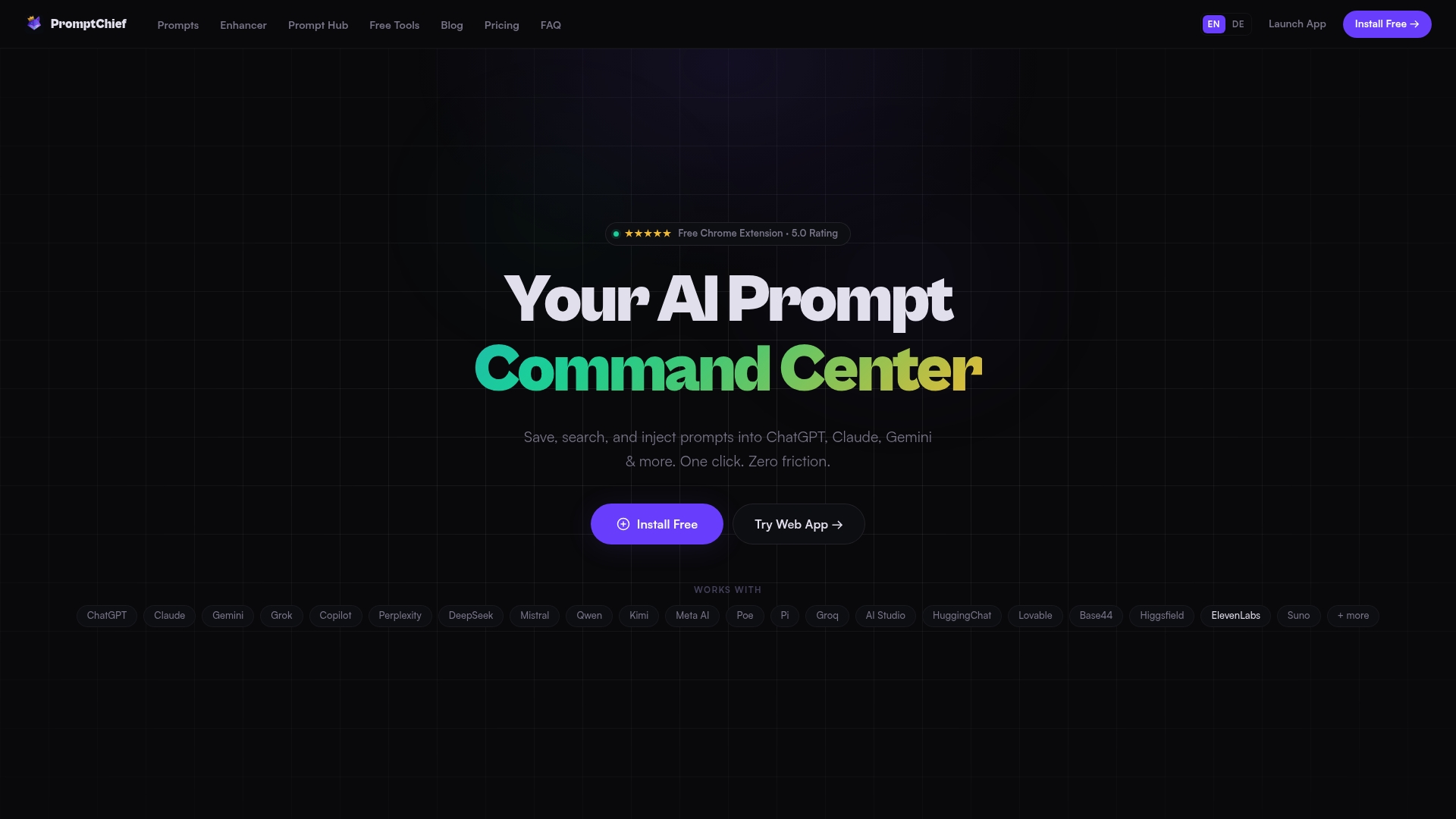
Getting started takes three steps: import a template from the gallery or a community repo, turn on cloud sync so it follows you across machines, and attach one test case so you'll know immediately if a future edit breaks the output. Fillable templates handle the variable swapping automatically, and the community Hub gives you a starting point if you're building a category from scratch rather than adapting an existing one.
Plans start with a Free tier at $0 per month, scale to Plus at $8.11 per month (or $69.90 billed annually), and Pro at $17.39 per month (or $149.88 annually) for heavier use. Teams needing shared workspaces run $12 to $15 per seat, per month. Check the full breakdown on the pricing page or start directly from the Promptchief homepage.
Sources
For readers who want to go straight to the source material: Google's Gemini API prompt gallery and its prompting strategy docs cover official examples and template design. For IDE-level integration, Android Studio's prompt library documentation explains variable injection and project-level storage. For community-maintained collections, the gemini-cli-prompt-library on GitHub offers a licensed, curated starting point.
- Prompt design strategies | Gemini API | Google AI for Developers
- Gemini prompt library — Android Studio documentation
FAQ
Can you give me a list of Gemini AI prompts?
Google's official prompt gallery lists ready-to-run examples for coding, JSON extraction, and multimodal tasks, and Promptchief's prompt library offers many additional free templates you can copy directly.
How do I find prompts for Gemini?
Start with Google's official gallery for verified examples, then check community repos on GitHub and prompt hubs for category-specific templates like marketing or data extraction.
Where can I find free Gemini prompts?
Free options include Google's official gallery, open GitHub repos like the gemini-cli-prompt-library, and Promptchief's free prompt collection, which includes templates you can save and reuse without cost.
Does Gemini have unlimited prompts?
Usage limits depend on your Gemini API plan or subscription tier, not on how many templates you save; a prompt manager like Promptchief has no bearing on Google's own usage caps but keeps your saved templates organized regardless of how many you use.
What's the difference between a prompt template and a few-shot example?
A template defines the structure, intent, context, and constraints, while few-shot examples are sample input-output pairs inserted inside that structure to show the model exactly what a correct response looks like.