
A prompt repository is a centralized, versioned collection of prompts and prompt metadata built so you can store, test, and deploy prompts the same way you'd manage application code. The core idea: instead of scattering prompts across sticky notes, browser tabs, and chat histories, you keep them in one place with structured metadata, a version history, automated tests, and a clear license. The immediate next step is either to browse a public hub like prompts.chat or to initialize a Git-backed folder on your own machine and commit your first prompt object today.
A useful prompt repo contains at minimum:
- Prompt object: the actual text, with placeholders marked
- Metadata:
id,role,objective,model_hints,tags,author,license - Version history: Git commits or a changelog entry per change
- Tests: at least one behavioral assertion per prompt
- License: an explicit field stating reuse terms
Two solid starting places: fork the Open Prompt Library on GitHub for a large, structured corpus you can search and export, or clone inventivepotter/promptrepo for a Git-native setup that already includes CI-style workflow patterns.
Key Takeaways
A well-maintained prompt repository treats every prompt as a structured, versioned, testable object — that single shift eliminates silent regressions and makes prompts reusable across models and teams.
| Point | Details |
|---|---|
| Start with Git or fork a public repo | Clone prompts.chat or Open Prompt Library to seed your collection, then add Git versioning from day one. |
| Add structured metadata | Use YAML or JSON with id, role, objective, model hints, tags, and license fields for every prompt. |
| Test and run CI on every change | Write at least one behavioral assertion per prompt and block merges when tests fail. |
| Attach license and attribution | Set an explicit license field and author credit before sharing any prompt publicly. |
| Use Promptchief for managed workflows | Promptchief provides cloud sync, Chrome extension injection into 27+ platforms, fuzzy search, and team workspaces without self-hosting. |
Table of Contents
- Notable public prompt repositories and what each is best for
- How prompt repositories are organized and common file formats
- Production workflows: versioning, testing, and deployment
- Licensing, attribution, red-teaming, and security for shared prompts
- Integrations, extensions, and tooling that make repositories usable
- How to choose between public hubs, self-hosted Git repos, or a managed prompt manager
- Starter repo structure and an example prompt object
- Why moving prompts from notes into a repository actually changes things
- When a managed prompt repository makes sense
- Sources
- FAQ
Notable public prompt repositories and what each is best for
The public ecosystem is richer than most people realize. Each hub has a different philosophy, and picking the wrong one wastes time.
prompts.chat is the community workhorse. The GitHub repo behind it hosts a large open-source collection organized as markdown lists, and it supports self-hosting, CSV/JSON data exports, and dataset integration. Best for: anyone who wants a browsable, forkable starting point with broad coverage of everyday use cases. It's the easiest repo to clone and adapt.
Open Prompt Library runs to over 2,100 prompts organized into searchable markdown categories, with JSON and CSV exports for programmatic use. Best for: teams that need a large corpus to seed their own internal library or run batch evaluations. The export format means you can pipe it directly into a vector store or a search index without manual reformatting.
promptslab/Awesome-Prompt-Engineering takes a different angle. Rather than a prompt collection, it's a curated index of prompt engineering resources: papers, tools, techniques, and example repos. Best for: learning. If you're building your first production repo and want to understand the field before committing to a structure, this is the right starting point.
Wolfram Prompt Repository is purpose-built for Wolfram Language and Wolfram Alpha integrations. Prompts are organized as named, callable functions with defined inputs and outputs, which is closer to a software library than a text collection. Best for: teams working in the Wolfram ecosystem who need structured, callable prompt personas. It's the clearest example of treating prompts as first-class API objects.
Reddit r/PromptEngineering is not a repo in the technical sense, but the resource threads and weekly megathreads function as a living, community-curated hub. Best for: discovering novel techniques, getting peer feedback on prompt drafts, and finding niche domain prompts that haven't made it into formal collections yet. Not engineered for production, but invaluable for learning what's actually working for practitioners right now.
Git-hosted repos with CI-style workflows (such as inventivepotter/promptrepo and jonverrier/PromptRepository) are the production-grade option. Prompts live as YAML or JSON files, changes go through pull requests, and automated tests run on every merge. Best for: engineering teams that need audit trails, peer review, and deployment pipelines. These are the repos to fork when governance matters.
How prompt repositories are organized and common file formats
Structure is where most ad hoc prompt collections fall apart. A folder of .txt files works for five prompts. At fifty, you can't search it. At five hundred, you can't maintain it.
The three common storage formats each serve a different stage of maturity:
| Format | Best for | Trade-offs |
|---|---|---|
| Plain markdown / CSV | Quick starts, human-readable browsing | Hard to query programmatically; no schema enforcement |
| YAML / JSON | Structured metadata, CI workflows, programmatic injection | Requires a schema; slight authoring overhead |
| Database / vector store | Large-scale search, semantic similarity, team access | Highest setup cost; overkill for small collections |
A minimal metadata schema for a single prompt object looks like this:
id: summarize-meeting-v2
role: assistant
objective: Summarize a meeting transcript into three bullet points
inputs:
  - transcript
placeholders:
  - "{{transcript}}"
model_hints:
  - gpt-4o
  - claude-3-5-sonnet
tags: [summarization, meetings, productivity]
license: MIT
author: your-handle
tests:
  - assert: output contains "Action items"
  - assert: output length < 300 chars
Tagging is the discovery layer. A flat tag list works fine at first, but a two-level taxonomy (category + subcategory, e.g., writing/summarization) scales better when your library grows past a hundred prompts. Fuzzy search on tags and the objective field covers most lookup needs without a full vector store.
Pro Tip: Switch to YAML or JSON as soon as you have more than a handful of prompts. The real payoff isn't human readability — it's that structured prompt objects can be injected programmatically into workflows, rendered with a template engine like Jinja2, and validated in CI without any manual reformatting. Plain text forces you to do that work by hand every time. For a deeper look at storage format trade-offs, the prompt storage guide on Promptchief walks through the decision in practical terms.
Production workflows: versioning, testing, and deployment
Treat prompts like code. That means Git-based repos plus CI-style tests to version and gate every change, not a shared doc that someone edits in place.
Wharton Generative AI Labs notes that prompt performance is model-dependent: a prompt that excels on one LLM can behave differently on another, or drift within the same model across API versions. That single fact is the strongest argument for a formal workflow. Without version history and per-model benchmarks, you won't know when a prompt broke or which model update caused it.
Here's a workflow that teams can follow immediately:
- Author the prompt as a YAML/JSON file with full metadata (role, objective, placeholders, model hints, tags, license, tests).
- Open a pull request using a PR template that requires metadata fields and at least one test assertion before review.
- Peer review the prompt text, metadata completeness, and test coverage — same as a code review.
- Run automated tests on the PR: smoke tests for output shape, assertion tests for safety constraints, and regression checks against a saved baseline output.
- Run model-specific benchmarks against each target model listed in
model_hints. A prompt passing on GPT-4o is not a guarantee it passes on Claude 3.5 Sonnet. - Merge and deploy via the injection pipeline: the prompt is pulled from the repo by the app or extension at runtime, not hardcoded.
For branching, a simple main / staging / feature/prompt-name structure works. Semantic versioning on prompt packs (v1.2.0) gives downstream consumers a stable reference. The changelog entry for each version should note which model versions were tested and what changed in the prompt text.
The three test types worth running on every prompt:
- Unit assertions: check that the output contains expected strings, stays within a length limit, or matches a format (JSON, bullet list, etc.)
- Integration tests: run the prompt against a real model or a lightweight mock and compare the output to a saved baseline
- Regression checks: flag when a prompt's output distribution shifts after a model update or a prompt edit
JuliusBrussee/the-prompt-library shows a practical implementation of assertion-based testing against real LLMs, where prompt updates must pass the full test suite before merging. For teams building this into a broader automation stack, the AI workflow automation guide covers CI/CD integration patterns in detail.
Licensing, attribution, red-teaming, and security for shared prompts
Always attach explicit licensing and clear attribution metadata before sharing any prompt publicly. This isn't bureaucratic overhead — without it, you have no legal basis to enforce how your prompts are used, and no way to credit the people who wrote them.
The practical checklist before any prompt goes public:
- License field: set explicitly (
MIT,CC BY 4.0,Apache 2.0, or a custom restriction). Leaving it blank defaults to "all rights reserved" in most jurisdictions, which is rarely what you want for a community hub. - Author attribution:
authorfield with a handle or name, plus asource_urlif the prompt was adapted from another repo. - Secrets scrubbing: scan for API keys, internal URLs, or proprietary system context before committing. A pre-commit hook that runs a secrets scanner (like
detect-secrets) catches this automatically. - Disallowed content filter: for prompts going into a public library, run a classifier or manual review against your content policy before merging.
- Red-team scenarios: test the prompt against adversarial inputs before it reaches production.
Red-teaming matters more than most teams expect. A prompt that looks benign in normal use can be manipulated to produce harmful outputs, leak system context, or bypass safety filters when an adversarial user probes it. Practitioners recommend evidence-based prompt management that includes adversarial testing as a standard step, not an afterthought.
Pro Tip: Before approving any prompt for a public library, run it through at least these five adversarial scenarios: (1) prompt injection via user input, (2) role-play override attempts ("ignore previous instructions"), (3) data exfiltration probes, (4) jailbreak phrasing variants, and (5) edge-case inputs that stress the placeholder logic. Document the results in the prompt's tests field. Avoiding common prompt mistakes at the authoring stage reduces the adversarial surface significantly.
Integrations, extensions, and tooling that make repositories usable
A well-structured repo sitting on GitHub is only useful if prompts can get from the file to the model without manual copy-paste. The integration layer is what turns a prompt collection into a working system.
The core integration types, in order of how often you'll use them:
- Chrome/web extension injection: a browser extension reads prompts from your repo (or a synced cloud store) and injects them directly into the AI platform's input field. No copy-paste, no context switching.
- API/SDK for programmatic injection: your app calls a prompt API endpoint, gets back the rendered prompt with placeholders filled, and sends it to the model. This is the production pattern for any app that uses prompts at runtime.
- Editor/IDE plugins: inject prompts into VS Code or Cursor directly from your library while coding. Useful for developer-focused prompt collections.
- Fuzzy search: a search layer over your metadata that returns the closest matching prompt even when the query doesn't exactly match a tag or title. Essential once your library exceeds a few dozen prompts.
- Vector DB connectors: semantic search over prompt embeddings. Overkill for small libraries; worth it when you have hundreds of prompts and need to find the "closest" one by meaning rather than keyword.
- Template engines (Jinja2): render placeholders in prompt text at runtime. The abilzerian/LLM-Prompt-Library shows how Jinja2-style parameterization makes prompts reusable across contexts without duplicating the base text.
- CI connectors: GitHub Actions or similar that run your test suite on every PR and block merges when assertions fail.
A concrete example of how these fit together: a Chrome extension pulls a system prompt from your cloud-synced repo, injects it into Claude's system field, and fills the {{user_role}} placeholder from a dropdown. The same prompt object, served via API, can also be called by a backend service that runs the same prompt against GPT-4o for a different use case. One source of truth, two injection paths. For reusing prompts across AI tools, the injection pattern is what makes it practical at scale.
How to choose between public hubs, self-hosted Git repos, or a managed prompt manager
Match the choice to your scale and governance needs. For personal learning, a public hub is fine. For an engineering team shipping prompts to production, Git plus CI is the minimum. For teams that need cloud sync, multi-platform injection, and built-in analytics without maintaining infrastructure, a managed prompt manager is the practical answer.
| Dimension | Public hub | Git-based self-host | Managed SaaS |
|---|---|---|---|
| Best for | Learning, browsing, forking | Engineering teams, CI/CD, audit trails | Cross-platform teams, non-technical users |
| Storage format | Markdown, CSV | YAML/JSON, any file type | Cloud DB, structured objects |
| Versioning & CI support | None built-in | Full Git history, GitHub Actions | Changelog, version history via UI |
| Integrations | Manual export | Custom API, SDK, CI connectors | Chrome extension, API, 27+ platform injection |
| Access & collaboration | Public or forked private | GitHub teams, branch permissions | Team workspaces, role-based access |
| Search & discovery | Basic GitHub search | Fuzzy search via tooling | Built-in fuzzy search, tagging, filters |
| Cost/hosting | Free | Free (self-managed infra) | Freemium to paid subscription |
The decision usually comes down to two questions: who needs access, and what happens when a prompt breaks in production?
If it's just you, a public hub or a local Git folder is enough. If a broken prompt affects a live product and you need to know who changed what and when, Git history is non-negotiable. If your team includes non-engineers who need to find and use prompts without touching a terminal, a managed solution with a browser extension and fuzzy search removes the friction that kills adoption.
Fork a public repo when you want a head start on content. Self-host in Git when governance and CI matter more than convenience. Adopt a managed solution like Promptchief when you need cloud sync, injection into multiple AI platforms, and team collaboration without building the infrastructure yourself. The best AI prompt managers comparison covers the managed-tool landscape in detail if you're evaluating options.
Starter repo structure and an example prompt object
A minimal repo should include a README, a prompts/ folder with structured files, a tests/ folder, and a CI config. Here's a file tree that works immediately:
my-prompt-repo/
├── README.md
├── .github/
│   └── workflows/
│       └── test-prompts.yml
├── prompts/
│   ├── summarization/
│   │   └── summarize-meeting-v2.yaml
│   └── writing/
│       └── blog-intro-generator-v1.yaml
├── tests/
│   └── test_summarize_meeting.py
└── CHANGELOG.md
A single prompt object in YAML, ready to copy into that structure:
id: summarize-meeting-v2
version: "2.1.0"
role: assistant
objective: Summarize a meeting transcript into three concise bullet points with action items
placeholders:
  - name: transcript
    description: Raw meeting transcript text
    required: true
model_hints:
  primary: gpt-4o
  tested_on:
    - gpt-4o
    - claude-3-5-sonnet-20241022
tags:
  - summarization
  - meetings
  - productivity
license: MIT
author: your-handle
source_url: ""
prompt_text: |
  You are a meeting summarizer. Given the following transcript, produce exactly
  three bullet points covering the main decisions made, and a separate "Action items"
  section listing owners and deadlines.

  Transcript:
  {{transcript}}
tests:
  - id: contains-action-items
    assert: output contains "Action items"
  - id: length-check
    assert: output length < 500
  - id: bullet-count
    assert: output matches regex "^- .+
- .+
- .+"
The CI job in .github/workflows/test-prompts.yml runs pytest tests/ on every pull request. Each test file calls the model (or a mock), captures the output, and runs the assertions defined in the YAML. A failing assertion blocks the merge. That's the whole loop: author, test, merge, deploy.
For reusable AI prompt templates you can adapt into this structure, Promptchief's template library gives you a ready-made starting set.
Why moving prompts from notes into a repository actually changes things
The fastest lesson from working with versioned prompt repos: you stop losing work, and you stop breaking things silently.
Before versioning, a prompt that worked well last month might get edited in place, and three weeks later nobody remembers what changed or why the outputs got worse. With Git, you revert in thirty seconds. That's not a theoretical benefit — it's the first thing practitioners notice when they make the switch. The second thing they notice is that ownership becomes clear. When a prompt has an author field and a commit history, the person who wrote it gets credit and gets the question when something breaks.
The one action worth doing this week: take your ten most-used prompts, add the metadata fields from the schema above (role, objective, model hints, tags, license), and write one assertion test for each. You don't need a full CI pipeline on day one. You need the habit of treating prompts as objects with defined behavior, not as text you paste and hope for the best. That shift in how you think about prompts is what separates a practitioner from someone who's just using AI tools.
When a managed prompt repository makes sense
If you need cloud sync, injection into multiple AI platforms, team workspaces, and built-in search without maintaining a server, a managed prompt manager is the practical choice over a self-hosted Git repo.
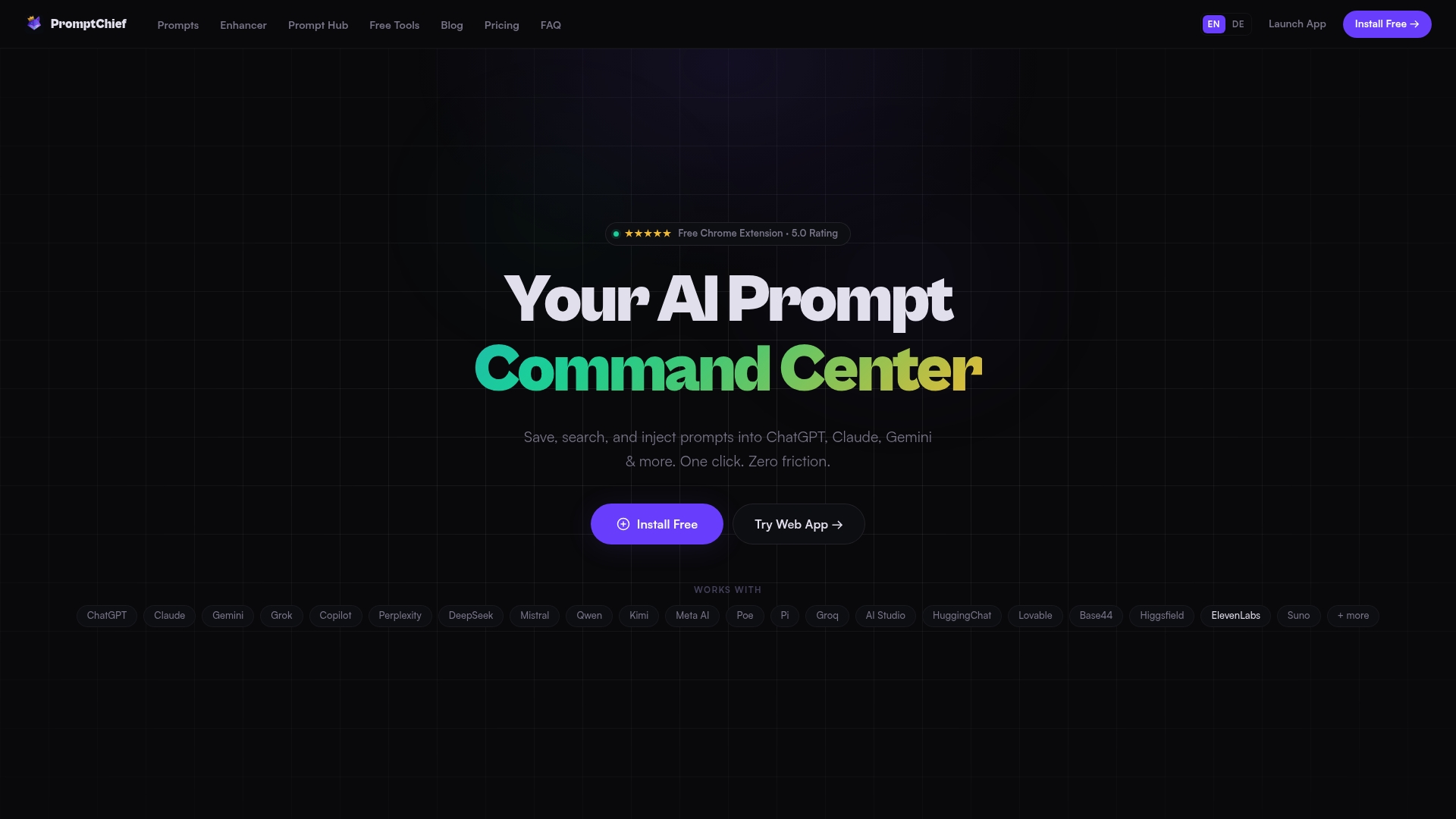
Promptchief is built for exactly that scenario. It gives you a cloud-synced prompt manager with a Chrome extension that injects prompts directly into 27+ AI platforms including ChatGPT, Claude, and Gemini, so the gap between your repo and the model disappears. Fuzzy search surfaces the right prompt in seconds. Magic placeholders handle parameterization without a template engine. Multi-step prompt chains let you sequence prompts the way a CI pipeline sequences jobs. Team workspaces add role-based access and shared libraries, and built-in analytics show which prompts get used and which don't.
The free plan covers personal use. For teams or production workflows, the Plus and Pro tiers add higher AI credit limits, advanced chain features, and team seat pricing. Start with the ready-to-use prompt examples to populate your library immediately, then connect the Chrome extension to inject them wherever you work.
Sources
FAQ
What is a prompt repository?
A prompt repository is a centralized, versioned store of AI prompts and their metadata — including role, objective, placeholders, model hints, tags, and license — managed like software so prompts can be tested, deployed, and reused programmatically.
Can ChatGPT generate prompts?
Yes. ChatGPT can draft prompt text, suggest metadata fields, and generate test assertions when you describe the task and target model. The output still needs human review, model-specific testing, and proper metadata before it belongs in a production repository.
What is the best website for managing and sharing prompts?
For browsing community prompts, prompts.chat and the Wharton Generative AI Labs library are strong starting points. For managing, syncing, and injecting prompts across multiple AI platforms as a team, Promptchief offers cloud sync, a Chrome extension, fuzzy search, and workspaces in one managed platform.
Do prompts work the same across different AI models?
No. As Wharton Generative AI Labs notes, prompt performance is model-dependent — a prompt that works well on one LLM can behave differently on another or drift within the same model over time. Per-model testing and benchmarks are required for any prompt used in production.