
Prompt debugging is the reproducible process of running a failing case again, capturing every intermediate output between the input and the broken result, then walking backward until you find the exact step that introduced the error. The first move is always the same: reproduce the failure at least three times and log what each step actually produced, not what you assumed it produced. Once you've localized the fault, you can decide whether to patch a single instruction or rebuild the step entirely, instead of guessing your way through the whole chain.
TL;DR:
- Chain failures can be subtle, such as missing fields or inconsistent outputs across similar runs, requiring detailed intermediate output logs for effective debugging.
- Reproducing failures at least three times helps determine if issues are deterministic or intermittent, informing whether to patch or rebuild steps.
- Common failure patterns include schema drift, invisible truncation, and confidence loss, which can be fixed with schema enforcement, completeness checks, or preserving hedging language.
- Using debugging tools like LangChain's
set_debug(True)and observability platforms improves traceability, accelerating root cause identification and resolution.- Maintaining a versioned prompt library and automatic testing suite allows continuous validation and prevents recurring bugs after model updates.
Table of Contents
- When Do You Actually Need Prompt Debugging?
- The Five-Step Forensics Workflow for Chains
- Eight Failure Patterns Every Chain Debugger Should Know
- Debugging Tools and Techniques That Actually Work
- Validation and Monitoring After You Fix It
- Two Quick Before-and-After Fixes
- Why Chains Are Worth the Debugging Overhead (Sometimes)
- Debug Faster With a Prompt Library Built for It
- Sources
- FAQ
When Do You Actually Need Prompt Debugging?
Not every bad output needs the full forensic treatment. A single-prompt failure is usually loud: the model returns malformed JSON, ignores a constraint, or produces obviously wrong code. You can often fix that with one instruction tweak. Chain failures are quieter and more dangerous, because a wrong number or a dropped field from step two can look completely plausible by the time it reaches step five.
Watch for these signals that you're dealing with a real debugging case, not a one-off fluke:
- Code generation that's subtly wrong, not obviously broken (wrong variable scope, off-by-one logic)
- Outputs that are inconsistent across near-identical runs with the same input
- Missing fields in structured output that were present in earlier steps
- Intermittent failures that pass most of the time, then fail without an obvious trigger
- Regressions that appeared right after a model version update, with no prompt changes on your end
Chains trade debuggability for latency and complexity. Every extra step is another place data can quietly degrade, and another network round trip you're paying for. If a single well-structured prompt can do the job, it's usually the safer bet.
The Five-Step Forensics Workflow for Chains
This is the forensics workflow built specifically for prompt chains, and it works because it forces you to stop staring at the final broken output and start looking at the boundary where things actually went wrong.
- Reproduce the failure. Run the exact same input at least three times. If it fails consistently, you have a deterministic bug. If it fails intermittently, note the failure rate. That distinction changes your whole approach.
- Capture every intermediate output. Log the original input, the output of each step in the chain, and the final wrong output. You cannot debug what you didn't record.
- Walk backwards from the final output. Start at the end and move toward the start, checking each step's output against what the next step actually needed. The drift often hides upstream of the step where the symptom appears.
- Inspect the boundary where things break. At each handoff between steps, check four things: completeness (did all the data survive?), fidelity (did values get altered or paraphrased?), provenance (can you trace where each piece of information came from?), and confidence markers (did hedging language like "approximately" or "likely" get silently dropped?).
- Match the symptom to a known failure pattern, then decide: patch or rebuild. If the boundary lost a field or a number, that's usually a two-line patch. If the entire step's instructions are ambiguous or the step is doing three jobs at once, rebuild it.
Pro Tip: Never trust a fix you haven't reproduced against. Run your patched prompt on the exact same failing input at least three times before moving on. A fix that works once might just be lucky.
The rebuild versus patch decision usually comes down to scope: a patch fixes a specific instruction that's causing a specific symptom, while a rebuild is warranted when the step's job description itself is the problem.
Eight Failure Patterns Every Chain Debugger Should Know
Once you've walked backward to the failing boundary, matching the symptom to a named pattern tells you exactly what to fix. These eight patterns cover most of what actually breaks in multi-step prompt chains:
- Compression loss: a step summarizes when it should have preserved. Fix by explicitly instructing the model to keep numeric values and named entities verbatim.
- Hallucinated bridge: the model invents a connection between two facts it doesn't actually have. Fix by adding an explicit rule: if information is missing, return "unknown" instead of guessing.
- Format laundering: each step subtly reformats the data, and by step four the schema has drifted. Fix by enforcing a strict template or schema at every boundary.
- Confidence loss: hedged language ("might", "approximately") gets stripped as the chain passes data forward, turning a guess into a stated fact. Fix by preserving hedging and source attribution explicitly.
- Cascade contamination: one wrong value early in the chain poisons every downstream step. Fix with consistency checks and checkpoints that catch anomalies before they propagate.
- Schema drift: the output structure slowly changes shape across steps. Fix by locking the output schema or normalizing it at each boundary.
- Invisible truncation: long outputs get silently cut off mid-list or mid-sentence, and nothing flags it. Fix by requiring a completeness confirmation at the end of each output.
- Implicit ordering assumption: a later step assumes information arrived in a certain order when it didn't. Fix with explicit labels and section markers instead of relying on position.
Debugging Tools and Techniques That Actually Work
Print statements are fine for a quick sanity check, but they don't scale past two or three steps; for more robust solutions, check out Signal — audio AI, model by model. Atomic testing, where you isolate and test each component or Runnable with a fixed input before wiring it into the full chain, prevents cascade bugs from ever reaching production and cuts your root-cause search time dramatically.
If you're building with LangChain, enabling set_debug(True) gives you a fast, developer-visible trace of every prompt and output at the component level during development. For production-grade forensics, observability platforms like LangSmith go further: trace views mark failing steps in red and show the exact parser error, mismatched type, or missing variable at the point of failure, which is why teams report meaningfully faster resolution times once a trace view replaces manual log-reading.
A few techniques worth building into your workflow immediately:
- Structure every prompt with explicit provenance markers so you can trace a value's origin later.
- Ask the model to list its assumptions before answering. Most failures are interpretation mismatches, not capability limits, and this exposes them instantly.
- Restate the task in your own words back to the model as a check, or generate two alternate interpretations and compare them.
- Use an instruction sandwich: constraints stated before and after the main task, since models tend to weight the end of a prompt heavily and forget the middle.
Developers moving from manual logging to a dedicated observability platform typically see the biggest jump in speed the first week, simply because they stop reconstructing chain state from scattered print output.
Validation and Monitoring After You Fix It
A fix that works today can silently break the next time the underlying model updates. That's why debugging can't be a one-time event.
- Build a small, representative test suite of prompts with known expected outputs, covering your highest-risk cases. Representative test prompts catch drift long before a customer does.
- Run that suite automatically on every model version upgrade and in your CI pipeline before deploying prompt changes.
- Track token usage, latency, and output consistency over time. A sudden jump in any of the three is often the earliest sign something upstream changed.
- Version your production prompts with changelogs, the same way you'd version code. When something breaks, you need to know exactly what changed and when.
Two Quick Before-and-After Fixes
A three-step research chain kept dropping the publication year from citations by the final summary step. Capturing intermediate outputs showed the summarizer was paraphrasing entire citation blocks instead of copying them. The fix: an instruction to preserve citation fields verbatim, character for character.
A single content-generation prompt kept producing generic marketing copy instead of the technical tone requested. Asking the model to list its assumptions first revealed it had interpreted "professional tone" as "sales tone." Tightening the instruction with an explicit example fixed it in one pass.
- Chain fix: preserve exact fields at the boundary, don't let a summarization step touch them.
- Single-prompt fix: force the model to expose its interpretation before generating final output.
Pro Tip: Keep your "before" and "after" prompt versions side by side in a changelog. Six months from now you won't remember why you added that one weird constraint, and you'll thank yourself for the diff.
Why Chains Are Worth the Debugging Overhead (Sometimes)
Chains buy you modularity at the cost of debuggability. Every extra step is a new place for compression loss or schema drift to creep in, and a new source of latency you're paying for on every request. I'd default to a single well-structured prompt unless a task genuinely needs distinct reasoning stages, like retrieval, then synthesis, then formatting. If you do build a chain, write your first prompt test before you write your third chain step. Debugging in reverse is always more expensive than instrumenting up front.
— John
Debug Faster With a Prompt Library Built for It
Half of prompt debugging is reconstructing the exact input, chain structure, and prior versions of a prompt that used to work. That's tedious to redo from scratch every time, which is exactly the gap Promptchief closes.
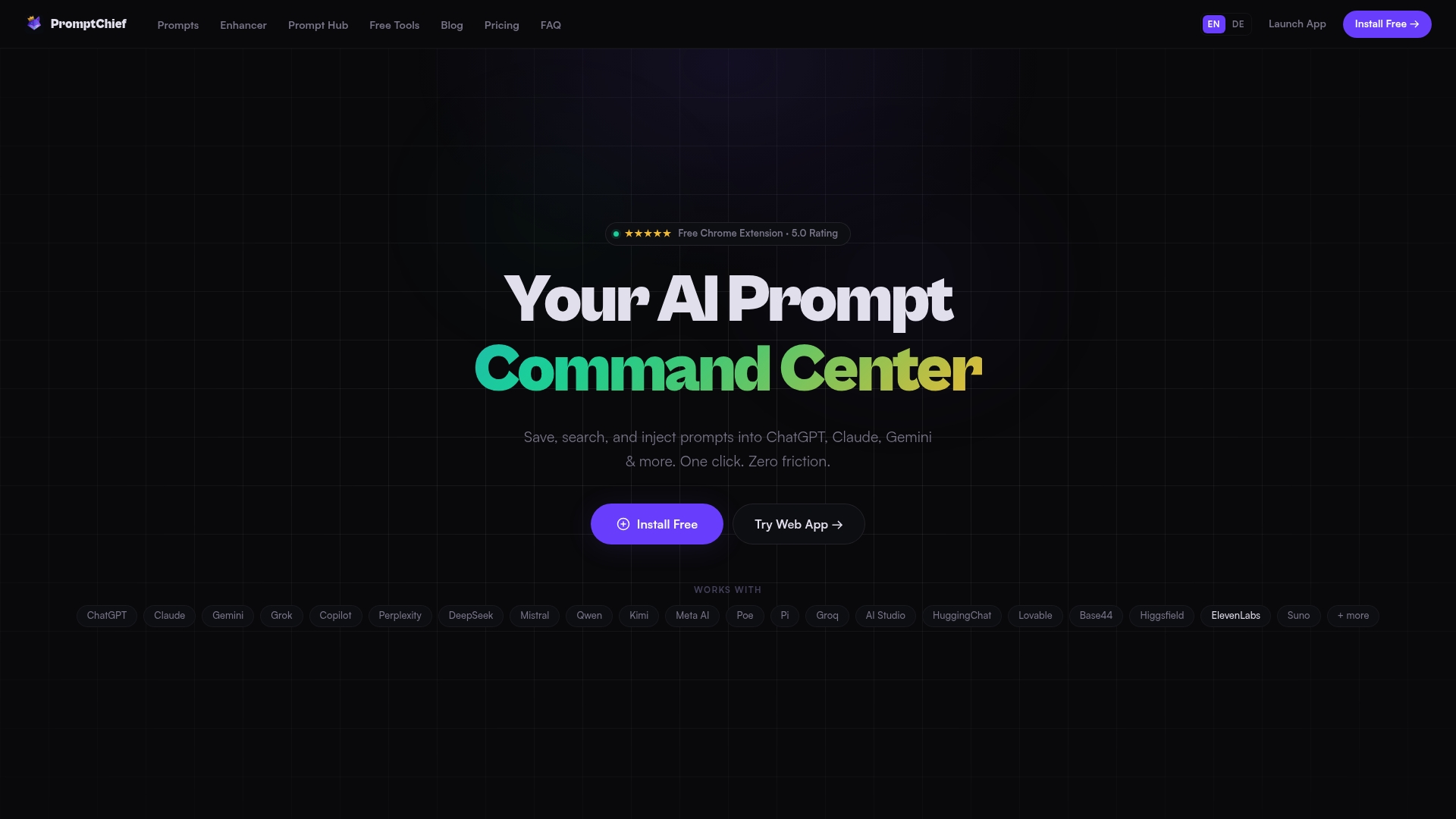
With a cloud-synced prompt management library, your test cases and known-good prompt versions stay searchable across every device instead of buried in old chat threads. Fuzzy search pulls up the exact prompt variant you used last week in seconds, and saved multi-step prompt chains mean you're not rebuilding chain structure from memory every time you need to reproduce a failure. That turns the reproduce-and-isolate step from a ten-minute scavenger hunt into a quick lookup. Set up your first saved chain and template library on the prompt management software page and see how much of your debugging time was really just re-finding things you'd already written.
Sources
- Prompt chain drift forensics
- Evaluating LLMs with LangSmith
- LCEL debugging LangChain chains — LangSmith tracing
- Atomic testing for AI pipelines (arXiv)
FAQ
What is prompt debugging?
Prompt debugging is the process of reproducing a failing AI output, capturing intermediate results at each step, and tracing backward to find the exact instruction or boundary that caused the error.
What's the difference between debugging a single prompt and debugging a chain?
Single-prompt failures are usually loud and obvious, like malformed output, while chain failures are quiet and propagate: a small error at step two can look completely plausible by the time it reaches the final output, which is why you need intermediate output capture at every boundary.
How do I find where a prompt chain broke?
Walk backward from the final wrong output, checking each step's output against what the next step needed, and inspect each boundary for completeness, fidelity, provenance, and confidence markers using the five-step forensics protocol.
What tools help with prompt debugging?
set_debug(True) in LangChain gives fast development-time traces, while observability platforms like LangSmith mark failing steps and surface parser errors in a trace view; a synced prompt library speeds up reproducing past test cases.
How do I stop the same prompt bug from coming back?
Keep a small test suite of representative prompts with expected outputs, run it automatically on every model upgrade, and version your production prompts with a changelog so you can trace exactly what changed.