
Prompt analytics maps the exact questions people ask AI tools to the mentions, citations, and gaps that follow, so teams can prioritize the content and product fixes that change how often they show up. It helps content leads, product owners, AI ops, and analytics teams spot the prompts where a brand is invisible, then turn that list into ranked briefs. Success is measurable: fewer blind spots, more citations, and a shorter path from gap to fix.
TL;DR:
- Prompt coverage varies significantly across buyer stages, with brands often showing high awareness-stage presence but low decision-stage citation.
- Citation gaps are caused by content structure issues like lack of schema or clear answer formatting, requiring targeted restructuring of existing pages.
- Competitive displacement signals reveal specific prompts where rivals outperform your brand, guiding precise content or authoritative asset development.
- Regular prompt set updates and versioning are essential, as AI models evolve and response styles change, impacting coverage and citation accuracy.
- Tracking internal AI adoption alongside mention and citation rates clarifies whether issues stem from content gaps or low team usage of AI tools.
Table of Contents
- Prompt Analytics vs. Keyword Analysis: Why Prompts Are the Real Unit
- What Are Prompt Coverage, Citation Gap, and Competitive Displacement?
- How Do You Build and Maintain a Prompt Set?
- Which Metrics and Dashboards Actually Matter?
- From Gap to Brief: A Five-Step Workflow
- How Practitioners Actually Run Prompt Analytics Day to Day
- Common Mistakes and What Actually Moves the Needle
- Managing Prompts Without Losing the Signal
- Sources
- FAQ
Prompt Analytics vs. Keyword Analysis: Why Prompts Are the Real Unit
Keyword analysis groups search queries into topics. Prompt analytics does something narrower and more useful: it treats each question a person asks an AI system as its own unit, worth tracking on its own terms.
A keyword like "expense management software" tells you almost nothing about intent. A prompt like "what's the best expense tool for a 15-person remote team that needs receipt scanning?" tells you the buyer stage, the constraint, and the exact phrasing an AI model will use to decide whether your brand deserves a mention. Similarweb's research on AI prompt analysis makes the case directly: prompts surface buying signals and needs that keyword research routinely misses, because people type full questions into chat interfaces the same way they'd talk to a colleague.
This matters for three overlapping disciplines:
- Answer engine optimization (AEO): tracking whether your content gets surfaced when someone asks ChatGPT, Claude, or Gemini a direct question.
- Content gap prioritization: finding which specific prompts have no good answer from your brand, ranked by how often they likely occur.
- Product insight: reading raw prompt language as a live feed of what buyers actually want, phrased in their own words.
Clinical research uses the term "prompt reporting" for something unrelated. A protocol deviation policy document, for instance, uses it to mean compliance disclosures. Worth knowing so you don't confuse the two when researching the term.
What Are Prompt Coverage, Citation Gap, and Competitive Displacement?
Three signals do most of the work in a mature prompt analytics practice, and each one implies a different fix.
- Prompt coverage is the share of tracked prompts where your brand appears at all. Segment it by question type (informational, comparative, transactional) and by buyer stage. A brand can have much higher coverage on awareness-stage prompts than on decision-stage prompts, and the blended number will hide that gap completely.
- Citation gap happens when an AI response mentions your brand but doesn't cite your page as a source. Siteimprove's research on prompt analytics frames this as a signal of which questions trigger brand mentions versus which ones send buyers straight to a competitor's cited source instead. A citation gap is usually a structure and authority problem: your content lacks the schema, clear answer formatting, or third-party validation the model wants before it commits to a citation.
- Competitive prompt displacement is when a rival shows up on a prompt where you don't. This is the most actionable signal of the three because it hands you the exact prompt text to target, not just a general topic.
Each signal points to a different remediation. Coverage gaps usually call for new content. Citation gaps call for restructuring existing pages (clearer headers, direct answers near the top, data tables). Displacement calls for either matching the competitor's content depth or building the authoritative asset they're currently winning with.
Pro Tip: Run your top 50 decision-stage prompts through three different AI models before you touch any content. A citation gap on ChatGPT but full coverage on Claude tells you the problem is model-specific formatting, not a content gap at all.
How Do You Build and Maintain a Prompt Set?
Start with selection rules, because an unbalanced prompt set will lie to you before you even open a dashboard.
Weight your set across the buyer journey deliberately. Siteimprove's analysis warns that a set skewed toward branded, awareness-stage queries inflates your apparent coverage while hiding real blind spots at the decision stage, where the actual buying happens. A balanced prompt set generally includes a mix of unbranded and branded prompts, with decision and comparison prompts deliberately overrepresented relative to how often people probably type them.
For each tracked prompt, store consistent metadata:
- Engine (ChatGPT, Claude, Gemini, Perplexity)
- Target persona and intent category
- Buyer stage tag
- Last-seen date and citation status
- A saved sample of the actual AI response
Version your prompts the way you'd version code. Hashing each prompt string lets you detect drift when a model's phrasing or answer style changes, and local-first prompt versioning tools apply a Git-like commit model to prompt sets, capturing inference logs and diffs without pushing sensitive data to a third-party cloud. A tool built for organizing and syncing prompts can carry a lot of this metadata load without extra tooling.
Refresh the set quarterly at minimum. AI models retrain and reweight sources faster than most content calendars move.
Pro Tip: Tag prompts with a "sample frequency" score even if it's a rough estimate. A gap on a prompt that occurs rarely is a lower priority than a gap on one that's common, even if both show zero coverage today.
Which Metrics and Dashboards Actually Matter?
Prompt-level metrics only become useful once you pair them with adoption data. Tracking mentions without tracking who inside your own organization is using AI tools productively gives you half a picture.
On the prompt side, track:
- Mention rate (appears anywhere in the response)
- Citation rate (appears as a linked or named source)
- Visibility score (a weighted blend of the two, often segmented by buyer stage)
- Sentiment of the mention
- Source-citation frequency, meaning which domains get cited most often across your tracked prompt set
On the workspace side, OpenAI's workspace analytics for ChatGPT Enterprise and Edu recommends watching the seats-enabled-to-active funnel, weekly active users (WAU) trends, and power-user identification. A team with high prompt visibility but low internal AI adoption has a different problem than a team with strong adoption but poor citation rates. Tracking chatgpt usage analytics at the workspace level is what makes that distinction visible.
Cohort comparisons help you triage fast: compare visibility scores across product lines or regions, and the lowest-performing cohort usually reveals which briefs to write first.
From Gap to Brief: A Five-Step Workflow
Detecting a gap is the easy part. Turning it into a shipped fix that moves the needle is where most teams stall.
- Identify the gap. Pull the prompt where you're absent, mentioned without citation, or displaced by a competitor.
- Diagnose the root cause. Read the actual AI response text. Practitioners doing this kind of forensic review check whether a competitor is cited as a genuine source or just referenced in passing, which tells you whether the fix is structural or a content-depth problem.
- Select the fix. Rewrite for clarity, restructure with clearer headers and schema, or build a new authoritative asset if none exists.
- Build the brief using the prompt text itself. The prompt's exact phrasing becomes your brief's working title and its first subhead, not just a rough topic idea.
- Measure the change. Rerun the prompt after publishing and track citation rate over a fixed window.
Prioritize using a simple formula: buyer-stage weight, times an estimated prompt volume proxy, times displacement severity. A decision-stage prompt where a top competitor is cited and you're absent should outrank ten awareness-stage prompts where nobody's cited at all.
Give each brief a reasonable measurement window before judging results to account for AI model update latency. AI models don't reindex instantly, and citation patterns can shift for reasons unrelated to your content changes, so a single-week check is nearly always premature.
How Practitioners Actually Run Prompt Analytics Day to Day
Most operational prompt analytics setups look less like a dashboard purchase and more like a lightweight logging habit bolted onto existing workflows.
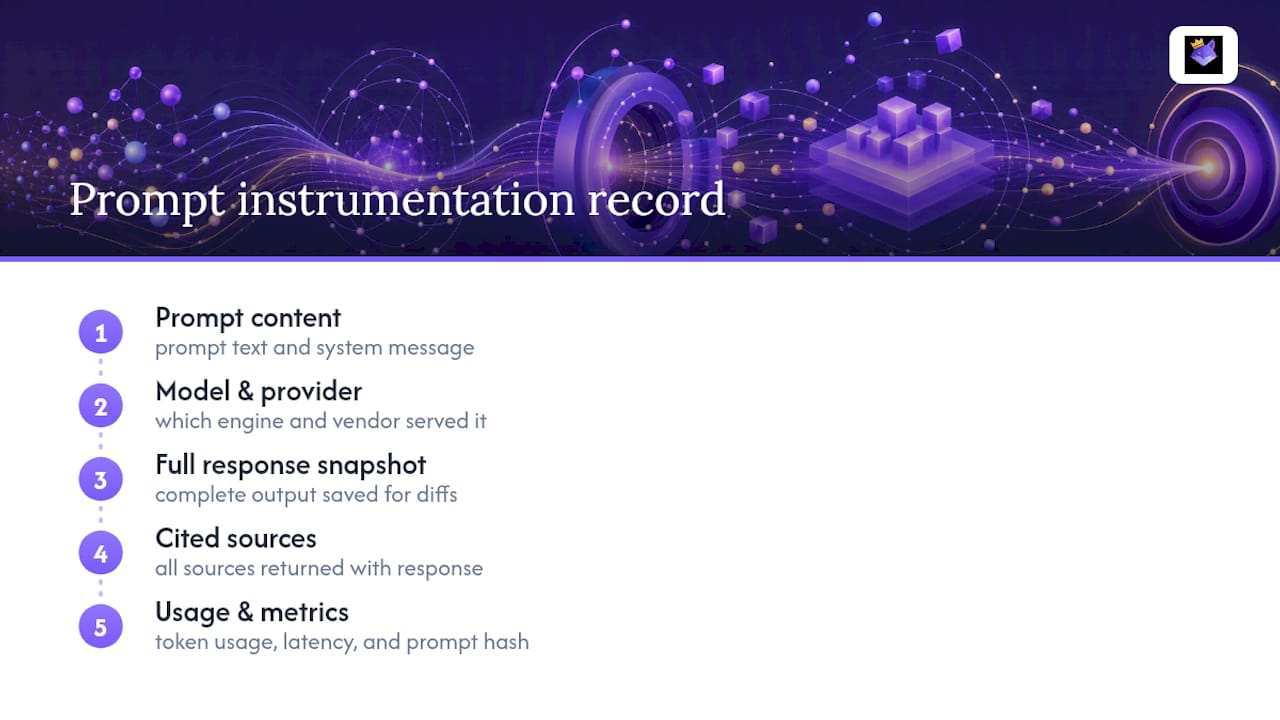
A solid instrumentation plan logs the prompt text, the system message, the model and provider, a full response snapshot, any cited sources in that response, token usage, latency, and a prompt hash for version tracking. That hash is what lets you diff two runs of the same prompt weeks apart and see exactly what changed in the model's answer.
Teams handling sensitive prompts increasingly favor local-first observability, where logs stay on infrastructure the team controls instead of routing through a third-party analytics vendor. This matters most for regulated industries running prompts that touch customer or product data, and private AI agent deployment patterns offer a useful reference point for how that architecture typically gets structured.
Per-model diffs matter more than most teams expect. The same prompt run against two different models often produces different citations entirely, which means a "fix" that works on one engine can leave you invisible on another.
Pro Tip: Log the full response snapshot, not just whether a citation occurred. A yes/no citation flag can't tell you why the citation disappeared three weeks later, but a saved snapshot can.
Common Mistakes and What Actually Moves the Needle
Most prompt analytics programs fail for the same three reasons. The prompt set is too branded, which hides decision-stage blind spots behind healthy-looking awareness numbers. Teams track mentions and stop there, missing the harder, more valuable citation-gap signal entirely. And prompts never get mapped to buyer stages, so every gap looks equally urgent when almost none of them are.
Start with decision-stage prompts. Map every gap to an existing page before writing anything new. Measure citations, not mentions, because that's the metric that predicts whether AI tools trust you enough to send a buyer your way. A three-item checklist gets most teams moving: pick 20 decision-stage prompts, check citation status on each, and rank the gaps by which ones already have a near-ready page you could fix in under a week.
— John
Managing Prompts Without Losing the Signal
Running a serious prompt analytics program means keeping track of dozens or hundreds of tracked prompts, their metadata, and the briefs they generate, across whatever AI tools your team actually uses day to day.
Promptchief handles that operational layer directly. The prompt management platform saves and organizes prompts with cloud sync across ChatGPT, Claude, Gemini, and two dozen other AI platforms. This way, the prompt set behind your analytics work lives in one searchable place instead of scattered across browser tabs and shared docs. Team workspace features let content, product, and analytics people work off the same tracked prompt library instead of rebuilding it independently, and a browser extension can make injecting a refined prompt into any AI tool a one-click step rather than a copy-paste chore.
If you're building your first prompt set for tracking, the ready-made prompt templates are a faster starting point than writing from scratch. Check current plan pricing to see which tier fits a team just starting to instrument this work.
Sources
- Prompt analytics: Understanding the questions that trigger brand mentions in answer engines
- Workspace analytics for ChatGPT Enterprise and Edu
- AI Prompt Analysis | Similarweb
FAQ
What Is Prompt Analysis?
Prompt analysis is the practice of examining the questions people type into AI tools, along with the AI's responses, to understand intent, coverage, and whether a brand gets mentioned or cited in the answer.
How Can I Analyze My Data Using ChatGPT?
You can paste structured data directly into ChatGPT and ask it to summarize trends, flag outliers, or build a table, though for ongoing tracking of prompt performance across a team, dedicated workspace analytics tools give more consistent, repeatable results than manual chats.
What Are the Three Types of Prompts?
Prompts are commonly grouped by buyer stage: awareness (informational, exploratory), consideration (comparative, "best X for Y"), and decision (transactional, ready to choose). Tracking coverage across all three stages, rather than clustering around one, is what keeps a prompt set from misrepresenting your actual visibility.
What Is a Prompt in ChatGPT?
A prompt is the exact text a person types into ChatGPT to get a response, ranging from a single question to a detailed multi-part instruction. In prompt analytics, that exact wording becomes the trackable unit tied to mentions, citations, and content gaps.
Does Prompt Analytics Replace Traditional SEO?
No. Prompt analytics works alongside keyword-based SEO, addressing a different surface: how AI answer engines represent your brand, rather than how search engine results pages rank your pages.