
Yes, prompt ROI is measurable: use the standard ROI formula, baseline your prompts with an eval harness, and track change across three categories, time saved, token cost reduction, and business-metric improvement. The first step is always the same: build a labeled test set and capture a baseline before you touch anything. Skip that step and every number you report afterward is a guess.
TL;DR:
- Confirm that a baseline test set is built and captured before starting prompt optimization to ensure accurate measurement of savings.
- Track cost per request, approval rates, and downstream KPIs with detailed tagging and regular invoice snapshots to avoid noisy or inaccurate results.
- Use an eval harness with 50 to 200 labeled examples to compare old and new prompts objectively before production deployment.
- Major cost reductions come from token trimming, caching, and routing to cheaper model tiers, but quality and risk trade-offs must be considered.
- Incorporate risk estimates and governance thresholds in ROI calculations to prevent overstating savings and ensure sustained, trustworthy improvements.
Table of Contents
- Prompt ROI formula: what counts as benefits and costs
- Key metrics and signals to track
- Measurement methods: build an eval harness and test before/after
- Where measurable savings actually come from
- Governance, risk, and trust costs in your ROI math
- How to report ROI: a conservative calculator template
- Practitioner notes on tools that support measurement
- Realistic expectations for scaling prompt ROI
- How PromptChief supports ongoing ROI measurement
- FAQ
- Sources
Prompt ROI formula: what counts as benefits and costs
The math behind prompt ROI is the same formula used across project finance: ROI equals (benefits minus costs) divided by costs, multiplied by 100, as Harvard Business School Online explains. For ongoing prompt work, most teams annualize the benefit side and track a separate payback period, the point where cumulative savings cover the initial engineering cost.
Benefits typically include:
- Operational time saved by staff who no longer rewrite or review AI output manually.
- Token cost reduction from shorter, more efficient prompts and responses.
- Conversion or KPI lifts tied directly to a prompt family's output quality.
- Reduced rework from fewer escalations, edits, or customer complaints.
Costs include the hours spent designing and iterating on prompts, the token spend burned during testing, any new infrastructure or monitoring tooling, and the time spent training staff on the new workflow. Convert time into dollars by multiplying minutes saved per task by the fully loaded hourly rate of the person doing the work. Convert token savings into dollars by multiplying the token delta by your provider's per-token rate.
Key metrics and signals to track
Reproducible ROI claims depend on what you log, not just what you calculate afterward. Treat instrumentation as part of the measurement, not an afterthought.
- Track cost per request, tokens in and tokens out, separately for input and output since providers often price them differently.
- Log approval or first-pass rate, the share of outputs accepted without human edits.
- Record time-to-complete for the task the prompt supports, from request to finished output.
- Tie each prompt family to a downstream KPI, whether that's a conversion rate, a support resolution time, or a content approval rate.
- Tag every request with an endpoint identifier and a cost attribution tag so spend can be traced back to a specific prompt version.
Snapshot your provider invoices on a fixed cadence, for example every 30 days, so you're comparing stable windows rather than partial billing cycles. Noisy estimates come from small samples: a handful of requests can swing wildly from normal variance, not from the prompt change itself.
Pro Tip: Freeze your sample window before you start a test, not after you see early results, or you'll unconsciously pick the window that favors your hypothesis.
Measurement methods: build an eval harness and test before/after
An eval harness, a labeled set of 50 to 200 representative examples, is the guardrail that keeps prompt optimization from quietly breaking something else. According to DataStudios' analysis of prompt ROI measurement, teams should evaluate changes by prompt family, running the same labeled examples through the old and new versions before any production rollout.

One in three organizations using generative AI in 2024 reported adoption, and yet most reported cost savings under 10% in service operations, a reminder that early wins are often smaller than expected unless measurement is disciplined.
Here is a practical sequence:
- Snapshot 30 days of vendor invoices and request logs as your baseline.
- Freeze a stable traffic sample, same task types, same volume pattern.
- Run the new prompt against the eval harness and compare pass rates before touching live traffic.
- Roll out in stages (5%, then 25%, then 100%) with a defined rollback condition if quality metrics drop.
- Normalize results for any volume change so you're comparing like to like.
The most common mistakes: skipping the eval harness entirely, reporting gross savings instead of net (ignoring the labor it took to achieve them), and downgrading to a cheaper model without measuring the downstream effect on approval rates or conversions.
Where measurable savings actually come from
Not every optimization produces the same kind of win, and knowing which lever you're pulling changes how confident you can be in the number.
- Token trimming and RAG chunk reduction typically cut 30 to 50% of token spend in batch operations, though already-optimized prompts may only yield 5 to 15% further gains. Our token-cost checklist walks through the specific trims that move the needle.
- Caching with stable prefixes is one of the lowest-risk savings levers available, since it reduces cost without changing model behavior.
- Routing to cheaper model tiers can cut costs sharply in classifier-style traffic, but it carries a real quality trade-off and needs eval-harness confirmation before wider rollout.
- Process wins, like reusing proven templates instead of rebuilding prompts from scratch, compound over time because every reused template skips the design-and-test cycle again.
Conversational or highly variable prompts tend to benefit less from trimming alone than fixed-format batch jobs, so match the lever to the traffic pattern before promising a number.
Governance, risk, and trust costs in your ROI math
A savings number that ignores risk is not a complete number. The NIST AI Risk Management Framework's Generative AI Profile recommends setting measurement thresholds before deployment and reviewing them continually rather than treating a single test as final.
To build risk into your reporting:
- Estimate the expected cost of remediation if the optimized prompt causes an error, a bad customer interaction, or a compliance issue.
- Estimate potential revenue loss if a cheaper model or shorter prompt lowers conversion or satisfaction, even slightly.
- Subtract that risk-adjusted cost from your gross savings to get a genuinely net number.
- Set an approval threshold, for example requiring eval-harness pass rates above a fixed bar before any production change ships.
A cost reduction that quietly lowers conversion is not a saving, it's a loss with better optics.
How to report ROI: a conservative calculator template
Net savings follows a simple structure: (monthly spend times reduction percentage times 12) plus the dollar value of any quality change, minus engineering hours times the fully loaded rate, a formula outlined in RevenueLab's prompt engineering ROI calculator.

Say a team spends $12,000 a month on a given prompt family and cuts usage significantly through trimming and caching, yielding substantial monthly and annual savings before costs.
Show stakeholders the assumptions behind reduction percentage and quality value, not just the final figure, along with a sensitivity range in case the reduction lands lower than projected.
Practitioner notes on tools that support measurement
A cloud-synced prompt library makes baseline creation faster because every version of a prompt is saved, searchable, and attached to a timestamp instead of scattered across documents and chat threads. Version history matters more than it sounds: without it, teams can't reliably prove which prompt produced which result.
Our prompt management features map directly onto the measurement steps above: templates standardize the starting point for an eval harness, prompt chains let you test multi-step workflows as a unit, cloud sync keeps every version available for comparison, and team workspaces give an ROI analyst and a prompt engineer the same source of truth. Productivity analytics surface usage patterns that help flag which prompt families are worth measuring first.
Realistic expectations for scaling prompt ROI
A focused two to four week prompt optimization sprint is the right move when you have a high-volume, well-defined task, customer support replies or outreach drafts, for example. System-level changes like caching or model routing deserve a longer investment, since they touch infrastructure rather than a single prompt family.
Ownership works best split three ways: an ROI analyst who owns the numbers, a prompt engineer who owns the iterations, and a product manager who owns the downstream KPI. Expect the biggest token and time wins in the first sprint, with governance and monitoring becoming the ongoing work after that. Teams that stop measuring after the first win tend to lose track of regressions within a quarter, and the savings quietly erode.
— John
How PromptChief supports ongoing ROI measurement
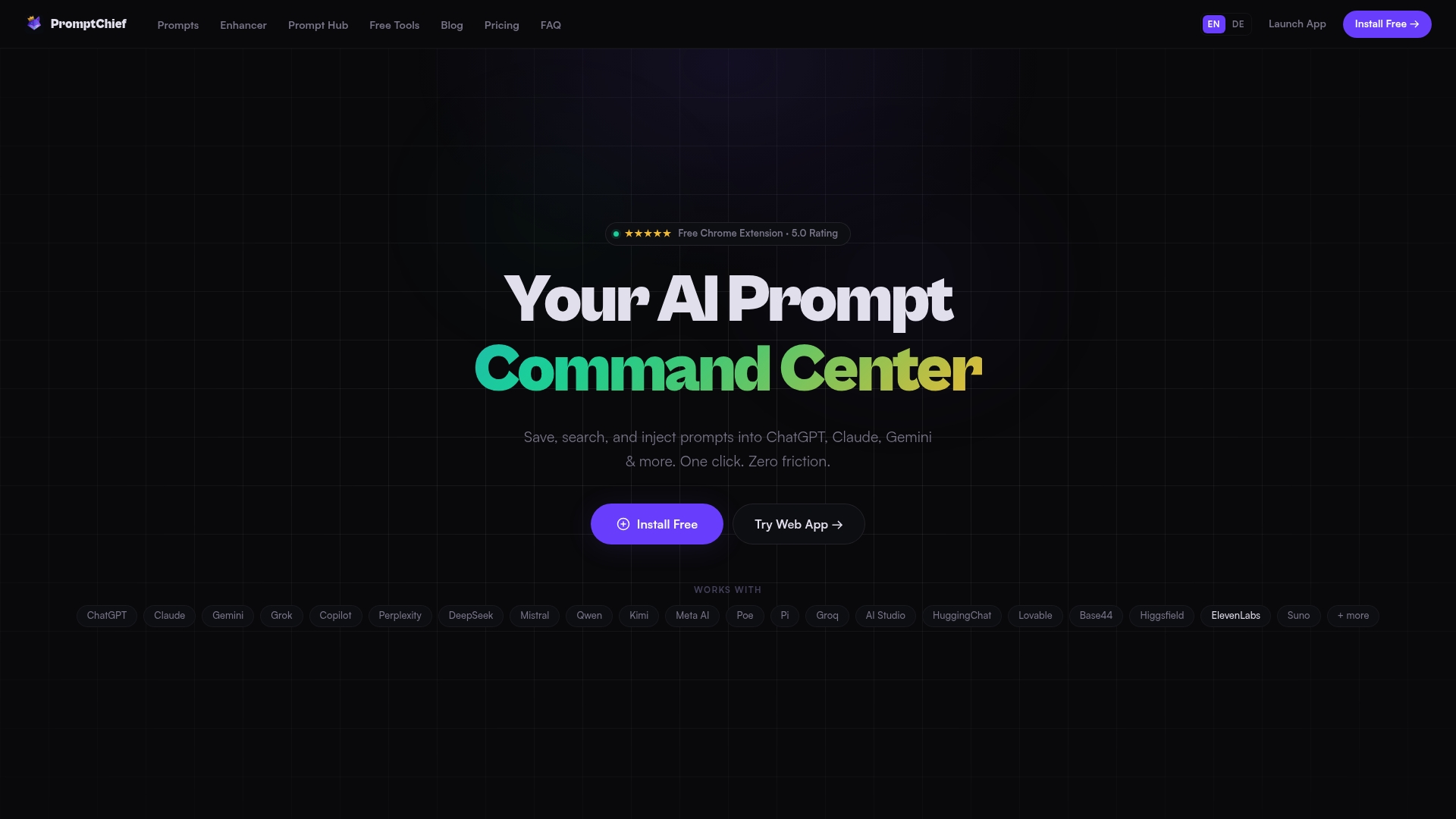
Once you know which prompt families drive savings, the hard part becomes keeping every version organized enough to keep measuring them. We built PromptChief as a cloud-synced library where templates, prompt chains, and team workspaces stay attached to the same baseline you tested against, so re-running an eval harness after a model update doesn't mean hunting through old chat logs. Analytics surface which prompts get reused most, a signal for where the next optimization sprint will pay off fastest. Start with our free plan or compare Plus and Pro pricing to see which tier fits your team's workflow.
FAQ
How can ROI be measured?
ROI is measured using the standard formula: (benefits minus costs) divided by costs, multiplied by 100, as described by Harvard Business School Online. For prompt work specifically, benefits include time saved, token cost reduction, and KPI improvements, while costs include engineering hours and test-phase token spend.
How to evaluate your prompt?
Build an eval harness of 50 to 200 labeled examples, run both the old and new prompt versions against it, and compare pass rates before any production rollout, a method DataStudios recommends for catching regressions early. Staged rollout with a rollback condition adds a second layer of safety once the harness passes.
How to measure AI ROI?
Measuring AI ROI at the organizational level combines cost tracking (tokens, infrastructure, engineering time) with outcome tracking (conversion lifts, time saved, error rates). The 2025 AI Index Report notes that most organizations using AI in 2024 reported cost savings under 10% in service operations, which sets a realistic benchmark for early-stage estimates.
Is a 20% ROI good?
Compare any reported percentage against net, not gross, savings before judging it.
Should I worry about model downgrades hurting ROI?
Yes. Switching to a cheaper model without running it through an eval harness first is one of the most common ways teams overstate savings, since a lower-cost model can quietly reduce approval rates or conversions. The NIST Generative AI Profile recommends measurement thresholds specifically to catch this kind of trade-off before it reaches production.
Sources
- 2025 AI Index Report (Stanford HAI)
- How to calculate ROI for a project (Harvard Business School Online blog)
- Prompt ROI: how to measure the real value of prompt engineering in AI workflows (DataStudios)
- Prompt Engineering ROI Calculator (RevenueLab)
- Artificial Intelligence Risk Management Framework: Generative AI Profile (NIST)