
A community prompt hub is a shared online library where people save, tag, fork, and rate AI prompts so others can find and reuse them instead of starting from scratch. It solves a real problem: rebuilding the same ChatGPT or Claude prompt from memory every week. The best hubs, including PromptChief's own community library, let you discover working prompts fast, adapt them to your model, and manage your personal collection alongside what the crowd contributes.
TL;DR:
- Community prompt hubs improve experimentation speed by providing quick access to tested prompts, reducing the need to create from scratch repeatedly.
- Effective hubs include features like version control, semantic search, consistent tagging, and multi-model compatibility to enhance usability and adaptability.
- When selecting a hub, ensure it supports search accuracy, proper permission controls, prompt export options, and resolves privacy concerns for team use.
- Trustworthy communities display prompt ratings, edit histories, and example input-output pairs, which aid in assessing prompt quality and reproducibility.
- Public prompts should be used cautiously, as performance can vary across models, and privacy issues may arise with sensitive data; personal libraries and careful evaluation help mitigate risks.
Table of Contents
- What Does a Community Prompt Hub Actually Do?
- What Features Should a Prompt Hub Actually Have?
- How Do You Choose the Right Community Prompt Hub?
- How Do You Get Started With a Prompt Hub?
- What Makes a Prompt Community Worth Trusting?
- Why Collaborative Hubs Beat Solo Prompt Files
- Get a Working Prompt Library Without Starting From Zero
- Sources
- FAQ
What Does a Community Prompt Hub Actually Do?
At its core, a community prompt hub is a searchable, centralized repository. Instead of scattering prompts across notes apps, Slack threads, and half remembered Google Docs, everything lives in one place, tagged and indexed so you can find it in seconds.
The benefit shows up fastest in experimentation speed. When someone has already published a working prompt for turning meeting transcripts into action items, you fork it instead of drafting from zero. Collaborative prompt engineering research backs this up directly: public sharing and community feedback loops help both newcomers and experienced prompt writers iterate faster, because you're refining someone else's tested starting point rather than guessing blind.
There's also a cost angle most people overlook. Verbose, poorly structured prompts burn tokens for no reason. Platforms with built-in optimization tools can cut prompt costs by up to 70% by trimming unnecessary verbosity, which matters a lot once you're running prompts at volume across a team.
A well organized hub delivers on a few fronts:
- Centralized, searchable prompt storage instead of scattered files
- Faster iteration through forking proven examples rather than drafting cold
- Lower token spend through rewrite and optimization tools
- Multi-model tags (GPT-4, Claude, Llama) that cut down on trial-and-error when a prompt behaves differently across platforms
That last point deserves attention. A prompt tuned for one model often underperforms on another, and clear model tagging saves you from finding that out the hard way mid-project.
What Features Should a Prompt Hub Actually Have?
Not every prompt library is built the same way, and the gaps show up once you're relying on one daily. Here's what separates a genuinely useful hub from a glorified bookmark folder.
Versioning and forking. When someone improves a prompt, you want to see what changed and why, not just inherit a mystery edit. Projects that maintain version-controlled repositories with edit histories let you trace a prompt's evolution and roll back if a "fix" made things worse. That provenance also protects your own work when a teammate forks it and modifies it beyond recognition.

Search that actually understands intent. Fuzzy or semantic search matters more than it sounds. Typing "summarize customer feedback" should surface a prompt tagged "sentiment analysis" even if the wording doesn't match exactly.
Consistent tagging and metadata. Hubs that tag by model compatibility and use case, the way many open prompt communities do, make filtering fast instead of frustrating.
Export flexibility. Copy, download, or API access, ideally with editor and IDE integrations for developers running prompts in code.
Here's what a solid feature checklist covers:
- Versioning with visible edit history and forking
- Semantic search plus standardized tags
- One-click copy, file download, and API export
- Multi-LLM compatibility notes
- Automatic prompt rewriting or token optimization
Pro Tip: Before committing to a hub, test its search on a vague, half-remembered query. If it can't find a relevant prompt from a rough description, it'll frustrate you the moment you're in a hurry.
How Do You Choose the Right Community Prompt Hub?
The right hub depends entirely on scale. A solo writer needs fast search and a clean personal library. A ten-person marketing team needs shared folders and permission controls. An enterprise needs audit trails and data residency guarantees.
Start by matching capabilities to your actual role, not the flashiest feature list. Shared libraries built for teams often win less on discovery gimmicks and more on IDE and CLI integrations plus granular permissions, since those reduce the friction between finding a prompt and actually shipping it in production.
Run this checklist during any trial period:
- Search for a prompt using a vague, natural-language query and see what returns.
- Check whether tags are consistent or a chaotic free-for-all.
- Fork a prompt, edit it, and confirm the edit history saves properly.
- Export a prompt via copy, download, and API if available.
- Ask directly about data residency and whether shared prompts are private by default.
- Compare free-tier limits against your actual monthly usage before assuming the paid plan is necessary.
Collaboration primitives matter more than most people realize going in. Can you comment on someone's prompt? Rate it? See who forked it and how they changed it? A hub without any of that is really just a file dump with search attached.
How Do You Get Started With a Prompt Hub?
Getting functional takes less time than people expect. Here's the practical path:
- Create your account and set up your profile. If you're joining as a team, configure shared workspace access right away rather than retrofitting it later.
- Browse by tag or model. Filter for your primary use case (marketing copy, code review, customer support) and your target model.
- Run a quick A/B test. Try two similar prompts on the same task and compare outputs before committing to one.
- Fork and adapt. Take a prompt close to what you need, tweak the wording, and save your version to your personal library.
- Enable cloud sync. Install a browser extension or IDE plugin so your saved prompts follow you across devices instead of living on one machine.
Pro Tip: Don't fork ten prompts on day one and forget them. Fork two, actually use them for a week, and only then expand your library. A hoarded, unused collection defeats the purpose entirely.
This mirrors how team prompt galleries inside collaboration tools already work: save, tag, share to a channel, and let colleagues build on what you started instead of duplicating effort.
What Makes a Prompt Community Worth Trusting?
Healthy prompt communities show their work. Look for stars or upvotes on individual prompts, visible edit histories, and, ideally, example inputs and outputs attached to each entry. Public libraries that encourage input-output pairs make prompts far easier to reproduce, because you can see exactly what result the author got before you run it yourself.
Good contribution etiquette means writing a short usage note (what model you tested it on, what broke, what worked) instead of dropping a bare prompt with zero context. Open communities that pair low-friction forking with lightweight reputation signals tend to surface quality faster, since bad prompts simply don't accumulate upvotes.
- Visible stars, upvotes, or ratings on each prompt
- Edit history showing how a prompt evolved
- Example inputs and outputs attached for reproducibility
- Usage notes describing model tested and known limitations
Why Collaborative Hubs Beat Solo Prompt Files
The honest case for community hubs isn't novelty, it's speed. Iterating on someone else's tested prompt beats writing cold, every time. That said, treat public prompts with reasonable skepticism: a prompt that performs beautifully on GPT-4 can flop on Claude, and privacy claims from a given platform deserve a real read before you paste anything sensitive into a shared space.
Duplication is the quiet cost nobody warns you about. Popular prompts get forked dozens of times with cosmetic tweaks, and sorting the genuinely improved versions from the copies takes judgment, not just star counts. Tools like PromptChief that combine a personal library with community discovery help here, because you're not relying on public reputation alone to separate signal from noise.
— John
Get a Working Prompt Library Without Starting From Zero
There are platforms that offer cloud sync so your saved prompts follow you across devices, fast search to actually find them again, one-click injection into multiple AI platforms, plus browser extensions that put your library one click from wherever you're typing.
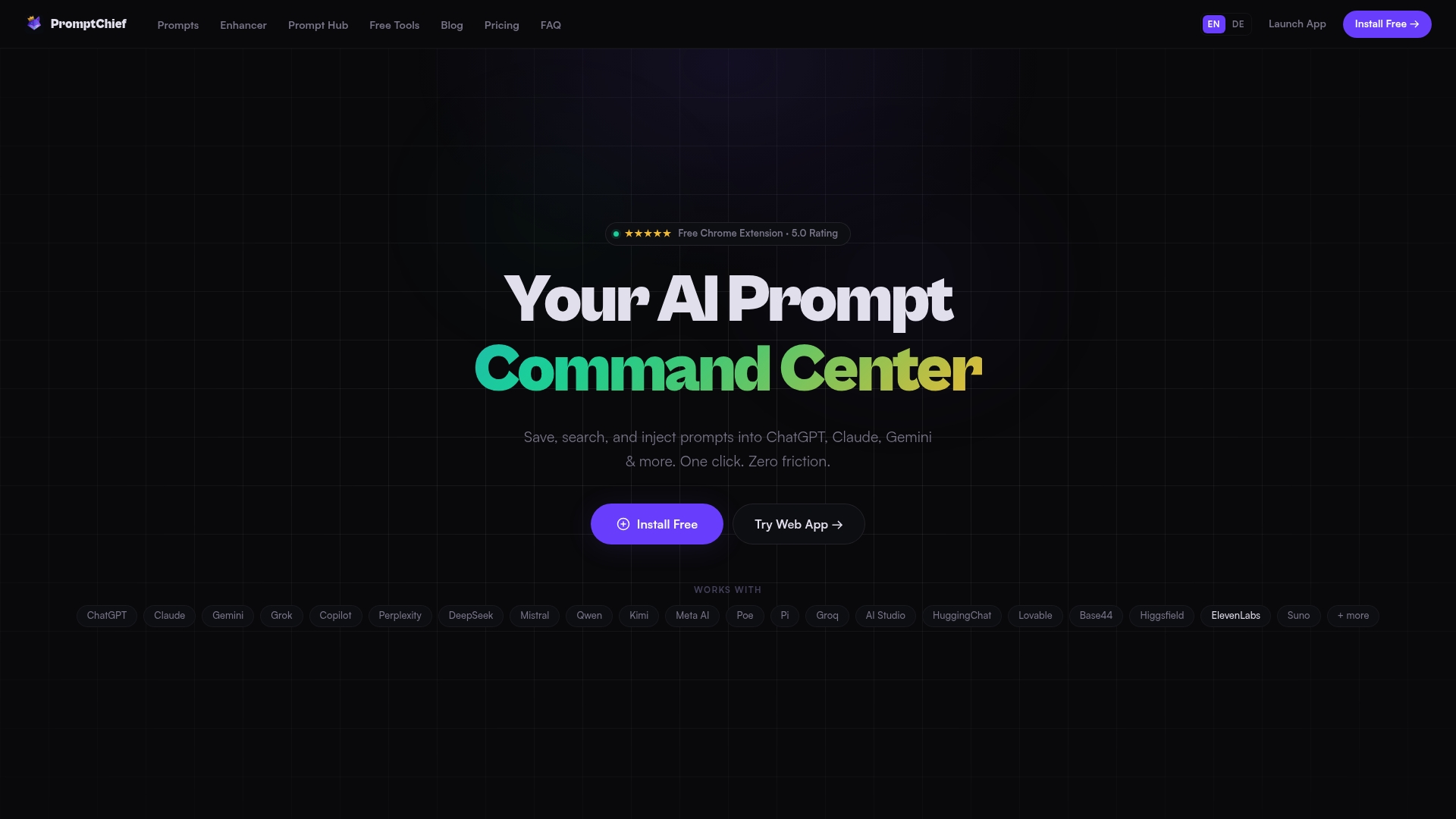
Some platforms provide shared workspaces instead of screenshot chains in Slack, which helps address coordination problems that many hubs struggle with. If you want a running start rather than a blank library, browse the ready-to-use prompt examples and fork a few into your own collection today. For a closer look at plan limits and team seat pricing, check the pricing page before you commit to anything.
Sources
- Amazon Bedrock — prompt management
- EACL 2026 demo — collaborative prompt engineering
- prompt-hub (GitHub) — Prompt Hub: The GitHub for AI Prompts
- Prompts
FAQ
What Is a Community Prompt Hub?
It's a shared, searchable online library where users save, tag, fork, and rate AI prompts so others can discover and reuse working examples instead of writing from scratch.
Are Community Prompt Hubs Free to Use?
Most operate on a freemium model. Public browsing and copying are usually free, while cloud sync, team workspaces, and higher usage limits typically sit behind a paid tier, as with PromptChief's Plus and Pro plans.
Can I Use the Same Prompts Across Different AI Models?
Not always without adjustment. A prompt tuned for GPT-4 can behave differently on Claude or Llama, which is why hubs that tag prompts by model compatibility save significant trial-and-error.
Is It Safe to Share Prompts Publicly?
It depends on the content. Avoid pasting proprietary data or client information into public prompts, and check whether the hub defaults shared prompts to public or private before uploading anything sensitive.
How Do I Organize Prompts I've Saved or Forked?
Tag consistently by use case and model, and separate your personal drafts from forked community prompts so you can track which versions you've customized. A tool like PromptChief's prompt management dashboard handles this organization automatically through folders and tags.