
Default to a chain or workflow. Reach for an agent only when the sequence of steps genuinely cannot be known in advance, and even then, keep that agent boxed inside a deterministic shell rather than letting it run the whole show.
That's the rule most experienced teams converge on once they've shipped a few of these systems: prefer deterministic solutions first, and introduce autonomy only where essential. Agentic workflows, the hybrid where a coded structure delegates one narrow, unpredictable piece to an LLM loop, are the pattern that actually survives contact with production, according to engineering analysis comparing agents and workflows.
Here's the quick test before you write a line of code:
- Can you draw the process on a whiteboard, box by box, before you start? If yes, build a chain or workflow.
- Is there one specific step where the right action depends entirely on what a previous step returned, and that dependency can't be reduced to a few branches? If yes, isolate an agent for that one subproblem, not the whole pipeline.
- Are you unsure? Start with a chain anyway. You can escalate later; you can't easily de-escalate a runaway agent.
Pro Tip: Before adding any agent, write down the guardrails first: max iterations, a token budget, and a timeout. If you can't state those three numbers, you're not ready to add autonomy yet.
Key Takeaways
Chains and workflows win on cost, auditability, and testability; agents earn their complexity only for the specific subproblem where the next step truly can't be predetermined.
| Point | Details |
|---|---|
| Default to chains | Start with a fixed sequence or workflow; escalate to an agent only for steps with unknowable order. |
| Cost multiplies with autonomy | Agent loops call the model repeatedly at runtime, driving up cost and latency compared to fixed-step chains. |
| Errors compound across turns | Reliability drops fast over many iterations, so shorter, deterministic paths are inherently more dependable. |
| Bound every agent | Set iteration caps, token budgets, and timeouts before deploying any agent loop, not after. |
| Use versioned prompts | Promptchief's prompt chains and cloud sync let teams test, roll back, and share bounded agent prompts fast. |
Table of Contents
- Chain vs Agent Workflows: What Each Term Actually Means
- Predictability, Cost, and Reliability Tradeoffs
- Building Blocks: Chaining, Routing, and the Rest
- How to Choose: A Decision Checklist for Your Next Build
- Running These Systems Safely in Production
- A Hybrid in Practice: Deterministic Shell, Bounded Agent Core
- Why Promptchief Fits This Architecture
- The Real Lesson Behind Chain vs Agent Workflows
- Sources
- FAQ
Chain vs Agent Workflows: What Each Term Actually Means
The terms get used loosely online, so here's how they actually differ at the code level.
- Chain. A fixed, linear sequence of LLM or tool calls where the order never changes at runtime. A document pipeline that translates, then summarizes, then formats to Markdown is a chain: step 2 always follows step 1, no exceptions, no branching.
- Workflow. A directed graph, often with branches, where your code decides the routing based on rules or a lightweight classifier. A support-ticket system that classifies intent, then routes to a billing handler, a technical handler, or a human escalation path is a workflow. The LLM might do the classifying, but your code owns the branching logic.
- Agent. An LLM-driven loop where the model itself picks the next tool call, evaluates the result, and decides what to do next, with no predetermined path. A travel assistant that has to research flight options, compare prices across sites, and rebook if a flight sells out mid-search is closer to a true agent problem, because the number of steps and their order depend on what it finds along the way.
The distinguishing question, and it's the one worth pinning to your desk, is: who picks the next step? In a chain, you do, at write time. In a workflow, your code does, at run time, using rules you defined. In an agent, the model does, at run time, using its own judgment. LangChain's documentation on workflow and agent primitives frames this same distinction as the core design decision behind every pattern it ships.
That single axis, control location, drives almost every downstream tradeoff in cost, testability, and risk that follows.
Predictability, Cost, and Reliability Tradeoffs
Control location determines how auditable your system is. A chain's execution path is fixed, so you can log it, replay it, and diff two runs against each other. A workflow adds branches, but each branch is still something you wrote and can unit test. An agent's path is decided by the model at runtime, which means two runs on identical input can take different routes, call different tools, and produce different token counts, a tradeoff that increases flexibility at the direct cost of predictability.
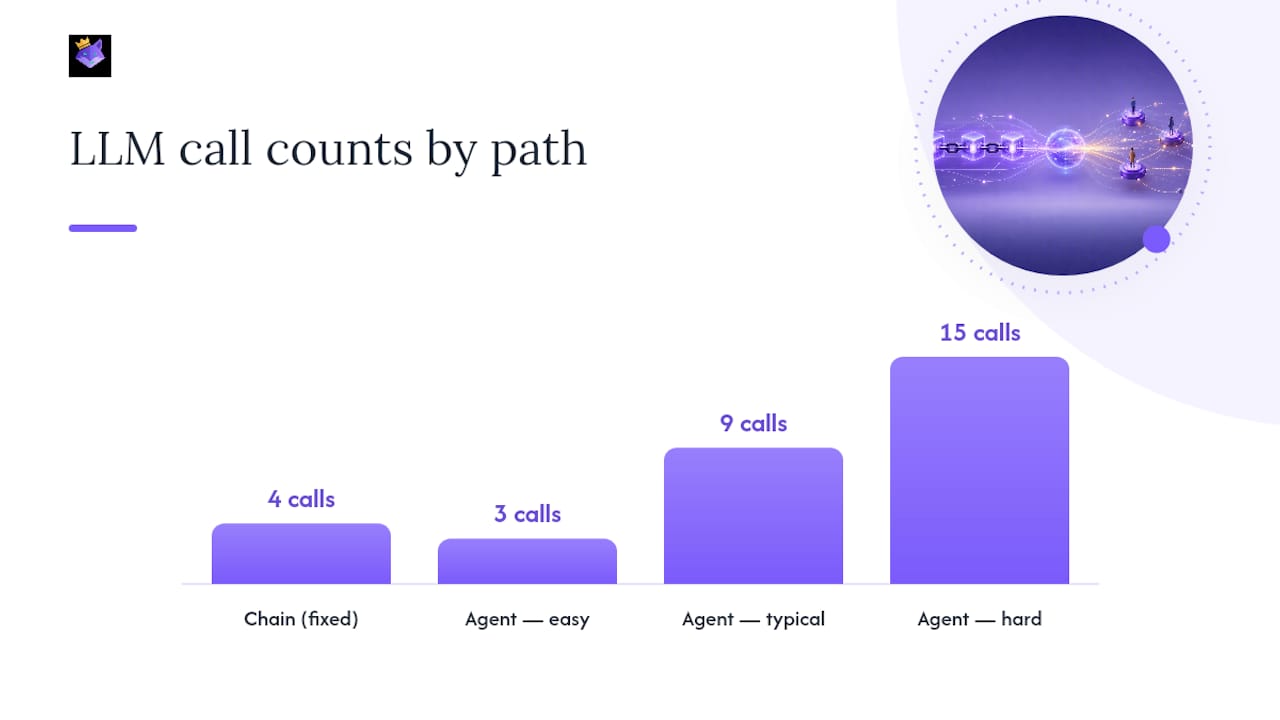
That unpredictability shows up first in your bill. A chain with four fixed steps costs four LLM calls, every time, no matter the input. An agent solving the same problem might take three calls on an easy input and fifteen on a hard one, because it re-plans, retries, and second-guesses itself as it goes. Each of those calls also adds latency; a fifteen-call agent loop is not just more expensive than a four-step chain, it's also slower by whatever your average per-call latency is, multiplied out.
Reliability compounds in the same direction. If a single step succeeds 95% of the time, a four-step chain with independent steps still succeeds a little over 81% of the time end to end. Push that same 95% reliability across fifteen agent turns and the math turns ugly fast, which is exactly why compounding error across iterations is one of the sharper arguments for keeping loops short. Fewer turns isn't just cheaper. It's the difference between a system you can trust and one you have to babysit.
Observability follows the same split:
- Chains and workflows support step-level testing: you can assert on the output of step 2 in isolation, the way you'd unit test any function.
- Agents need end-to-end, goal-based evaluation instead, because there's no fixed "step 2" to assert against; you're scoring whether the final outcome met the goal, not whether any particular intermediate call looked right.
Pro Tip: If your team can't explain, in one sentence, why a specific run took the path it took, you've already lost auditability. That's your signal to pull logic back into code.
Building Blocks: Chaining, Routing, and the Rest
Most systems don't need a single grand architecture. They need the right primitive for each piece, stitched together.
- Prompt chaining breaks one big task into sequential calls, each validated before the next fires. A content pipeline that drafts, then fact-checks, then edits for tone works well here, and you should hard-gate each handoff with a quick output check rather than trusting the model to self-report success. Promptchief's own prompt chains feature is built around exactly this pattern for multi-step tasks like code review.
- Routing puts a lightweight classifier in front of your handlers so cheap, common requests hit a fast, cheap model while complex ones escalate to a stronger, pricier one. This is one of the most underused cost levers in production systems: most incoming requests are routine, and paying frontier-model prices for all of them is waste.
- Parallelization fans a task out to multiple calls at once, then aggregates. Summarizing twenty documents by running twenty concurrent calls and merging the results is far faster than a serial chain, provided the sub-tasks are genuinely independent.
- Orchestrator-worker patterns have a central coordinator break a task into subtasks and hand them to specialized workers, bounding each worker's scope tightly so it can't wander.
- Evaluator-optimizer loops pair a generator with a critic that scores and requests revisions, useful when quality matters more than speed, but you need a hard cap on revision rounds or it never stops.
- Multi-agent coordination, several agents negotiating or dividing labor, carries the highest coordination cost and the least predictability of any pattern here. Reserve it for cases where a single agent demonstrably can't hold the whole context, not by default.
Most production systems described across the industry end up as workflows, or workflows with a bounded agent step, not pure multi-agent systems. That's not a limitation. It's what actually ships.
How to Choose: A Decision Checklist for Your Next Build
Treat architecture selection as an escalation ladder, not a single upfront decision. Start with the simplest structure that could work, and only add complexity where the simpler structure genuinely fails:
- Single call. One prompt, one response. Try this first, always. Most tasks that feel like they need an "agent" actually need a better prompt.
- Chain. Fixed sequence of calls. Escalate here when one call can't reliably do the whole job in one pass.
- Workflow. Add branching once you have genuinely different paths, not just different phrasing of the same path.
- Bounded agent. Isolate a loop inside your workflow only for the one subproblem where the step count can't be predetermined, research depth, tool selection, or multi-turn negotiation with an external API.
- Full agent. Reserve for cases where nearly the entire task is unpredictable start to finish. This is rare in production and rarer than most teams think.
Run through this checklist before writing code:
- Does this need to be auditable for compliance or debugging? Favor workflows.
- Is your cost or latency budget fixed per request? Favor chains, since their call count is predictable.
- What's the acceptable failure mode if something goes wrong: a wrong answer, a stuck loop, or a real-world side effect (a purchase, an email sent, a file deleted)? The riskier the failure, the more you want deterministic code between the model and the action.
- Can you write a unit test for each step? If yes, that step belongs in a chain or workflow, not an agent loop.
Three quick scenario mappings show how this plays out. A resume-screening pipeline is a workflow: parse, extract fields, score against criteria, route to a human for borderline cases. Nothing here is genuinely unpredictable, so a workflow gives you full auditability. A research-and-book travel task needs a bounded agent, because the number of searches, comparisons, and rebooking attempts can't be fixed ahead of time, but wrap it in a workflow shell that enforces a search cap and requires human confirmation before payment. A coding assistant that edits files and runs tests is usually an agentic workflow: a workflow manages the file diff and test run cycle deterministically, while a bounded agent loop handles the actual code generation and self-correction within a capped number of attempts.
Pro Tip: Set your iteration cap before your first test run, not after your first runaway bill. A cap of 5 to 8 tool calls handles the overwhelming majority of bounded-agent subtasks without starving genuinely hard cases.
Running These Systems Safely in Production
Chains and workflows test the way normal software tests: write unit tests for each step, assert on expected output shapes, and run them in CI like anything else. Agents need a different harness entirely, one that scores whether the final goal was met across a batch of varied inputs, because there's no single "correct" intermediate step to assert against. Run agent evaluations at volume, not one-off, since a single successful run tells you almost nothing about the failure rate at scale.

Observability has to be built in from day one, not bolted on. Trace every tool call, keep durable state so you can replay a run exactly, and design side effects to be reversible wherever possible; a booking agent that can cancel is a very different risk than one that can't.
Cost control comes down to a short list of concrete levers:
- Cache repeated calls and retrieval results instead of re-fetching identical context every run.
- Use retrieval (RAG) to pull in only the context a step needs, instead of stuffing full history into every prompt.
- Set explicit token budgets and iteration caps per agent loop, a control that industry guidance treats as close to mandatory once autonomy enters the system.
- Throttle concurrent agent runs at the scheduler level so a burst of traffic doesn't multiply your cost curve unexpectedly.
Memory strategy matters just as much. Long, unpruned conversation histories quietly inflate both cost and error rate, since the model has to re-parse everything on every turn. Prune aggressively, and prefer targeted retrieval over dumping full history into context.
Finally, separate side effects from judgment. Keep anything irreversible, a database write, a payment, a sent email, inside deterministic workflow code with explicit checks, and let the agent only propose actions that a validator or a human gate can approve before they execute.

Pro Tip: Route every agent's proposed action through a validation step before it touches anything real. The agent decides what to try; your code decides whether it's allowed to happen.
A Hybrid in Practice: Deterministic Shell, Bounded Agent Core
Picture a document-processing pipeline: a workflow handles intake, classification, and formatting, all deterministic, while a single bounded agent step handles messy, unstructured extraction from scanned invoices where the fields and formats vary too much to hardcode.
- The workflow shell owns routing, retries, and output validation.
- The agent step is capped at a handful of tool calls and a fixed token budget.
- Prompt versioning and reusable prompt chains let the team roll back a bad extraction prompt in seconds instead of redeploying code.
Teams that treat prompts as versioned, shareable assets rather than throwaway strings cut iteration time on bounded agent steps dramatically, because a failed extraction prompt can be rolled back or swapped without touching the surrounding workflow code at all.
That separation, code owns structure, prompts own judgment, and both are managed like the software artifacts they actually are, is what keeps agentic workflows testable instead of fragile.
Why Promptchief Fits This Architecture
Every hybrid pattern in this article leans on one thing: prompts you can version, test, and roll back without touching your workflow code. That's the exact gap Promptchief closes. Instead of a bounded agent's extraction prompt living as a hardcoded string buried in a Python file, it lives in a searchable library you can update, compare against a previous version, and sync across your team instantly.
For developers running the escalation ladder described above, single call to chain to workflow to bounded agent, the friction point is almost always iteration speed on that last agent prompt. Promptchief's multi-step prompt chains let you build and test the sequential logic behind a chain step directly, while cloud sync means the same tested prompt is available whether you're debugging locally or deploying from a teammate's machine. If your extraction prompt drifts and needs a fix at 2 a.m., you're editing one entry in a shared library, not hunting through a codebase.
Start by browsing ready-to-use prompt examples built for exactly this kind of bounded, testable agent step, and see how much faster iteration gets once your prompts stop living in scattered text files.
The Real Lesson Behind Chain vs Agent Workflows
The industry's obsession with "agentic" everything gets the emphasis backward. Most teams that jump straight to a full agent aren't solving a harder problem; they're solving an ordinary problem with a harder tool, and paying for it in cost, latency, and debugging hours they didn't budget for.
The more useful mental model is that "agent" isn't an architecture, it's an escape hatch you reach for when a workflow genuinely can't express your logic. Treat it that way and you'll build fewer, smaller agent loops, each one boxed tightly inside code you can test. That's the part conventional advice glosses over: the hard engineering work isn't building the agent, it's building the deterministic shell disciplined enough to contain it.
The prompt layer is where teams underinvest the most relative to how much it costs them in iteration speed. A bounded agent step is only as reliable as the prompt driving it, and prompts that live as untracked strings scattered across a codebase turn every fix into a deploy. Version them, test them, share them. The architecture debate matters, but the prompt discipline underneath it is what actually determines whether your hybrid system holds up under real traffic.
Sources
- Agents vs workflows
- Agents vs Workflows vs Chatbots: Key Differences | AI/TLDR
- Chains vs Agents: Choosing the Right Architecture for Your AI App
- Agents vs Workflows
- Workflows and agents - Docs by LangChain
FAQ
What is the difference between a chain and an agent?
A chain runs a fixed sequence of steps you defined ahead of time; an agent decides its own next step at runtime based on what previous steps returned.
What's the difference between an agent and a workflow?
A workflow branches based on rules or logic your code controls, while an agent's branching decisions are made by the model itself as it runs, with no fixed path.
Is ChatGPT an agent or LLM?
ChatGPT is a large language model that can be wired into agent-style behavior with tools and looping logic, but on its own it isn't an autonomous agent, it's the model an agent or workflow calls.
What is an agent workflow?
An agent workflow, more precisely an agentic workflow, is a hybrid pattern where a deterministic workflow shell handles structure and routing while a bounded agent loop handles one genuinely unpredictable subproblem inside it.
When should I avoid agents entirely?
Avoid agents whenever you can draw the full sequence of steps ahead of time; a chain or workflow will be cheaper, faster, and easier to audit for that same task.