
The most reliable way to reduce AI hallucinations is layered defense: pair retrieval-augmented generation with explicit uncertainty instructions, conservative decoding settings, and continuous monitoring, rather than betting on any single fix. Start today by dropping temperature to 0.0–0.3 for factual tasks and adding a plain "say you don't know" instruction to your system prompt. Then layer in retrieval and monitoring over the following weeks.
TL;DR:
- Implement layered defenses combining retrieval-augmented generation, explicit uncertainty instructions, and conservative decoding settings for the most reliable hallucination mitigation.
- Lowering temperature to 0.0–0.3 and adding "say you don't know" prompts can significantly reduce factual and citation hallucinations in production.
- Ground retrieval responses in verified documents and handle empty retrieval results explicitly to prevent ungrounded or unsupported answers.
- Regularly measure hallucination rates using metrics like groundedness and relevance scores through sampling, and enforce continuous monitoring and regression testing.
- Use version control and structured prompt templates to prevent prompt drift, which is a common source of regressions and hallucination resurgence.
Table of Contents
- What Actually Causes AI Hallucinations?
- Why Does Layered Defense Beat Single-Point Fixes?
- How Do You Write Prompts That Prevent Hallucinations?
- Does RAG Actually Stop Hallucinations?
- What Decoding Settings Reduce Invented Facts?
- When Should You Fine-Tune Instead of Just Prompting?
- How Do You Measure Hallucination Rate in Production?
- What Should Be on Your Pre-Launch Hallucination Checklist?
- How Prompt Management Reduces Hallucination Risk in Practice
- What Governance Actually Keeps Hallucinations in Check?
- Try PromptChief to Keep Your Mitigation Prompts Consistent
- Sources
- FAQ
What Actually Causes AI Hallucinations?
Large language models don't "lie." They predict the next token based on probability, and that mechanism has no built-in concept of truth. A model will generate a fluent, confident-sounding citation for a paper that doesn't exist because the token sequence looks statistically plausible, not because it's trying to deceive anyone. Understanding this mechanism is the first step toward fixing it, because each root cause points to a different fix.
Four structural problems drive most hallucinations you'll see in production:
- Next-token prediction limits: the model optimizes for plausible continuations, not verified facts, so anything outside its training distribution gets filled in with a best guess.
- Training-data noise and coverage gaps: contradictory sources, outdated facts, and thin coverage of niche domains leave holes the model papers over with invented detail.
- Context drift and "lost-in-the-middle" effects: as prompts grow longer, models weight the beginning and end of the context more heavily, letting critical instructions buried in the middle get ignored.
- Prompt corruption: ambiguous phrasing, conflicting instructions, or leftover boilerplate from a previous version of a prompt can quietly push the model toward the wrong answer.
A lifecycle-based survey of hallucination research groups these into pretraining problems (what the model learned) and post-training problems (how it's prompted and deployed). That distinction matters for engineering, because you fix a coverage gap differently than you fix a context-drift problem.
It's also worth categorizing hallucinations by type, since your mitigation strategy should match the failure mode:
- Factual hallucinations: the model states something false as fact, such as a wrong date or nonexistent product feature.
- Reasoning hallucinations: the logic chain breaks down even when individual facts are correct, common in multi-step math or planning tasks.
- Citation hallucinations: the model invents a source, DOI, or URL that sounds real but doesn't exist.
- Code hallucinations: the model references a library function, API, or parameter that was never implemented.
- Entity hallucinations: the model confuses or merges two real entities, like attributing a quote to the wrong researcher.
Factual and citation hallucinations respond well to retrieval and verification. Reasoning hallucinations need chain-of-thought and self-critique. Code hallucinations need sandboxed execution. Treating all five as one problem is why so many mitigation efforts stall out.
Why Does Layered Defense Beat Single-Point Fixes?
No single technique gets hallucination rates near zero on its own. A multi-layered mitigation framework built for high-stakes applications combines three layers, each covering the failure modes the others miss.
- Prompt layer: system-level instructions, constraints, and explicit uncertainty fallbacks that shape what the model attempts to answer and how it hedges when it isn't sure.
- Architectural layer: retrieval-augmented generation, metadata filtering, and reranking that ground responses in verified external documents instead of parametric memory alone.
- Behavioral layer: fine-tuning and RLHF that reward conservative, well-calibrated answers over confident guessing, adjusting the model's underlying tendencies rather than just its inputs.
A typical production flow moves through all three: a user query hits your system, gets routed to a retriever if it's a factual question, gets wrapped in a prompt template with your constraints and the retrieved context, goes to the model, then passes through a verifier that checks groundedness before the answer reaches the user. Low-confidence or ungrounded answers escalate to a human reviewer or a safe fallback response instead of shipping straight through.
The reason this works better than any single fix is straightforward: each layer catches a different failure mode. Prompt constraints stop the model from answering outside its lane. RAG stops it from relying on stale parametric memory. Behavioral tuning stops it from defaulting to confident guessing when it should hedge. Defense-in-depth guidance from industry practitioners makes the same case: stacking imperfect defenses reduces the odds that any one gap reaches the user. Skip a layer, and you're betting the whole system on the layer you kept.
How Do You Write Prompts That Prevent Hallucinations?
The ICE pattern, Instructions, Constraints, Escalation, gives you a repeatable structure for prompts that resist hallucination. Instructions tell the model what to do. Constraints tell it what not to do and how to handle uncertainty. Escalation gives it an explicit off-ramp, an "I don't know" fallback, instead of forcing a guess.
That escalation clause matters more than most teams realize. Models are trained to be helpful, and "helpful" often gets interpreted as "always produce an answer." Without an explicit permission to say "I don't have enough information," the model will often manufacture one rather than leave a blank. A single line like "If you cannot verify this from the provided context, say so explicitly" measurably changes model behavior in practice, according to Microsoft's best-practices guidance for mitigating LLM hallucinations.
Placement inside the prompt matters as much as wording. IBM's guidance on prompt caching recommends putting invariant instructions, the rules that never change, at the top of the system prompt, and mutable content like user queries or retrieved documents toward the end. This isn't just an organizational habit. It preserves cache hit rates (since the model provider can cache the stable prefix) and reduces the odds that "lost-in-the-middle" attention effects bury your critical constraints in the noise of a long context window.
A few operational patterns worth adopting:
- Repeat your single most critical constraint (say, "never invent a citation") near the end of the prompt as well as the beginning, since recency bias helps reinforce it.
- Use chain-of-thought prompting for multi-step reasoning tasks, then add a self-critique pass where the model checks its own answer against the retrieved context before finalizing it.
- Version every production prompt in source control, the same way you'd version code, so a "quick fix" pushed by one engineer doesn't silently break behavior for everyone else.
- Treat prompt patches as regression-tested changes: run your evaluation set against the old and new prompt before shipping.
Structured templates like the ICE-based approach in PromptChief's practical guide to reducing hallucinations give teams a starting point instead of reinventing the wheel with every new prompt.
Pro Tip: Keep a "known bad" test set of prompts that historically triggered hallucinations in your app. Run it against every prompt change before deployment. It catches regressions that a general benchmark will miss.
Does RAG Actually Stop Hallucinations?
Retrieval-augmented generation reduces factual hallucinations by grounding answers in retrieved documents instead of the model's internal parametric memory, but it does not eliminate reasoning errors. A model can retrieve the correct source and still draw the wrong conclusion from it, or contradict the retrieved text outright. RAG fixes "the model doesn't know this," not "the model can't reason about this."
A clinical evaluation of a cancer-information chatbot found that grounding responses in retrieved medical sources measurably cut hallucinations, but the study also flagged a real trade-off: tightening fidelity to sources sometimes narrowed the range of questions the system could confidently answer at all. More grounding means less coverage unless you invest in a bigger, cleaner document set. That trade-off should shape how aggressively you tune your retrieval thresholds for a given use case.
Getting the engineering right requires attention to several specific settings:
- Chunking strategy: chunks that are too large dilute relevance scoring; chunks that are too small lose context at boundaries and can cut a fact in half.
- Top-k and similarity thresholds: a tutorial on layered hallucination mitigation recommends top-k around 5 with similarity thresholds in the 0.7 to 0.85 range for high-risk production domains, adjusted based on how dense your document corpus is.
- Metadata filtering: filter by document date, source authority, or category before ranking, so an outdated or low-trust document never even enters the candidate pool.
- Reranking: a second-pass reranker catches cases where the initial vector similarity search returned topically related but factually irrelevant chunks.
- Provenance capture and citation forcing: require the model to cite the specific chunk it drew from, which both improves user trust and gives you an audit trail when something goes wrong.
Getting RAG operational details right is what separates a demo from a production system, and technical patterns for combining RAG with prompt templates are worth studying in depth if you're building this yourself.
The coverage vs. fidelity trade-off: tightening grounding to reduce hallucinations in the cancer-chatbot study above came with a measurable narrowing of what the system could confidently address, a pattern worth expecting whenever you tune retrieval for stricter factual accuracy.
One case gets missed constantly: what happens when retrieval comes back empty. If your retriever finds nothing relevant and your prompt doesn't explicitly handle that, the model will frequently answer from parametric memory anyway, quietly reintroducing the exact hallucination risk you built RAG to prevent. Handle "no result" as its own branch: return a fallback message, route to a human, or explicitly tell the model "no relevant documents were found, so state that you cannot answer" rather than letting it fill the gap on its own.
A domain data provider like Nausika's maritime data feeds illustrates the broader principle: grounding is only as good as the external source behind it, so vetting your retrieval corpus matters as much as tuning the retrieval algorithm.
What Decoding Settings Reduce Invented Facts?
Temperature controls how much randomness the model injects into its token choices, and for factual tasks, lower is almost always better. A temperature between 0.0 and 0.3 makes the model consistently choose its highest-probability tokens, cutting down on the creative leaps that produce invented names, numbers, and citations. Save higher temperatures, 0.7 and above, for creative writing or brainstorming tasks where variation is the point, not the risk.
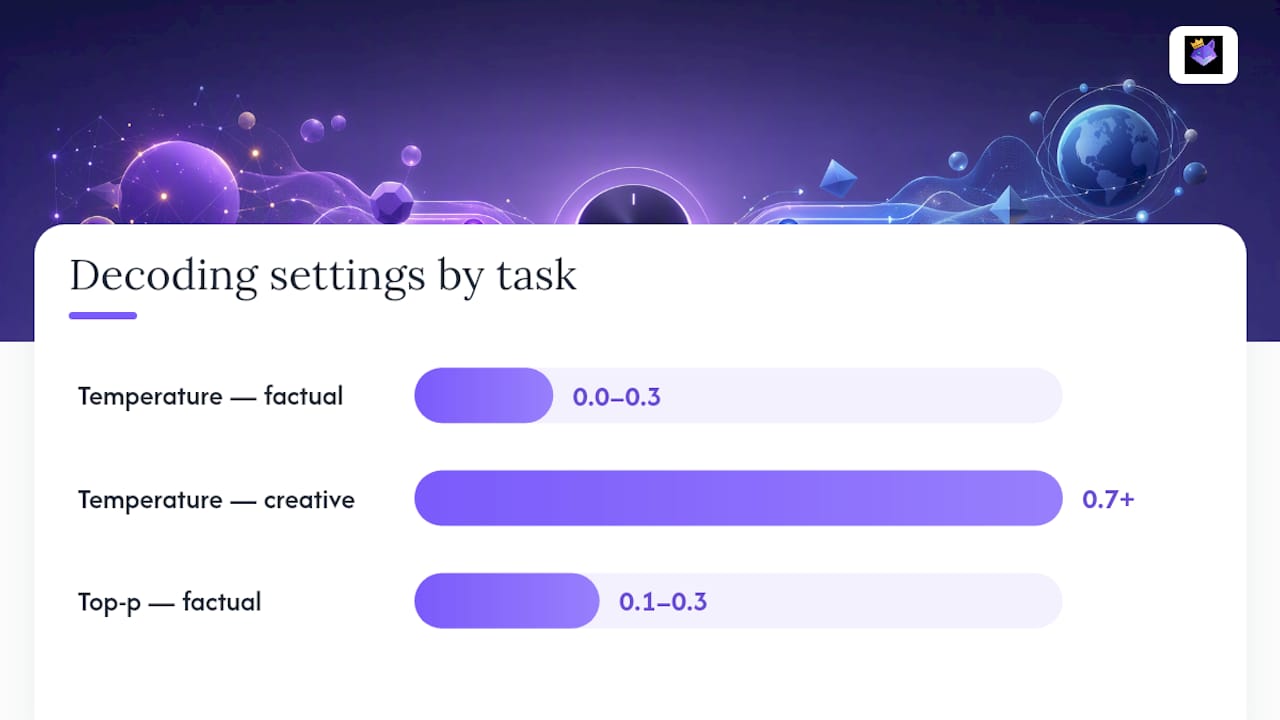
Top-p (nucleus sampling) and top-k work alongside temperature to shape the candidate pool the model draws from at each step. For factual or code-generation tasks, a narrow top-p (around 0.1 to 0.3) combined with low temperature keeps the model tightly focused on its most confident predictions. For open-ended tasks, widening both settings restores useful variety. There's no universal "correct" setting. Match it to what the task actually needs.
Decoding controls only get you partway there. Automated post-processing checks catch what slips through:
- Schema enforcement: require structured outputs (JSON, typed fields) so a hallucinated field is a validation failure the system catches automatically, not a silent error a user has to spot.
- Null handling: explicitly allow "null" or "unknown" as valid schema values, so the model has a legitimate way to express uncertainty instead of fabricating a plausible-looking value to fill the field.
- Numeric sanity checks: bound-check generated numbers against expected ranges, since an LLM will happily generate a percentage over 100 or a date decade in the future.
- DOI and URL existence verification: programmatically resolve any citation or link the model generates before showing it to a user, since invented citations are one of the most common and most damaging hallucination types.
- Sandboxed execution for code: run generated code in an isolated environment and pair it with static analysis before treating it as trustworthy, catching hallucinated library calls that look syntactically fine but reference functions that don't exist.
When Should You Fine-Tune Instead of Just Prompting?
Fine-tuning changes the model's underlying behavior instead of just its inputs, and it's the right call when you have a narrow, high-volume domain where curated data exists and prompt engineering keeps hitting a ceiling. Training on a clean, domain-specific dataset, verified legal contracts, vetted medical literature, your own product documentation, teaches the model the patterns of your domain directly, reducing the odds it reaches for a generic, sometimes wrong, answer from its broader training data.
RLHF (reinforcement learning from human feedback) takes this further by shaping reward signals to explicitly favor factual correctness and conservative, hedged answers over confident guessing. A model trained with reward signals that only reward "sounding helpful" will learn to guess. A model trained with reward signals that also penalize unfounded confidence learns to hedge appropriately, which is exactly the behavior you want for high-stakes applications.
Neurosymbolic approaches and knowledge injection sit at the more experimental end of this spectrum. Techniques like FactLLaMA and Self-Checker, described in the lifecycle survey of hallucination mitigation approaches, inject structured facts or verification steps directly into the generation or post-processing pipeline. These trade implementation complexity for tighter factual control, and they're generally worth the investment only once simpler layers, prompting and RAG, have been exhausted.
The practical decision rule is simple: reach for retrieval when your facts change often or your domain is broad, since retraining can't keep pace with a knowledge base that updates weekly. Reach for fine-tuning when your domain is narrow, stable, and you have quality labeled data, since that's where retraining actually pays off in speed and consistency at inference time. Most production systems end up needing both, but in that order of investment.
How Do You Measure Hallucination Rate in Production?
You can't manage what you don't measure, and hallucination rate isn't a single fixed number. It shifts with every model update, every prompt change, and every shift in the questions users actually ask. The 2026 AI Index's responsible AI commentary makes the point directly: rates measured once at launch tell you almost nothing about rates six months later, after the underlying model has been silently updated by the provider.
Four metrics form a baseline measurement plan for most production systems:
| Metric | What it measures | How to sample it |
|---|---|---|
| Hallucination rate | Percentage of responses containing unsupported or false claims | Weekly sampling across all traffic, plus targeted checks on high-risk paths |
| Groundedness score | How well a response's claims trace back to retrieved source documents | Automated check on every RAG response, using source-to-claim overlap |
| Relevance score | Whether retrieved documents actually matched the query intent | Sampled review of retrieval logs, especially near-miss cases |
| User trust score | Downstream signal from thumbs-up/down or correction rates | Continuous, aggregated from live user feedback in the interface |
Sampling strategy matters as much as the metric definitions. Weekly random sampling catches broad drift. Targeted sampling of your highest-risk conversation paths, the ones where a hallucination causes real harm, catches the failures that matter most but occur too rarely for random sampling to surface reliably.
LLM-as-judge, using a second model to evaluate the first model's outputs for groundedness, is a useful scaling tool but a risky single source of truth. Judge models carry their own biases and blind spots, so diversify: use more than one judge model, and route a defined percentage of judged outputs to human review, especially anything the judge flags as borderline. Set clear SLAs for escalation and alert thresholds (for example, a hallucination rate spike of more than a defined percentage over a rolling seven-day window triggers a human review of recent model or prompt changes), and run regression tests against your evaluation set before shipping any model or prompt version to production.
What Should Be on Your Pre-Launch Hallucination Checklist?
A short pre-launch checklist catches most of the avoidable failures before they reach real users. Run through it before every production deployment, not just the first one.
- Temperature set appropriately for the task, 0.0 to 0.3 for factual work, higher only where creativity is the goal.
- Explicit uncertainty instruction present in the system prompt, giving the model permission to say "I don't know."
- RAG enabled and tested for every factual query path, with a defined fallback for "no relevant document found."
- Citation policy enforced, with DOI or URL verification running before any link reaches a user.
- Null and "unknown" values accepted as valid schema outputs, not treated as failures the model has to work around.
Different risk profiles call for different first moves, and mapping the two saves you from applying a generic fix to a specific problem.
| Primary risk | First move | Next move if risk persists |
|---|---|---|
| Invented citations or sources | Enforce citation forcing plus URL/DOI verification | Add a dedicated fact-check pass before response delivery |
| Outdated or missing factual knowledge | Enable RAG with metadata filtering by date | Expand or refresh the underlying document corpus |
| Multi-step reasoning errors | Add chain-of-thought plus self-critique prompting | Fine-tune on domain-specific reasoning examples |
| Hallucinated code or API calls | Sandbox execution plus static analysis | Fine-tune on your verified internal codebase |
| Rising rate after a model update | Roll back to the last known-good model version | Rerun the full regression evaluation set before re-deploying |
Circuit-breaker rules give you a safety net when the checklist and metrics still aren't enough. Define a hard threshold, an alert-worthy jump in hallucination rate or groundedness failures, that automatically routes affected traffic to a human reviewer or a safe fallback response rather than continuing to serve degraded answers. The prevention playbook framework for hallucination governance frames this as a maturity progression: start with manual spot checks, and build toward automated circuit-breakers as your traffic and risk profile grow.
How Prompt Management Reduces Hallucination Risk in Practice
Most hallucination "regressions" teams report after a deployment aren't model regressions at all. They're prompt regressions: someone edited a shared prompt, forgot to update every copy of it, or shipped a change nobody tested against the eval set. Reusable, versioned prompt templates close that gap directly, because there's exactly one canonical version of each prompt instead of five slightly different copies scattered across engineers' notes and Slack threads.
A stable workflow looks like this: keep your system prompt's invariant instructions, the ICE constraints and uncertainty fallback, in a version-controlled canonical template. Inject retrieved context and user input only at the mutable end of the prompt, following the same caching-friendly structure IBM recommends. Every team member pulls from the same template rather than reconstructing it from memory, which is exactly the kind of prompt drift that quietly reintroduces hallucinations you'd already fixed once.
This is the practical case for treating prompts as versioned assets rather than throwaway text. A tool like PromptChief's prompt management platform is built around that exact problem: cloud-synced libraries mean the ICE-structured template your team tested last month is the same one every engineer pulls today, on any device, instead of a copy-pasted variant that quietly drifted. Multi-step prompt chains let you enforce the retrieve-then-constrain-then-verify flow described earlier as a repeatable sequence rather than something rebuilt by hand for every new feature.
For teams building hallucination mitigation into a live product, the operational value isn't abstract. Losing track of which prompt version is actually live is one of the most common, least discussed causes of a hallucination regression nobody can explain. Fixing that isn't glamorous work, but it's foundational to every layer described above.
What Governance Actually Keeps Hallucinations in Check?
Zero hallucinations isn't a realistic engineering target, and chasing it wastes resources you should be spending elsewhere. The goal is a rate below your specific harm threshold, and that threshold looks different for a customer support bot than for a medical information tool. Treating every hallucination as equally unacceptable leads teams to over-engineer low-risk paths while under-monitoring the high-risk ones that actually matter.
What keeps a hallucination rate stable over time isn't a single clever prompt. It's governance: a team that reviews evaluation metrics on a fixed cadence, treats every model or prompt update as a change requiring regression testing, and has an actual escalation path when the rate spikes rather than a vague plan to "look into it." I've seen far more teams fail from skipping the monitoring step than from picking the wrong decoding setting.
Prioritize measurement and targeted fixes over sweeping rewrites. If your hallucination rate spikes on one specific query type, fix that path. Don't rebuild your entire retrieval pipeline in response to a narrow failure. The teams that manage this well treat hallucination reduction as ongoing maintenance, not a project with an end date.
— John
Try PromptChief to Keep Your Mitigation Prompts Consistent
Prompt drift undoes hallucination fixes faster than almost anything else in a production AI system. Some prompt management platforms provide a canonical, cloud-synced version of mitigation prompts, ICE templates, retrieval wrappers, and escalation fallbacks, so the constraints tested last week remain consistent across devices and team members.
The platform's prompt management features let you save and organize your hardened prompt templates, then inject them directly into ChatGPT, Claude, Gemini, and other tools without copy-pasting a stale version from an old document. Multi-step prompt chains can enforce a retrieve-then-verify sequence as a repeatable workflow, avoiding the need to rebuild it from scratch with each new feature. Team workspace features can help ensure everyone pulls from the same tested library, which helps prevent drift that could reintroduce fixed hallucinations.
Start with the free plan to organize your first set of mitigation templates, or check the Plus and Pro plans if your team needs shared workspaces and higher usage limits.
Sources
For deeper technical grounding beyond this guide, these sources cover the research and industry guidance behind the recommendations above: the cancer-chatbot RAG evaluation study on fidelity/coverage trade-offs, the multi-layered mitigation framework tutorial on three-layer architectures, Microsoft's best-practices guidance on RAG and prompt engineering, the lifecycle-based survey of causes and mitigations, Telus Digital's defense-in-depth commentary, the 2026 AI Index responsible AI report, IBM's prompt caching guidance, and the AI hallucination prevention playbook.
- Reducing Hallucinations and Trade-Offs in Responses in Generative AI Chatbots for Cancer Information: Development and Evaluation Study
- Multi-Layered Framework for LLM Hallucination Mitigation in High-Stakes Applications: A Tutorial
- Hallucinations in LLMs: A Lifecycle-Based Survey of Causes, Detection, Mitigation, and Prevention
- 2026 AI Index / Responsible AI commentary
FAQ
Does AI Still Hallucinate in 2026?
Yes. Even the most advanced models still generate unsupported or false claims, because next-token prediction has no built-in fact-checking mechanism. Rates have improved with better training and mitigation techniques, but the 2026 AI Index's responsible AI report notes rates still shift with every model update, so continuous monitoring stays necessary rather than optional.
What Calms Down AI Hallucinations?
Lowering the decoding temperature to roughly 0.0 to 0.3 for factual tasks, adding an explicit "say you don't know" instruction, and grounding answers in retrieved documents through RAG are the three fastest levers. Combining all three, rather than relying on just one, produces a more reliable drop in unsupported claims according to layered mitigation research.
What Is the Root Cause of AI Hallucinations?
The core mechanism is next-token prediction: models generate the statistically most plausible continuation of text, not a verified fact. That gets compounded by training-data gaps, contradictory sources, and context-drift effects in long prompts, all detailed in the lifecycle survey of hallucination causes.
Is Hallucination a Coping Mechanism?
Not in any intentional sense. A model has no awareness that it's guessing. It's better described as a statistical byproduct of training objectives that reward fluent, plausible-sounding output over calibrated uncertainty, which is why explicit uncertainty instructions and RLHF tuning toward conservative answers help reduce it.
Can Prompt Management Tools Help Reduce Hallucinations?
Yes, indirectly but meaningfully. Tools like PromptChief prevent prompt drift by keeping mitigation prompts, uncertainty instructions, ICE constraints, retrieval wrappers, in one versioned, cloud-synced library so teams don't accidentally revert to an untested prompt version.