
Multi-turn prompting is a prompt-engineering pattern that treats each exchange as a managed state update. Rather than sending isolated, stateless requests, you maintain a conversation object across turns, explicitly controlling what context the model sees at each step. Done well, it preserves user intent across a full session. Done carelessly, it drifts, forgets constraints, and burns tokens on irrelevant history.
Three things to do right now if you're building a multi-turn system:
- Pick a persistence pattern before writing a single prompt. Choose between a conversation buffer, rolling summary, or state-reconstruction approach based on your session length and latency budget.
- Add a periodic history-reminder block. Re-inject distilled key facts every N turns to counteract attention dilution in long conversations.
- Instrument an evaluation loop from day one. Log inputs, outputs, token counts, and intent-accuracy scores so you can catch regressions before they reach production.
Research published on arXiv shows that a State-Update prompting strategy, which reconstructs a compact dialogue state each turn, improved information-filtering performance by 32.6%, cut token consumption by 59.4%, and reduced inference time by 73.1% compared to naive history concatenation. That's not a marginal gain. It's the difference between a system that scales and one that collapses at turn 15.
The OpenAI Conversations/Responses API, Google's Firebase server prompt templates, and LangChain's PromptTemplate and Memory components each offer different abstractions for managing this state. Promptchief adds a layer on top: versioned templates, prompt chains, and cloud sync so your team isn't rebuilding the same state-reconstruction block from scratch every sprint.
Key Takeaways
State reconstruction is the single highest-leverage change you can make to a multi-turn system: it cuts token consumption, reduces inference time, and preserves cross-turn intent without growing the context window.
| Point | Details |
|---|---|
| State reconstruction wins | The State-Update approach cut token consumption by 59.4% and inference time by 73.1% versus naive concatenation. |
| Repeat critical constraints | Re-inject system invariants every 5–10 turns to counteract attention dilution in long sessions. |
| Layer your memory tiers | Combine a hot buffer (last 3–5 turns), a warm summary, and a cold vector index for sessions longer than 20 turns. |
| Test across full turn depth | Run scripted 20-turn regression tests; single-turn validation misses the failure modes that matter in production. |
| Promptchief for governance | Use Promptchief's versioned templates and prompt chains to manage state-reconstruction blocks across models and teams. |
Table of Contents
- What is multi-turn prompting, and when do you need it?
- How do LLMs actually handle multi-turn context?
- What memory and persistence patterns should you use?
- What are the most common multi-turn failure modes?
- How do you design prompt templates for multi-turn flows?
- Which frameworks and APIs support multi-turn prompting?
- How do you test and iterate on multi-turn prompts?
- How do you manage token budgets and control costs?
- A production checklist and anti-patterns to avoid
- What does the research say about multi-turn degradation?
- The part most teams get wrong about multi-turn systems
- Promptchief makes multi-turn prompt management practical
- Sources
- FAQ
What is multi-turn prompting, and when do you need it?
A "turn" is one complete exchange: a user message plus the model's response. Multi-turn prompting means the model receives the accumulated history of prior turns as part of its input on every subsequent request. At the API level, this is usually a list of message objects with role fields (system, user, assistant) concatenated into a single prompt payload.
This matters because LLMs are stateless by default. The model has no memory between API calls. Every request is a fresh inference. The illusion of continuity comes entirely from what you inject into the context window.
When multi-turn prompting is necessary:
- Chatbots and virtual assistants where the user's follow-up questions reference earlier answers
- Multi-step data extraction workflows where each turn refines or validates the previous output
- Iterative content generation, such as drafting, reviewing, and revising a document across several exchanges
- Agentic workflows where the model calls tools, receives results, and decides next steps across multiple rounds
- Coding assistants that need to track variable names, function signatures, and prior decisions
When single-shot or batched prompts are preferable:
- Classification or extraction tasks where each input is independent
- High-volume, low-context jobs like summarizing a list of documents in parallel
- Latency-critical paths where appending history would push token counts past a practical threshold
A developer building a customer-support bot needs multi-turn prompting. A developer running nightly batch sentiment analysis on support tickets does not. The distinction is whether the model's next response depends on what was said before.
How do LLMs actually handle multi-turn context?
Every request to a language model is stateless at the infrastructure level. When you send a multi-turn conversation, you're not resuming a session. You're sending a new request that happens to include prior messages as text. The model processes the entire concatenated sequence in one forward pass.
Context accumulates through token-level concatenation: each new turn appends to the message list, and the total token count grows linearly. Attention mechanisms process the full sequence, but positional bias means tokens near the end of the context receive stronger gradient signal than tokens buried in the middle. A system instruction placed at turn 1 and never repeated will carry less effective weight by turn 20 than the same instruction placed at turn 19.
Two API patterns address this differently. The OpenAI Responses API uses previous_response_id to chain responses server-side, so you don't have to manually manage the message list. The model reconstructs the conversation object from the stored chain. Google's Firebase AI Logic uses server prompt templates with a {{history}} injection tag, where the SDK populates the history slot automatically on startChat/sendMessage calls.
Both patterns still face the same underlying constraint: a finite context window. GPT-4o has a 128K token context; Gemini 1.5 Pro reaches 1M tokens. But larger windows don't eliminate the problem. They delay it and make the attention-dilution effect subtler and harder to debug.
Pro Tip: Front-load invariants in your system prompt and repeat critical constraints as a fixed-position reminder every 5–10 turns. A one-line "Reminder: always respond in JSON" injected periodically costs a handful of tokens and measurably stabilizes output format across long sessions.
Three failure patterns trace directly to this architecture: the model forgets an early constraint (attention dilution), it leaks irrelevant context from old turns into new answers (noise accumulation), and it produces answers that contradict earlier turns (positional bias on recent tokens). Understanding the root cause points directly to the fix.
What memory and persistence patterns should you use?
The choice of memory pattern is the most consequential architectural decision in a multi-turn system. Each pattern trades token cost, latency, accuracy, and engineering complexity differently.
| Pattern | Accuracy | Token cost | Latency | Complexity | Best fit |
|---|---|---|---|---|---|
| Ephemeral message buffer | High (short sessions) | Grows linearly | Low | Low | Short sessions, prototypes |
| Rolling summarization | Medium-high | Bounded | Low-medium | Medium | Medium-length sessions |
| State reconstruction | High | Low (fixed size) | Low | Medium | Production chatbots, agents |
| Vector memory + RAG | High (long-term) | Selective | Medium-high | High | Long-horizon, knowledge-heavy |
| Knowledge graph | Very high | Low per query | High | Very high | Structured domain knowledge |
| Server-side session state | High | Offloaded | API-dependent | Low-medium | Managed API environments |
| Function calling | Deterministic | Low | Medium | Medium | Tool use, structured actions |
State reconstruction deserves special attention. Instead of appending the full raw history, you extract key facts from each turn into a compact structured block and re-inject that block at the top of the next turn. The State-Update prompting paper formalizes this: extract supporting evidence into a parsable tag structure each turn, then feed that extracted support as a "previously selected" reminder. The result is a fixed-size input that preserves cross-turn signal without reprocessing large verbatim history.
Vector memory with RAG uses Pinecone or FAISS to store turn embeddings and retrieve only the most semantically relevant prior context at query time. Pinecone is the managed option: zero infrastructure overhead, sub-100ms retrieval at scale, and a straightforward Python SDK. FAISS is the self-hosted option: free, fast on-prem, and well-suited for teams with data-residency requirements or cost constraints. Both integrate cleanly with LangChain's Memory components, which abstract the retrieval call behind a standard interface.
A practical production architecture layers all three tiers:
- Hot layer: last 3–5 raw turns in the message buffer (full fidelity, immediate context)
- Warm layer: rolling summary of turns 6–20 (compressed, bounded tokens)
- Cold layer: vector index of full session history (retrieved on semantic relevance)
This tiered approach keeps the active context window small while preserving long-horizon recall. The engineering cost is real, but for sessions longer than 20 turns, it's the only pattern that doesn't eventually break.
What are the most common multi-turn failure modes?
Production multi-turn systems fail in predictable ways. Knowing the failure mode tells you the fix.
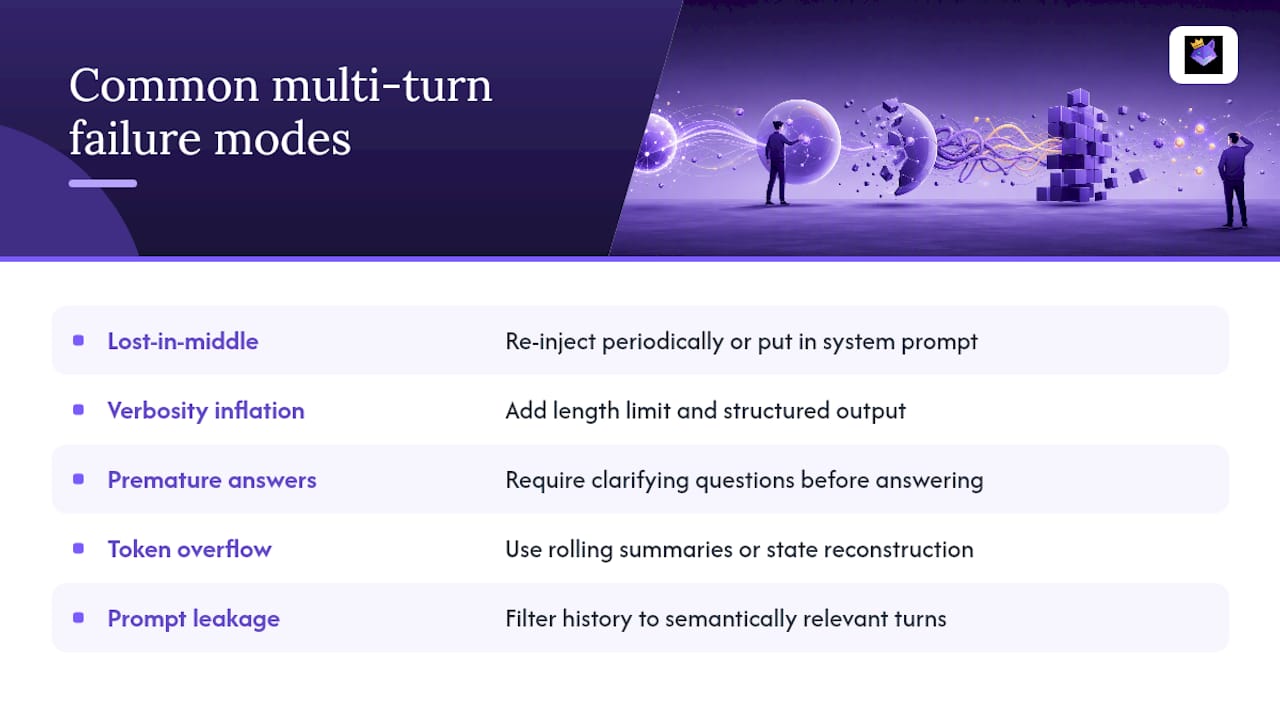
Lost-in-the-middle forgetting happens when a constraint set in an early turn loses effective attention weight as the conversation grows. The model doesn't "forget" in a human sense. It just attends more strongly to recent tokens. Fix: re-inject the constraint as a periodic reminder, or move it into the system prompt where it anchors every turn.
Verbosity inflation is a compounding effect. The model's responses get longer each turn because it's implicitly mimicking the growing context. Fix: add an explicit length constraint to the system prompt ("Respond in 2–3 sentences unless the user asks for detail") and enforce it with a structured output schema.
Premature answers occur when the model answers a question before gathering enough context across turns. Fix: use a multi-step dialogue pattern where the system prompt instructs the model to ask clarifying questions before committing to an answer.
Token overflow and truncation happen when the message list exceeds the context window. Hard truncation silently drops the oldest turns, which often contain the system prompt and critical constraints. Fix: implement rolling summarization or state reconstruction before you hit the limit, not after.
Prompt leakage is when irrelevant turns from earlier in the session contaminate the current response. Fix: filter the history before injection, keeping only turns that are semantically relevant to the current query.
A before/after example for token overflow:
Before (broken): Append all turns indefinitely. At turn 30, the system prompt is truncated. The model loses its persona and safety constraints silently.
After (fixed):
def build_context(turns, system_prompt, max_tokens=3000):
    context = [{"role": "system", "content": system_prompt}]
    recent = turns[-5:]  # always keep last 5 turns
    summary = summarize(turns[:-5])  # compress older turns
    if summary:
        context.append({"role": "system", "content": f"Summary: {summary}"})
    context.extend(recent)
    return context
Security and privacy: when persisting conversation data, redact or hash PII before storage. For health applications, HIPAA requires that protected health information (PHI) be encrypted at rest and in transit, with access controls and audit logs. GDPR's right-to-erasure requirement means you need a deletion path for stored conversation data for EU users even in a US-primary deployment. Never embed API keys, passwords, or sensitive user data in prompt strings. Sanitize all user inputs before reinjection to prevent prompt injection attacks.
Pro Tip: Write automated regression tests keyed to critical invariants: persona consistency, safety constraint adherence, and system prompt fidelity. Run them after every prompt change. A 5-turn scripted conversation that checks whether the model still refuses out-of-scope requests costs minutes to write and catches the majority of regressions.
How do you design prompt templates for multi-turn flows?
Good multi-turn templates separate concerns cleanly: the system prompt holds invariants, the history block holds compressed prior context, and the user turn holds only the current input. Mixing these layers is the most common source of brittle behavior.
Core pattern catalog:
- System role: persona, constraints, output format, and safety rules. Write these once and never modify them at runtime.
- History injection block: a compressed or structured summary of prior turns, injected as an assistant or system message before the current user turn.
- User role: the current input only. No history, no instructions.
- Structured output enforcement: require JSON or XML in the system prompt and validate the schema on every response. This makes parsing deterministic and catches format drift early.
A state-reconstruction template looks like this:
SYSTEM:
You are a support assistant. Always respond in valid JSON.
Format: {"answer": "...", "follow_up": "..."}

PREVIOUSLY_SELECTED:
<state>
  user_goal: {{user_goal}}
  confirmed_facts: {{confirmed_facts}}
  open_questions: {{open_questions}}
</state>

USER: {{current_input}}
Each turn, you extract user_goal, confirmed_facts, and open_questions from the model's previous response and populate the <state> block. The model sees a fixed-size context regardless of session length.
For the "previously selected" reminder pattern, keep the block under 200 tokens. Anything longer starts to compete with the current user input for attention weight.
Security note: never embed secrets, tokens, or credentials in prompt strings. Limit sensitive fields in the state block to what the model genuinely needs to answer the current question. Sanitize user inputs with an allowlist or escaping layer before reinjection, especially in agentic systems where the model's output feeds back into the next prompt.
Pro Tip: Version every template with a semantic identifier (e.g., support-v2.3) and store it in a prompt library. When a regression appears, you can diff two template versions in seconds rather than reconstructing what changed from memory. Promptchief's AI prompt templates library gives you a starting point for state-reconstruction and history-remind patterns you can fork and adapt.
For practical guidance on structuring prompts before you layer in history management, the AI prompt engineering guide covers the foundational principles that apply equally to single-turn and multi-turn designs.
Which frameworks and APIs support multi-turn prompting?
Three tools cover the majority of production use cases: LangChain, the OpenAI Responses API, and Google's Firebase AI Logic with server prompt templates.
LangChain provides the most complete abstraction layer. PromptTemplate handles variable injection into prompt strings, and the Memory components manage session state in-process. ConversationBufferMemory stores raw turns; ConversationSummaryMemory compresses them automatically; VectorStoreRetrieverMemory integrates Pinecone or FAISS for semantic retrieval. The LangChain GitHub repo has runnable examples for all three patterns. LangChain is the right choice when you need a flexible, composable system and don't mind the abstraction overhead.
from langchain.memory import ConversationSummaryMemory
from langchain.llms import OpenAI

llm = OpenAI(temperature=0)
memory = ConversationSummaryMemory(llm=llm)
memory.save_context({"input": "My order is #1234"}, {"output": "Got it."})
history = memory.load_memory_variables({})
OpenAI Responses API manages conversation state server-side. You pass previous_response_id on each request, and OpenAI chains the responses into a conversation object without you maintaining the message list. This is the lowest-friction option for OpenAI-only deployments. The conversation state docs explain the semantics and the tradeoffs between client-managed and server-managed history.
response = client.responses.create(
    model="gpt-4o",
    input="What was my order number?",
    previous_response_id=last_response_id
)
Google Firebase AI Logic uses server prompt templates with a {{history}} placeholder. The SDK populates the history slot on startChat/sendMessage calls, keeping client code clean. SDK support varies by language, so test your target SDK before committing to this pattern.
const chat = model.startChat({
  history: previousMessages,
});
const result = await chat.sendMessage("Summarize what we've decided.");
Architecture options:
- Client-managed history: you own the message list, filter it, and send it on every request. Maximum control, maximum responsibility.
- Server-managed conversation objects: the API owns the chain (OpenAI
previous_response_id). Simpler client code, less flexibility for custom compression. - Hybrid: client maintains a hot layer of recent turns plus a warm summary; server handles the current turn. Best for long sessions with latency requirements.
Pro Tip: For teams exploring AI brainstorming and ideation workflows that feed into multi-turn systems, this developer-facing explainer on AI brainstorming covers structured prompting patterns that translate directly into multi-turn design.
How do you test and iterate on multi-turn prompts?
Testing multi-turn systems requires a different mindset than testing single-turn prompts. A prompt that works perfectly at turn 1 can fail catastrophically at turn 10. The only way to catch that is a structured evaluation loop run across the full turn sequence.
A practical iterative workflow follows these steps:
- Define success criteria first. Specify intent accuracy, output format compliance, safety constraint adherence, and maximum acceptable token consumption per turn. Write these down before touching a prompt.
- Run a baseline. Execute your current prompt against a scripted 5–10 turn conversation and log every output.
- Score against criteria. Measure intent accuracy (did the model answer the right question?), information-filtering score (did it avoid injecting irrelevant history?), hallucination rate, and token count per turn.
- Identify the failure turn. Multi-turn regressions usually appear at a specific turn number. Find it.
- Refine the prompt. Apply one change at a time: add a reminder, compress the history block, tighten the output schema.
- Re-run and compare. Log the delta against the baseline. Google's Vertex AI prompt iteration docs recommend testing order effects and saving each iteration as a named template.
- Version and save. Commit the winning template with a semantic version tag. Never overwrite a working template in place.
Evaluation checklist for practitioners:
- Intent accuracy: does the model answer the question the user actually asked at turn N?
- Information-filtering score: does the response avoid contamination from irrelevant prior turns?
- Hallucination rate: does the model invent facts not present in the conversation or system prompt?
- Token consumption per turn: is it growing linearly (bad) or staying bounded (good)?
- Latency per turn: is inference time stable across turns or degrading?
- Stability over N turns: run 20-turn scripted sessions and check whether persona and constraints hold.
- Adversarial robustness: does the model maintain safety constraints when a user tries to override the system prompt mid-conversation?
For test-case design, build three categories: deterministic scenarios (scripted conversations with known correct outputs), edge cases (very long sessions, topic switches, ambiguous references), and adversarial inputs (prompt injection attempts, out-of-scope requests). Log model config, prompt version, token counts, and timestamps on every run so you can reproduce any result.
For teams who want to go deeper on automated prompt testing, automated prompt engineering covers systematic methods for running and scoring prompt iterations at scale.
How do you manage token budgets and control costs?
Token costs in multi-turn systems compound. A 10-turn conversation with 500 tokens per turn doesn't cost 5,000 tokens. It costs roughly 27,500 tokens if you naively append the full history each turn (turn 1 costs 500, turn 2 costs 1,000, and so on up to turn 10 at 5,000).
Cost-control patterns:
- State reconstruction: re-inject a fixed-size state block instead of the full history. The State-Update paper reports a 59.4% reduction in token consumption using this approach.
- Compressive summarization: after every 5 turns, summarize the oldest 5 into a single paragraph and discard the originals. Keep the summary under 150 tokens.
- Selective RAG retrieval: don't retrieve all stored turns. Embed the current user query and retrieve only the top-3 most semantically relevant prior turns from Pinecone or FAISS.
- Caching parsed results: if the model extracts structured data (entities, decisions, preferences) from a turn, cache the parsed result and re-inject the cache rather than the raw turn text.
An illustrative token budget for a 10-turn customer-support session (example figures only):
- System prompt: 300 tokens (fixed)
- State block: 150 tokens (fixed, reconstructed each turn)
- Last 3 raw turns: ~600 tokens (rolling)
- Current user input: ~50 tokens
- Total per request: ~1,100 tokens versus ~2,750 tokens with naive full-history concatenation
Operationally, instrument token usage on every request. That threshold gives you headroom to trigger summarization before truncation silently drops your system prompt. Monitor inference latency per turn separately from total session latency. A sudden latency spike at turn N usually means the context window is near capacity and the model is processing a much larger payload than expected.
Use Promptchief's API cost calculator to model token costs across GPT-4o, Claude, and Gemini before committing to a model for a production workload.
A production checklist and anti-patterns to avoid
Design phase:
- Define the memory pattern before writing prompts (buffer, summary, state reconstruction, RAG)
- Write system invariants once and lock them; never modify at runtime
- Enforce structured output (JSON or XML) from turn 1
- Set a maximum context window utilization threshold (60% is a safe default)
Testing phase:
- Run scripted 5-turn and 20-turn regression tests before every deployment
- Test adversarial inputs: prompt injection, persona override attempts, out-of-scope requests
- Validate that the system prompt survives to turn 20 without truncation
Deployment phase:
- Log every request: prompt version, model config, token count, latency, and output
- Set alerts for context window utilization, latency spikes, and error rates
- Store conversation data encrypted at rest; apply PII redaction before persistence
Anti-patterns to remove immediately:
- Ad-hoc history concatenation with no summarization or truncation strategy
- Embedding PII, credentials, or secrets in prompt strings
- Brittle string-parsing assumptions on model outputs (use schema validation instead)
- Modifying the system prompt mid-session in response to user requests
- Treating a prompt that works at turn 3 as validated without testing at turn 15
What does the research say about multi-turn degradation?
The most concrete published evidence comes from the State-Update Multi-turn Dialogue Strategy paper. The authors attribute the gains to two mechanisms working together: extracting supporting evidence into a parsable tag structure each turn, and feeding that extracted support as a "previously selected" reminder. The input size stays fixed while cross-turn signal is preserved.
Broader experimental evidence, documented in developer analyses and blog experiments, consistently shows that multi-turn performance degrades as session length grows. The degradation pattern is not random. It concentrates in the middle of the context window, where tokens receive the weakest attention weight relative to the beginning (system prompt) and end (recent turns). This "lost-in-the-middle" effect is why constraints placed in early turns and never repeated tend to erode by turn 10–15.
The practical implication is direct: rolling summaries and state reconstruction work because they move older context from the middle of the window (low attention) to the beginning (high attention), repackaged as a compact, high-signal block. The mechanism is not magic. It's positional attention management.
For teams building on iterative refinement workflows, IBM's iterative prompting guidance and Monday.com's 7-step iterative prompting framework both converge on the same principle: define evaluation criteria before refining, and save every iteration as a versioned template.
The part most teams get wrong about multi-turn systems
Most teams treat multi-turn prompting as a context-management problem. It's actually a state-management problem with a context-management constraint.
The distinction matters. Context management asks: "How do I fit the conversation history into the window?" State management asks: "What does the model need to know right now to answer correctly?" Those are different questions, and the second one is harder. A team that optimizes for fitting history into the window will build a system that's technically correct and practically unreliable. The model has all the tokens, but they're the wrong tokens.
The teams that build reliable multi-turn systems early tend to share one habit: they define what "state" means for their application before writing a single prompt. For a customer-support bot, state might be {user_id, open_issue, confirmed_facts, tone_preference}. For a coding assistant, it might be {language, active_file, recent_errors, user_constraints}. That definition becomes the schema for the state-reconstruction block, which becomes the template, which becomes the versioned artifact in the prompt library.
The other thing teams consistently underestimate is the organizational cost of prompt governance. A prompt is a production artifact. It needs version control, review cycles, regression tests, and an owner. Teams that treat prompts as throwaway strings end up with a dozen slightly different versions of the same template scattered across codebases, no way to trace which version caused a regression, and no process for rolling back. The engineering discipline that applies to code applies equally to prompts.
Observability is the last gap. Most teams instrument their LLM calls for latency and error rate. Few instrument for conversational correctness: does the model still follow the system prompt at turn 15? Is intent accuracy degrading over session length? Without those metrics, you're flying blind on the failure modes that actually matter.
Promptchief makes multi-turn prompt management practical
Building reliable multi-turn systems means managing dozens of prompt templates, state-reconstruction blocks, and history-remind patterns across multiple models and environments. That's where Promptchief's prompt management platform fits directly into the workflow.
Promptchief lets you save, version, and inject state-reconstruction templates and system prompts across ChatGPT, Claude, Gemini, and 24 other platforms from a single cloud-synced library. The multi-step prompt chains feature maps directly to multi-turn flows: build a chain that reconstructs state, injects a history-remind block, and enforces a structured output schema, then reuse it across sessions without rebuilding from scratch. Team workspaces mean your prompt library is shared, versioned, and accessible to every engineer on the project. Start with the free plan and upgrade when your team needs advanced chain orchestration and analytics. Visit Promptchief to see how it fits your multi-turn workflow.
Sources
The following docs, repos, and papers are the most useful starting points for implementation.
- A State-Update Prompting Strategy for Efficient and Robust Multi-turn Dialogue
- Conversation state | OpenAI developer docs
- Server prompt templates — multi-turn interactions | Firebase AI Logic
- Multi-Turn Prompt Design: How Context Accumulates
FAQ
What is a multi-turn prompt?
A multi-turn prompt is a sequence of messages sent to a language model that includes prior conversation turns, allowing the model to reference earlier context when generating its next response. Each turn consists of a user message and a model reply, concatenated into a single API request.
What is multi-turn in AI?
Multi-turn in AI refers to a conversational interaction where the model's responses depend on the accumulated history of prior exchanges in the session. Because LLMs are stateless by default, multi-turn behavior is achieved by explicitly injecting prior messages into each new request.
What does multi-shot prompting mean?
Multi-shot prompting (also called few-shot prompting) means including multiple example input-output pairs in a single prompt to guide the model's response format or reasoning style. It differs from multi-turn prompting: multi-shot is about examples within one request, while multi-turn is about managing state across multiple sequential requests.
How do you prevent a multi-turn system from forgetting early instructions?
Re-inject critical constraints as a periodic reminder every 5–10 turns, and use state reconstruction to maintain a compact, fixed-size context block rather than appending raw history indefinitely.
Which memory pattern is best for long multi-turn sessions?
A tiered architecture works best for sessions longer than 20 turns: keep the last 3–5 raw turns in a buffer, compress older turns into a rolling summary, and store full session history in a vector index (Pinecone or FAISS) for semantic retrieval. This keeps the active context window bounded while preserving long-horizon recall.