
Multi language prompts are instructions written for a large language model in one language, or several, to get output in a specific language. Write them natively, and pre-translate only the parts that benefit from English-model strength, such as examples or rules. The trade-off is simple: native prompts keep cultural nuance, while English components often play to what the model learned best.
TL;DR:
- Write each system prompt natively, keep key terms consistent in a glossary, and create two or three short, culturally appropriate examples for every target language.
- Compare a fully native prompt with English instructions and target language examples, because the stronger option depends on task, language resources, translation quality, and model.
- Test the same samples, score fluency, faithfulness, register, hallucinations, and token cost, change one variable at a time, and keep separate winners for each model.
- For lower resource languages, allow extra testing and native speaker checks; if performance remains weak, use English instructions with explicit target language output rules.
Table of Contents
- What types of multilingual prompting exist?
- When should you pre-translate and when should you prompt cross-lingually?
- How do you build reusable multilingual prompt templates?
- How do you test multilingual prompts?
- How do system prompts and multimodal inputs change things?
- How I work with multilingual prompts
- Why most multilingual prompt advice aims at the wrong target
- Keep your multilingual prompts organized and in sync
- FAQ
- Sources
What types of multilingual prompting exist?
Most multilingual prompting can be grouped into broad approaches, and a 2025 survey of multilingual prompt engineering covers the wider landscape if you want the academic view.
- In-lingual (native) prompts: instruction, context and examples all in the target language. Best when tone, register and cultural fit matter.
- Cross-lingual templates: an English-first template that asks for output in another language. Fast to maintain, but nuance can flatten.
- Hybrid (selective pre-translation): some components stay in English, others are written or translated into the target language.
Think of every prompt as modular, with components such as instruction, context, examples and output format. Each module can live in a different language, which is what makes the hybrid family so flexible.
Expect uneven results. The same survey reports that performance varies by language resource level and task, and a separate summary of the survey's findings points to proficiency disparity as the main barrier: high-resource languages usually do better because of larger pre-training corpora. Plan for more testing if your language is lower-resource.
When should you pre-translate and when should you prompt cross-lingually?
Research from ACL's Findings of NAACL suggests that treating the prompt as modular and selectively pre-translating specific components can improve performance. The best choice depends on the task, the language's resource level, translation quality, the tokenizer and the model. A companion paper on translation strategies reaches a similar conclusion for cross-lingual prompting.
Run this checklist in one session:
- Name the task. Question answering, summarization and natural language inference can react differently to the same strategy.
- Rate the language. High-resource languages tolerate native prompts well; low-resource ones may need English scaffolding.
- Check translation quality. A weak machine translation of your rules can hurt more than it helps.
- Test two variants. Full native prompt versus English instructions with target-language examples.
- Keep the winner per model. Results do not always transfer between LLMs.
Pro Tip: Translate the examples first and leave the instructions alone. It is an easy change to test and can be revealing.
How do you build reusable multilingual prompt templates?
Start with the modular layout: instruction, then context, then examples, then output. Here is a minimal pattern in multiple languages.
English: "Task: Summarize the text below in three sentences. Context: Readers are non-experts. Example: [short sample]. Output: plain paragraph."
Spanish: "Tarea: Resume el texto siguiente en tres frases. Contexto: Los lectores no son expertos. Ejemplo: [muestra breve]. Salida: un párrafo sencillo."
Microsoft's guidance on localizing AI-based features warns against assuming that translating a prompt is enough. It recommends avoiding idioms and notes two approaches: translate the prompt, or ask the model to answer in the target language. Its research on cultural differences in language models frames adaptation as transcreation, meaning you adjust idioms, register and cultural context instead of translating literally.
Build these habits into every template:
- Pick a semantic anchor for key terms. Fix one translation per term in a glossary and reuse it in every prompt.
- Write the system prompt natively. Microsoft's practitioner guidance says native system prompts preserve nuance and correct formality better than direct translations.
- Add few-shot examples per language. Two or three short samples in each target language beat one English sample reused everywhere.
- Specify register. State formal or informal, and name honorific levels for Japanese or Korean.
Keep each language's examples in a small library:
- English: neutral, idiom-free phrasing.
- Chinese and Japanese: state politeness level explicitly.
- Spanish: say whether you want tú or usted, and which regional variant.
Pro Tip: Keep examples short and translation-aware: pick sentences with no puns or local references, so any error you see comes from the prompt, not the sample.
For more starting points, our translation and localization prompt and formula for writing AI prompts pair well with this structure. If your outputs sound stiff, this partner guide on humanizing AI text covers instruction design for tone.
How do you test multilingual prompts?
Keep testing small and repeatable. The survey on multilingual prompt engineering supports comparing variants per language and, where you can, adding native-speaker spot checks.
- Chunk long text into one-page pieces.
- Prime the model with a confirmation step so it "reads" the source before translating, a tip from the Maastricht University prompt library.
- Compare the selective-translation prompt against the fully native one on a handful of samples.
- Score fluency, faithfulness, register, hallucination and token cost.
- Log and iterate. Change one variable at a time.
Watch tokens closely. Token usage can vary across languages, so compare variants with our free token counter. Our free token counter helps you compare variants.
Prompt modularity is the finding to build on: selectively translating only some prompt components often beats translating the whole prompt.
How do system prompts and multimodal inputs change things?
Write one localized system prompt per locale rather than a translated copy of the English one. Our production-ready system prompt is a good base to adapt.
- Localized instructions: short and native for English, Chinese, Japanese and Spanish, each stating register and output language.
- Media handling: pass images with the text prompt in the model's required schema, and tune image resolution to balance quality against token usage.
- Graceful fallback: if a language performs poorly, fall back to English instructions with target-language output rules, and say so in the prompt.
How I work with multilingual prompts
My routine is short: draft a native prompt, add a glossary anchor, translate only the examples, test on two or three languages, then save the winner. Keeping those templates in a cloud-synced library means the same tested version follows me across devices instead of living in scattered notes.

Why most multilingual prompt advice aims at the wrong target
The common advice is to translate everything or write everything in English. The evidence points elsewhere: the gains come from choosing which components to translate, and that choice is task, language and model specific. So stop hunting for a universal rule. Build a small test habit instead.

Prioritize in this order. First, write native system prompts and a term glossary, because they cost almost nothing. Second, test selective translation of examples. Third, spot-check with a native speaker before you trust any language you cannot read. Overrated: elaborate prompt tricks. Underrated: consistent terminology and short examples.
Even learning research hints at the value of variety. A UW–Madison study found that mixing languages within one study session can help vocabulary retention. Mixing languages across your test set may likewise surface weaknesses faster than testing one language at a time.
— John
Keep your multilingual prompts organized and in sync
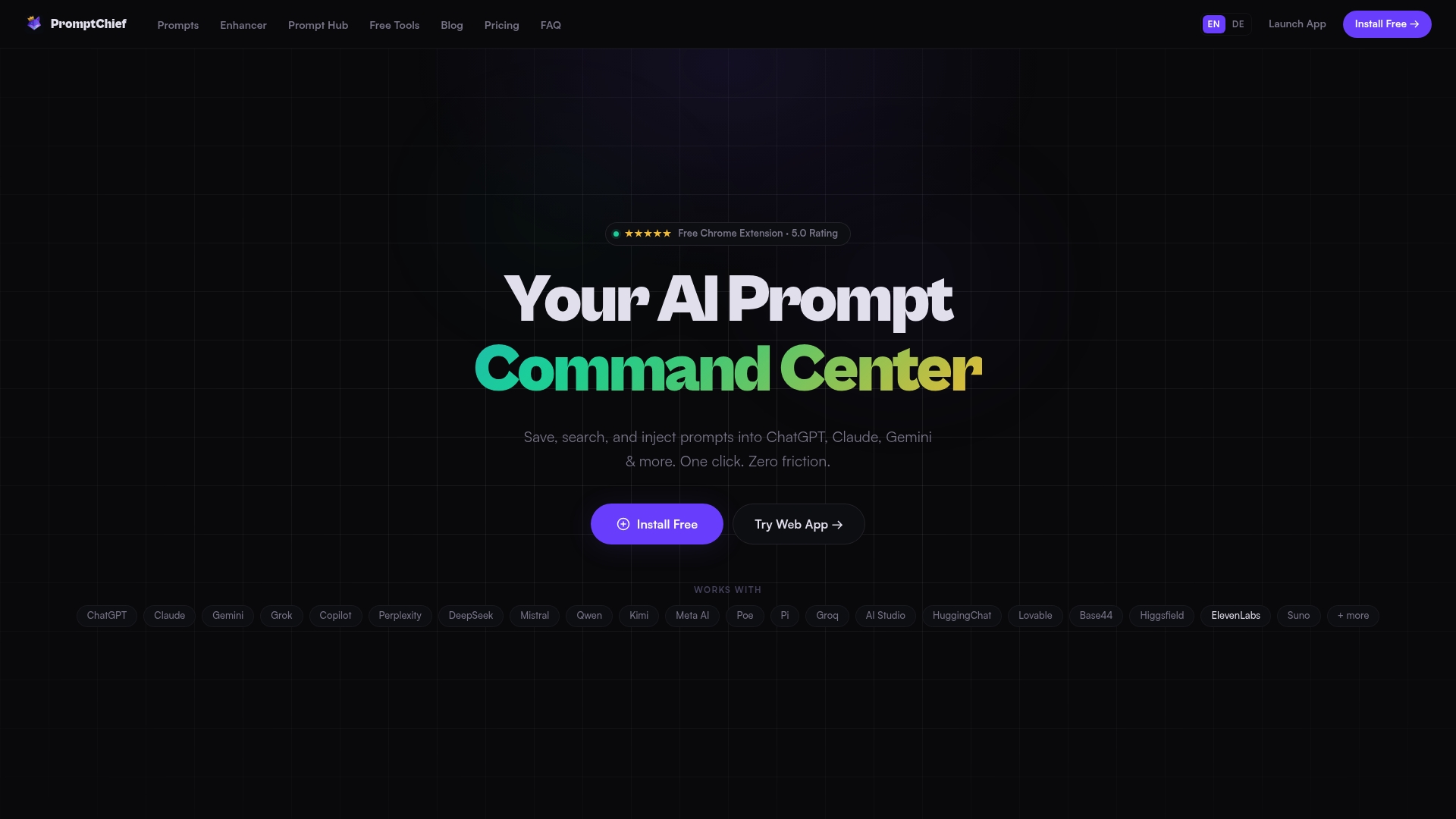
Multilingual work multiplies prompt versions fast: every language, every example set, every system prompt. We built PromptChief so you save each tested version once and find it again by search, on any device. Chain steps like prime, translate and check with our prompt chains, and start on the Free plan at Promptchief.
FAQ
What are some good prompts for language learning?
Ask the model to write the same thought in two languages and explain what nuance changes, an exercise from the Maastricht University prompt library. You can also request short dialogues at a set register. Keep practice short and regular.
What are multimodal prompts?
Multimodal prompts combine text with media such as images. The media item is passed alongside the text, formatted to the model's schema, as described in the vLLM documentation. Lower image resolution can reduce token use.
Do multilinguals have higher IQ?
Research discusses cognitive benefits. A Stanford-hosted article describes cognitive benefits such as greater metalinguistic awareness and improved verbal analytical processing.
How do I make multi language prompts more consistent?
Keep one glossary of fixed term translations and reuse it in every prompt. Use the same modular layout in each language and test each variant on the same samples.
Sources
- Multilingual Prompt Engineering in Large Language Models: A Survey Across NLP Tasks
- Microsoft
- Beyond English: The Impact of Prompt Translation Strategies across Languages and Tasks in Multilingual LLMs - ACL Anthology
- New research suggests mixing languages during study session might be a more effective learning method – Waisman Center – UW–Madison