
TL;DR:
- A cloud-synced prompt manager enables quick injection of templates into multiple AI models, improving consistency and saving time. Structured prompt templates with placeholders perform reliably across different models because their core structure communicates clear intent. Using a prompt management platform like Promptchief ensures organization, version control, team collaboration, and efficient retrieval, transforming scattered prompts into a powerful workflow.
A cloud-synced prompt manager is the fastest way to handle ChatGPT prompt templates across every model you use. Save a template once, inject it anywhere, and stop rebuilding the same prompt from scratch every session. The recommended next step: open Promptchief, paste one of the templates from Section 4 below, and hit inject the next time you open ChatGPT.
Two things change immediately when you make that switch:
- No more copy-pasting. Integrated managers embed prompts directly into the AI interface, cutting the tab-switching loop entirely.
- Team consistency. Everyone on your team pulls from the same versioned library instead of maintaining their own messy text files.
Pro Tip: Save your first template before you finish reading this article. Even a rough draft in your manager beats a perfect prompt buried in a Notion doc.
Table of Contents
- What makes a ChatGPT prompt template different from a regular prompt?
- Do prompt frameworks like STCO and CRAFT actually transfer across models?
- High-performing prompt templates you can copy and store right now
- Discovery libraries vs. integrated prompt managers: what actually changes?
- How to choose a prompt management platform for your workflow
- Three prompt workflows that replace static text files
- Quick-start checklist for writing and maintaining prompt templates
- Why Promptchief fits the criteria for managing ChatGPT prompt templates
- Key Takeaways
- The part most guides skip about prompt templates
- Promptchief gives you injection and sync from day one
- Useful sources and further reading
- FAQ
What makes a ChatGPT prompt template different from a regular prompt?
A prompt template is a reusable, structured instruction set with placeholders for the parts that change. A one-off prompt is written for a single moment. A template is written to work dozens of times across different inputs, models, and users.
Every high-quality template has six components:
- Role — who the AI is playing ("You are a senior software engineer reviewing a pull request")
- Context — the situation or background the AI needs to understand
- Task — the specific action to perform
- Constraints — what to avoid, word limits, tone rules
- Placeholders — dynamic fields like
{product_name}or{audience}that get swapped at runtime - Output format — bullet list, JSON, numbered steps, or plain prose
A template without placeholders is just a saved prompt. The placeholder is what makes it a system — one structure that handles infinite variations without rewriting the instruction logic each time.
Placeholders map directly to what Promptchief calls "magic fields": variables that get filled in at injection time, so you never paste a half-finished prompt into ChatGPT again.
Pro Tip: Write your output format instruction last, after you've drafted everything else. It's the easiest part to forget and the one that most affects how usable the response actually is.

Do prompt frameworks like STCO and CRAFT actually transfer across models?
Yes, and the reason is structural. Well-structured templates perform consistently across modern LLMs because they communicate intent clearly rather than relying on model-specific quirks.
STCO (Situation, Task, Constraints, Output) is the leaner of the two. It works well for single-step tasks where you need a clean, predictable result.
CRAFT (Context, Role, Action, Format, Test) adds a testing step, which makes it better for iterative workflows where you're refining output across multiple runs.
The model doesn't make the template portable — the structure does. ChatGPT, Claude, and Gemini all respond to clear intent. Ambiguity is the only thing that breaks cross-model consistency.
Here's the same task framed for two models using STCO:
- ChatGPT: "You are a marketing copywriter. Write a 3-sentence product description for
{product}targeting{audience}. Avoid jargon. Output as plain text." - Claude: Same prompt, identical structure. Claude's longer context window means you can add a brand voice sample without hitting limits, but the STCO skeleton stays unchanged.
Pro Tip: Build every new template in STCO first. If the output needs refinement across runs, add the Test step and promote it to CRAFT.
High-performing prompt templates you can copy and store right now
These templates use STCO structure and magic placeholders. Copy any of them into Promptchief and they're ready to inject.
- Cold email draft — "You are a B2B sales writer. Write a 5-sentence cold email to
{prospect_role}at{company}about{value_prop}. No buzzwords. Subject line included." - Document summarization — "Summarize the following text in
{word_count}words for a{audience}audience. Preserve key figures and decisions. Output as bullet points. Text:{input_text}" - Code review — "You are a senior
{language}engineer. Review the following code for bugs, readability, and performance. Flag each issue with severity (low/medium/high). Code:{code_block}" - Content outline — "Create a
{section_count}-section outline for an article titled{article_title}targeting{audience}. Each section gets a one-sentence description." - Social copy (LinkedIn) — "Write a LinkedIn post about
{topic}for a{role}audience. 150 words max. Conversational tone. End with one question." - Data extraction — "Extract all
{data_type}from the text below. Return as a JSON array with keys:{key_list}. Text:{input_text}" - Bug ticket summary — "Convert the following code review comment into a structured bug ticket. Fields: title, severity, steps to reproduce, expected vs actual behavior. Input:
{review_comment}"
To convert any of these into an injectable version in Promptchief, wrap each variable in curly braces and save. At injection time, Promptchief surfaces a fill-in form so you never send a prompt with an unfilled {placeholder} by accident.
Avoiding vague instructions and specifying output formats are the two changes that most reliably improve first-run quality across all seven templates above.
Pro Tip: Run each new template on ChatGPT and Claude back-to-back on the same input. If the outputs diverge significantly, your constraint layer is too thin. Add one more constraint and retest.
Discovery libraries vs. integrated prompt managers: what actually changes?
Static prompt libraries are excellent for finding inspiration. They force copy-paste workflows. An integrated manager injects prompts directly into the AI interface and syncs them across every device you own.
| Feature | Discovery library | Integrated manager |
|---|---|---|
| Access method | Browse and copy | Inject via extension |
| Sync | None (local or clipboard) | Cloud sync across devices |
| Team sharing | Manual (export/share link) | Shared workspace with roles |
| Search | Category browse | Fuzzy search across all prompts |
| Placeholders | Static text | Dynamic magic fields |
| Analytics | None | Usage and performance tracking |
| Chaining | Not supported | Multi-step prompt chains |
The practical gap shows up in daily use. A library saves you from writing a prompt from scratch. A manager saves you from everything else: finding the prompt, filling in variables, switching tabs, and remembering which version worked last week.
Promptchief supports 27+ AI platforms including ChatGPT, Claude, and Gemini through a Chrome extension and web app, covering the full feature set in the right column above.
How to choose a prompt management platform for your workflow
The primary productivity barrier for professional users isn't a shortage of prompts. It's disorganization. The right platform solves that with structure, not just storage.
Evaluate any platform against this checklist:
- Injection support — does it push prompts directly into ChatGPT and other interfaces, or does it just copy to clipboard?
- Browser extension — a web app alone creates context-switching; an extension eliminates it
- Multi-model compatibility — you'll use more than one LLM; the manager should cover all of them
- Team workspaces — shared libraries with role-based access matter the moment a second person touches your prompts
- Version control — without a dedicated tool, teams accumulate messy files; version history lets you roll back a prompt that stopped performing
- Analytics — usage data tells you which templates earn their place and which need rewriting
- Security — enterprise integrations should prioritize secure sharing, role-based access, and auditability
On pricing: most platforms offer a free tier with limits on prompt count or AI credits. Upgrade triggers typically hit when you need team seats, unlimited chains, or analytics. Test the injection workflow and the fuzzy search during any free trial — those two features reveal more about daily usability than any feature list.
Pro Tip: During a trial, deliberately search for a prompt using a misspelled keyword. If the manager can't surface it, fuzzy search isn't real. That's the test most buyers skip.
Three prompt workflows that replace static text files
Single injection for quick tasks
Open Promptchief's extension, search for your template by keyword, fill in the magic fields, and inject. The prompt lands in ChatGPT's input box, pre-filled. Total time: under 10 seconds versus 45+ seconds of copy-paste-edit.
Chained prompts for multi-step jobs
Automated injection and chaining let you link prompts so the output of one feeds the next. A practical example: a code-review prompt flags issues with severity tags, then a chained bug-ticket prompt converts each flagged item into a structured ticket. Two prompts, one workflow, no manual reformatting between steps. See the full prompt chain guide for setup details.
Team sharing and review
The biggest productivity gains come from organization: centralized, searchable, and injectable prompts enable consistent outputs across teams.
Assign ownership to each template, set a review cadence (monthly works for most teams), and use the workspace's role permissions to prevent untested edits from reaching the shared library.
Pro Tip: Chain your research prompt to your outline prompt before you add a drafting prompt. Getting the first two links right is faster than debugging a three-step chain from scratch.
Quick-start checklist for writing and maintaining prompt templates
Every template in your library should have these fields before it goes live:
- Name — descriptive, searchable (not "prompt 1")
- Tags — at least two: task type and model it was tested on
- Version number — start at v1.0 and increment on any structural change
- Test cases — two sample inputs with expected output notes
- Performance notes — what worked, what didn't, which model gave the best result
- Owner — who maintains it and approves changes
- Rollback point — the last version that produced acceptable output
For iteration, a simple A/B method works: run version A and version B on the same input three times each, then compare output quality against your stated constraints. Retire the weaker version.
On security: never store prompts that contain real customer data, API keys, or proprietary code samples in a shared workspace unless the platform explicitly supports encrypted storage and role-gated access. Avoiding ambiguous instructions is a quality issue; storing sensitive data in a shared prompt is a compliance issue. Treat them differently.
Why Promptchief fits the criteria for managing ChatGPT prompt templates
Map the checklist from Section 6 to what Promptchief actually delivers:
- Injection: Chrome extension injects directly into ChatGPT, Claude, Gemini, and 24+ other platforms
- Multi-model support: 27+ AI platforms covered from one library
- Team workspaces: shared libraries with seat-based access and role controls
- Chains: multi-step prompt chains built into the platform
- Analytics: productivity tracking shows which templates get used and which sit idle
- Version control and fuzzy search: find any prompt even with a partial or misspelled query
- AI prompt rewriting: nine style options to adapt any template without starting over
The freemium plan covers individual use. Team seats and AI credit limits are the upgrade triggers for collaborative workflows. Start by saving one template from Section 4, enabling injection, and running a cross-model test on the same input.
Pro Tip: Invite one teammate during the trial period. Shared workspaces reveal friction points that solo use never surfaces.
Key Takeaways
A cloud-synced prompt manager with injection, fuzzy search, and team workspaces is the most direct path from scattered prompt files to consistent, repeatable AI output across every model you use.
| Point | Details |
|---|---|
| Save one template first | Pick any template from Section 4, add placeholders, and store it before testing anything else. |
| Run a cross-model test | Run the same template on ChatGPT and Claude; output divergence signals a weak constraint layer. |
| Enable injection | Injection cuts prompt delivery time from 45+ seconds to under 10 seconds per use. |
| Set a versioning policy | Every template needs a version number, owner, and rollback point before it enters a shared workspace. |
| Use Promptchief | Promptchief covers injection, 27+ models, chains, analytics, and team workspaces under one freemium plan. |
The part most guides skip about prompt templates
Prompt templates get treated as a writing problem. Write a better prompt, get a better output. That framing is incomplete. The real bottleneck is retrieval and consistency, not composition.
Most teams already have decent prompts. They're in Slack threads, Notion pages, personal text files, and browser bookmarks. The problem is that nobody can find them when they need them, and nobody knows which version is current. A new team member writes a new prompt from scratch because the good one is buried in a doc from eight months ago.
The templates in this article aren't special because they're well-written. They're useful because they're structured for storage and injection. A template that lives in a cloud manager with fuzzy search and version history is worth ten times a better-written prompt that lives in a text file.
That's the shift worth making. Not from bad prompts to good prompts. From prompts you lose to prompts you can find, fill, and fire in under 10 seconds.
Promptchief gives you injection and sync from day one
Promptchief's free tier lets you save, search, and inject prompts across ChatGPT, Claude, Gemini, and 24+ other platforms from the first session. No setup beyond installing the Chrome extension.
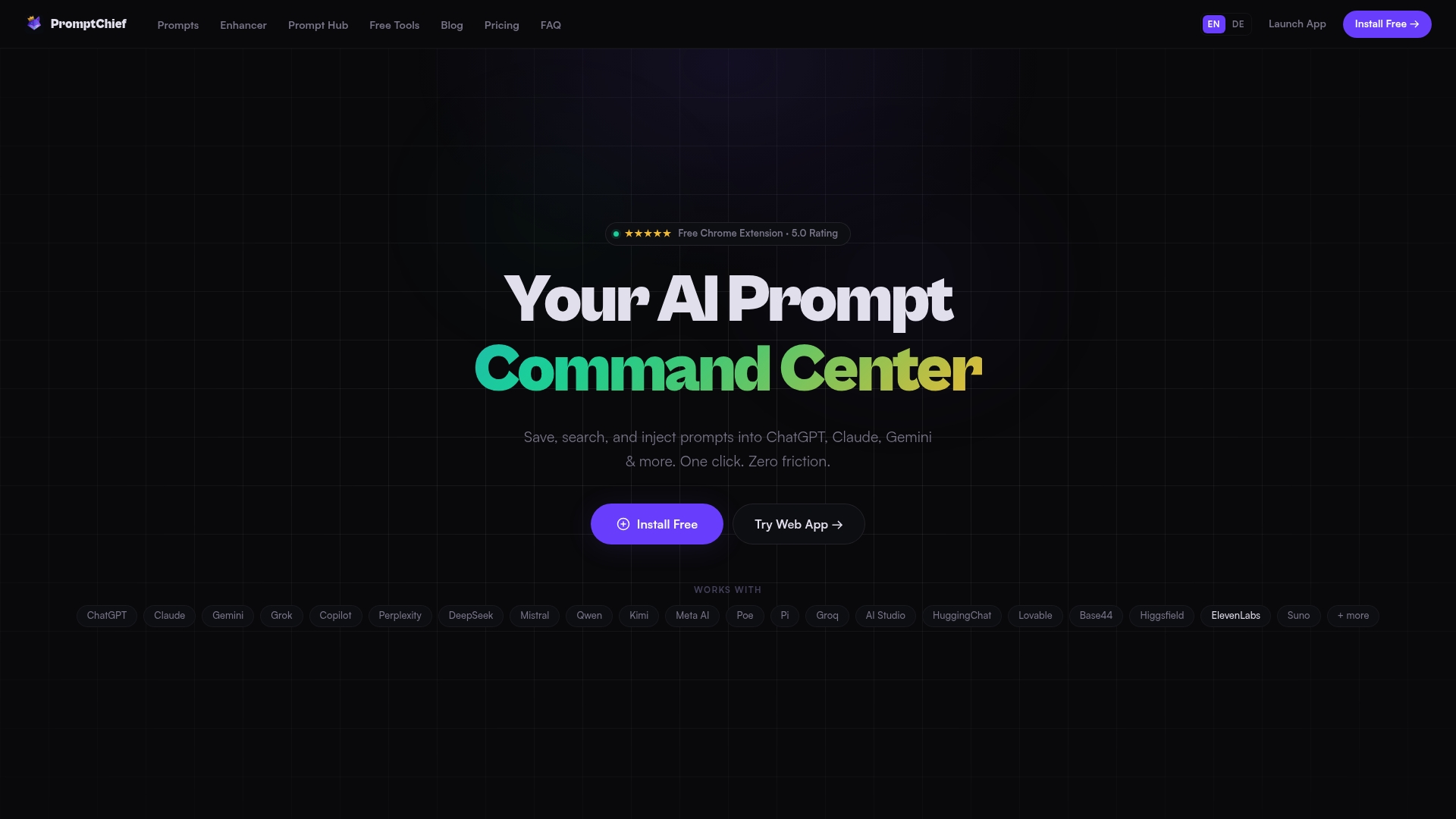
The clearest test during a free trial: save the code-review template from Section 4, open a ChatGPT session, and inject it with one click. Then chain it to the bug-ticket template and run both on a real code sample. That two-step workflow shows you exactly what injection and multi-step prompt chains feel like in practice. When you're ready to add a teammate or unlock analytics, the upgrade path is straightforward. Start your free trial at Promptchief and save your first template today.
Useful sources and further reading
- Best Prompt Libraries Developers Actually Use in 2026 (DEV Community) — covers the difference between discovery libraries and integrated managers, with framework guidance
- Prompt Manager for ChatGPT — Promptchief — product page detailing injection, cloud sync, and multi-model support
- Automated Prompt Engineering Explained (Promptchief) — automation patterns for chaining and extension-based injection
- AI Prompt Engineering: A Practical Guide (Promptchief) — deeper technical background on prompt structure and engineering techniques
- Configure AI Assistants for Enterprise Productivity (Tekkr) — governance and secure sharing guidance for enterprise teams
- AI Prompt Mistakes to Avoid (Smarter Business) — practical checklist for avoiding vague instructions and improving first-run quality
- Prompt Engineering 101 (Promptchief) — step-by-step instruction for readers building their first structured templates
- The Complete Prompt Management Workflow (Promptchief) — detailed guide to chaining, team patterns, and power-user workflows
- AI Prompt Library — 100+ Free Prompts (Promptchief) — starter prompts you can import directly into the platform
- The 7 Best AI Prompt Managers in 2026 (Promptchief) — feature comparison across prompt management platforms
FAQ
What is a ChatGPT prompt template?
A ChatGPT prompt template is a reusable instruction set with placeholders for variable inputs, structured around role, context, task, constraints, and output format so the same prompt works across multiple use cases without rewriting.
How do prompt templates work across different AI models?
Templates built with frameworks like STCO or CRAFT transfer across ChatGPT, Claude, and Gemini because they communicate intent clearly rather than relying on model-specific behavior. Minor constraint adjustments may improve results, but the core structure stays the same.
What is the difference between a prompt library and a prompt manager?
A prompt library is a static collection for discovery and copying. A prompt manager like Promptchief adds cloud sync, direct injection into AI interfaces, magic placeholders, version control, and team workspaces.
How should I store and organize my prompt templates?
Use a cloud-synced manager with fuzzy search, tags, version numbers, and owner fields. Each template should have at least two tags, a version number, and documented test cases before entering a shared workspace.
Does Promptchief support models other than ChatGPT?
Promptchief supports 27+ AI platforms including Claude, Gemini, and others through its Chrome extension and web app, with the same injection and sync features across all supported models.