
Use few-shot chain-of-thought prompting stored in a cloud prompt manager to get reliable, auditable answers from any multi-step AI task. IBM and AWS both cite improved accuracy, transparency, and debuggability as the primary reasons teams adopt CoT for production. The fastest path to those gains: pick one high-value task, write 3–5 few-shot exemplars, save them as golden chains in Promptchief, and run a human-in-the-loop review before you deploy.
Table of Contents
- How does chain-of-thought prompting actually work?
- CoT vs. meta-prompting vs. Auto-CoT: which one fits your task?
- Which tasks actually benefit from CoT prompting?
- How to design effective few-shot CoT exemplars
- How do you test and validate CoT chains before deploying them?
- How to manage CoT prompts with a cloud-synced prompt manager
- Security, model selection, and cost when deploying CoT at scale
- Your CoT deployment checklist
- Key Takeaways
- Why centralization changes everything about CoT at scale
- Promptchief makes CoT prompting production-ready
- Useful sources
- FAQ
How does chain-of-thought prompting actually work?
Chain-of-thought (CoT) prompting asks a model to show its reasoning steps before giving a final answer, rather than jumping straight to a conclusion. There are two flavors. A zero-shot cue adds a phrase like "Let's think step by step" to the prompt — fast to write, but inconsistent across runs. A few-shot exemplar provides 3–5 worked examples where each one walks through intermediate steps and ends with a clearly marked answer. AWS guidance recommends the few-shot approach for production because curated examples stabilize reasoning and reduce variance.
The core benefits are accuracy on multi-step problems and interpretability. When a model writes out its reasoning, you can see exactly where logic breaks down, which makes debugging far faster than staring at a wrong final answer. IBM notes that revealing intermediate steps is CoT's main operational value for professional and regulated applications.
A short worked example makes this concrete:
Problem: A server handles 120 requests per minute. Each request takes 0.4 seconds of CPU time. How many CPU-seconds does the server consume per hour? Step 1: 120 requests/min × 60 min = 7,200 requests/hour. Step 2: 7,200 × 0.4 seconds = 2,880 CPU-seconds/hour. Answer: 2,880 CPU-seconds.
The trade-offs are real. CoT generates more tokens per request, which raises both latency and API cost. And if your exemplars contain flawed logic, the model learns to replicate that flaw consistently — a problem curated few-shot chains are specifically designed to prevent.
Core benefits at a glance:
- Improved accuracy on arithmetic, multi-hop reasoning, and symbolic tasks
- Interpretable reasoning paths that support auditing and debugging
- Applicable to any task a person can solve through language
- Emergent at scale: research shows CoT gains are most pronounced in large models
CoT vs. meta-prompting vs. Auto-CoT: which one fits your task?
| Method | How it works | Best for | Key failure mode |
|---|---|---|---|
| Few-shot CoT | Curated exemplars guide step-by-step reasoning | Production tasks needing consistency | Exemplar quality determines output quality |
| Zero-shot CoT | Single cue ("Let's think step by step") | Rapid prototyping, low-stakes tasks | High variance across runs |
| Auto-CoT | LLM generates its own exemplars automatically | Scaling exemplar creation | Prone to reasoning errors without review |
| Meta-Prompting | LLM acts as conductor, delegates to expert roles | Complex orchestration, exemplar optimization | Higher complexity and resource demands |
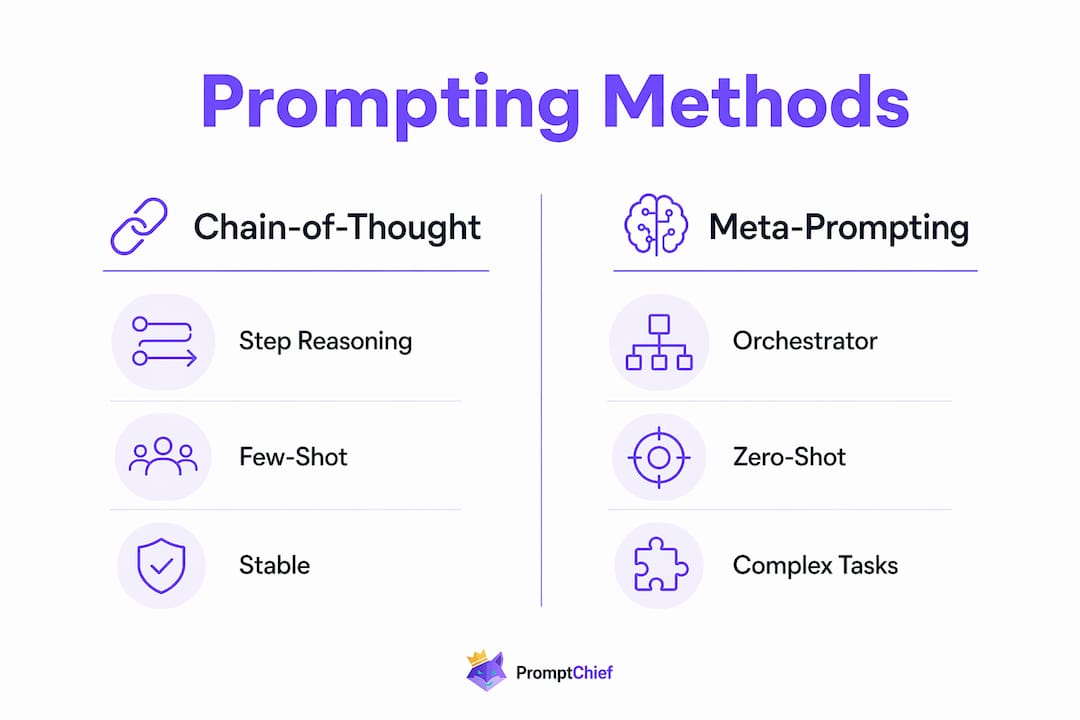
Few-shot CoT is the workhorse for production. Zero-shot CoT is useful when you need a quick answer and can tolerate inconsistency. Auto-CoT reduces the manual effort of writing exemplars, but it introduces reasoning errors that require human verification before any chain goes live. Think of it as a draft generator, not a finished product.
Meta-prompting operates at a different level: it instructs an LLM to act as an orchestrator, routing subtasks to specialized expert roles. Teams use it to generate or refine CoT exemplars at scale, or to coordinate multi-agent pipelines where each agent handles one reasoning step. It complements CoT rather than replacing it. For teams building more advanced scaffolding, Tree-of-Thought and Graph-of-Thought extend CoT further, though they add significant complexity and cost.
Pro Tip: Always run a human-in-the-loop review on Auto-CoT outputs before promoting them to production. One bad exemplar silently degrades every downstream response that uses it.
Which tasks actually benefit from CoT prompting?
Not every task needs a reasoning chain. CoT earns its token cost when the problem has multiple dependent steps, when a wrong-but-plausible answer is a real risk, or when someone downstream needs to audit the reasoning.
Tasks where CoT consistently helps:
- Multi-step arithmetic and algebra (word problems, financial calculations)
- Multi-hop reasoning (questions that require chaining facts across sources)
- Policy and compliance decisions where the reasoning path must be documented
- Complex QA where a confident wrong answer is worse than a slower correct one
- Debugging and root-cause analysis tasks
Skip CoT when the task is a single lookup, a classification with no dependencies, or a high-throughput pipeline where every extra token directly hits your cost ceiling. A customer-intent classifier running millions of times a day does not need intermediate steps. A contract-risk assessment does.
Signal checklist: If users frequently get wrong-but-plausible answers, if your team needs traceability for compliance, or if you are debugging a reasoning error you cannot locate, those are clear signals to add a CoT chain.
How to design effective few-shot CoT exemplars
A repeatable workflow beats ad-hoc prompt writing every time. Follow these steps:
- Select representative problems. Choose 3–5 examples that cover the range of difficulty and phrasing your production inputs will have. Avoid cherry-picking only easy cases.
- Write full stepwise solutions. For each example, write every intermediate step in plain language. Do not skip steps that feel obvious.
- Mark the final answer clearly. Use a consistent separator like
#### Answer:or**Final Answer:**so the model and your validation scripts can parse it reliably. - Vary difficulty and phrasing. If all your exemplars look identical, the model overfits to that pattern. Include one harder case and one with different surface phrasing.
- Add placeholder tokens for reuse. In Promptchief, use magic placeholders like
{{task_input}}and{{domain}}to parameterize exemplars. One template covers dozens of task variants without rewriting the chain.
A few things to avoid: verbose chains that bury the reasoning in prose, exemplars where the instruction and the final answer appear on the same line, and examples that demonstrate a shortcut the model should not generalize. For more on prompt formatting best practices, the fundamentals apply directly to exemplar design.
How do you test and validate CoT chains before deploying them?
A chain that looks good on three examples can fail badly on the fourth. Build a small but structured test plan before any exemplar goes to production.
Start with a holdout dataset of 20–30 inputs the model has not seen. Run A/B tests comparing outputs with and without the CoT chain. Have a human reviewer read the intermediate steps, not just the final answers. That review catches logic drift and hallucinations that accuracy metrics alone miss.
Metrics worth tracking: final-answer accuracy, chain consistency across repeated runs, error type breakdown (logic errors vs. hallucinations), and token cost per request. Self-consistency sampling — generating multiple reasoning paths and selecting the most common answer — improves reliability for high-stakes decisions, though it multiplies compute cost proportionally.
Edge cases to test explicitly: adversarial inputs designed to confuse the chain, unusually long inputs that push the model toward length-induced errors, and inputs from domains slightly outside your exemplars' coverage.
Pro Tip: Log the full chain alongside model outputs, not just the final answer. That log becomes your audit trail and cuts exemplar iteration time significantly when something breaks.
How to manage CoT prompts with a cloud-synced prompt manager
Storing golden exemplars in a central repository is the single most effective control against drift and copy-paste errors. Here is what that workflow looks like in Promptchief:
- Author and test locally. Write your exemplar, run it against your holdout set, and confirm the chain produces correct intermediate steps.
- Mark as golden. Once human-reviewed, flag the chain in Promptchief as a verified exemplar. This prevents unreviewed drafts from leaking into production.
- Tag by task and model. Use tags like
#compliance-qaor#gpt4-testedso your team can filter quickly. Promptchief's fuzzy search means you can find a chain by partial keyword even if you forgot the exact name. - Version on every change. When you update an exemplar, Promptchief creates a new version. Roll back takes seconds if a change degrades performance.
- Inject across models. Deploy the same golden chain to ChatGPT, Claude, Gemini, or any of the 27+ platforms Promptchief supports, without rewriting the prompt for each one.
- Monitor and review periodically. Schedule a monthly review of your golden exemplars. Model updates and data drift can quietly change how a chain performs.
Promptchief acts as the centralized prompt repository your team actually needs: cloud-synced, versioned, and accessible from any device. For developer-level integration details, the developer integration notes cover API connections and multi-model deployment.
Pro Tip: During incident triage, use Promptchief's fuzzy search and task tags to pull the last known-good exemplar in under a minute. That speed matters when a production chain is misbehaving at 2 AM.

Security, model selection, and cost when deploying CoT at scale
CoT chains often contain sensitive context. Before you deploy, run through this checklist:
- Access controls: Restrict which team members can edit or promote golden exemplars. Read-only access for most users, write access for prompt owners.
- Audit logging: Log every chain injection with a timestamp and user ID. Regulated industries need this for compliance.
- Data exposure: Review what appears in intermediate steps. A chain that reasons about customer PII writes that PII into the model's context window and potentially into logs.
- Model selection: Stronger reasoning models produce more reliable chains. Test each exemplar on the specific model you plan to deploy it on. A chain tuned for one model can behave differently on another, even with identical wording.
- Cost gating: CoT increases token usage and latency for every request. Measure token cost per validated task, then apply selective CoT: run the full chain only for queries flagged as complex, and use a lighter prompt for routine ones. Use the API cost calculator to model the cost difference before you commit.
For teams concerned about data residency and the environmental footprint of large model usage, GreenCube offers an infrastructure perspective worth reviewing alongside your deployment decisions.
Your CoT deployment checklist
Run through this in one session to go from concept to a deployed golden exemplar:
- Choose one high-value task where multi-step reasoning matters
- Write 3 exemplars with full stepwise solutions and clear answer markers
- Run a human-in-the-loop review of every intermediate step
- Test against a holdout set and log accuracy and token cost
- Mark the chain as golden in Promptchief
- Tag by task type and model
- Deploy to your target model(s) via Promptchief injection
- Set a calendar reminder for a monthly exemplar review
Pick one task this week, run the checklist, and compare accuracy against your baseline prompt. The difference is usually visible within the first ten test cases.
Key Takeaways
Few-shot CoT exemplars, human-verified and stored in a cloud prompt manager, are the most reliable path to consistent multi-step AI reasoning in production.
| Point | Details |
|---|---|
| Few-shot beats zero-shot | Curated 3–5 exemplars stabilize reasoning and reduce output variance for production tasks. |
| Auto-CoT needs human review | Automated exemplar generation saves time but introduces reasoning errors; always verify before deploying. |
| Token cost is real | CoT increases token usage per request; apply selective CoT gating for high-volume pipelines to control cost. |
| Versioning prevents drift | Storing and versioning golden exemplars in a prompt manager prevents copy-paste errors and silent degradation. |
| Promptchief centralizes the workflow | Promptchief's cloud sync, tagging, versioning, and multi-model injection cover the full CoT deployment lifecycle. |
Why centralization changes everything about CoT at scale
The conventional advice on chain-of-thought prompting focuses almost entirely on prompt design. Write good exemplars, use the right cue, pick the right model. That advice is correct but incomplete. The harder problem is operational: keeping those exemplars consistent, auditable, and up to date across a team that is constantly iterating.
Every team I have seen struggle with CoT in production shares the same root cause. Exemplars live in someone's notes, a shared doc, or a Slack thread. Someone edits one version and forgets to update the others. A model update quietly changes how a chain behaves and nobody notices until a user reports a wrong answer three weeks later. The prompt design was fine. The management was the failure.
Centralization is not a nice-to-have for CoT workflows. It is the control that makes everything else work. When your golden exemplars are versioned, tagged, and accessible from any device, debugging takes minutes instead of hours. When your team can see which chains are human-verified and which are drafts, you stop shipping unreviewed prompts by accident. That operational discipline is what separates a CoT prototype from a CoT production system.
Promptchief makes CoT prompting production-ready
If you have spent time designing CoT chains only to lose them in a doc or rebuild them from memory for a different model, Promptchief solves exactly that. Your golden few-shot exemplars live in one cloud-synced library, versioned and tagged, ready to inject into ChatGPT, Claude, Gemini, or any of 27+ supported platforms without rewriting a single line.
The prompt management workflow covers the full lifecycle: author, test, mark golden, deploy, and monitor. Team workspaces mean your whole team works from the same verified chains, not personal copies. The free plan gets you started today, and the Pro plan adds team seats, advanced versioning, and AI prompt rewriting in 9 styles. See the pricing page and run your first golden exemplar through the platform this week.
Useful sources
- Chain-of-Thought Prompting Elicits Reasoning in Large Language Models (NeurIPS 2022) — the original Wei et al. paper; read this for theory and benchmark results
- What is chain of thought (CoT) prompting? | IBM — practitioner-focused explainer covering interpretability and production use cases
- What Is Chain-of-Thought Prompting? | AWS — implementation guidance including exemplar counts, self-consistency, and cost trade-offs
- Chain-of-Thought Prompting | Prompt Engineering Guide — covers Auto-CoT and human-in-the-loop verification recommendations
- Enhance your prompts with meta prompting | OpenAI Cookbook — practical guide to using meta-prompting for exemplar generation and orchestration
- Meta Prompting for AI Systems (arXiv) — research paper on Tree-of-Thought, Graph-of-Thought, and advanced CoT scaffolding; consult for theory before adopting complex pipelines
- Language Models Perform Reasoning via Chain of Thought | Google Research — Google's summary of CoT emergent properties and benchmark performance
- AI Prompt Engineering: A Practical Guide | Promptchief — deployment-focused guide for teams building production prompt workflows
For research and theory: start with the NeurIPS paper and the arXiv meta-prompting paper. For implementation: IBM, AWS, and the Prompt Engineering Guide are the most directly applicable. For platform integration: the Promptchief resources cover the full operational workflow.
FAQ
What is chain-of-thought prompting in simple terms?
Chain-of-thought prompting asks an AI model to write out its reasoning steps before giving a final answer, which improves accuracy on multi-step problems and makes errors easier to find.
How many exemplars do you need for few-shot CoT?
AWS recommends 3–5 high-quality exemplars for production use, covering a range of difficulty and phrasing to stabilize the model's reasoning.
What is the difference between CoT and meta-prompting?
CoT guides a single model through step-by-step reasoning; meta-prompting instructs a model to act as an orchestrator that delegates subtasks to specialized expert roles, often used to generate or refine CoT exemplars at scale.
How does Promptchief help with CoT prompt management?
Promptchief stores human-verified golden exemplars in a cloud-synced library with versioning, tagging, and one-click injection across 27+ AI platforms, eliminating copy-paste errors and keeping your team on the same verified chains.
When should you not use chain-of-thought prompting?
Skip CoT for single-step lookups, simple classifications, or high-throughput pipelines where the extra token cost outweighs the accuracy gain.